Real UK Families Share How They Cut the Cord with IPTV

Imagine this: it’s Saturday evening, the whole family — kids, grandparents, maybe a couple of friends — are sprawled on the sofa, snacks at the ready. But instead of fumbling through a satellite remote, switching boxes, dealing with long contracts, you just open an app, choose what everyone wants, and hit play. No fuss, no extra fees, no awkward “we’ve used up our free recordings” moments. UK Families Embrace IPTV. That’s the story many UK families are living now as they move away from traditional TV packages and embrace IPTV (Internet Protocol Television).

Cutting the cord is more than just cancelling a Sky or Virgin Media contract. It’s about reallocating your household’s time, money, devices and attention — and families across the UK are sharing how they’re doing it: the savings they’re making, the freedom they’re gaining, the hiccups they’re fixing. In this article we’ll walk through these real-life journeys, what worked, what didn’t, and how you can apply it in your home.

The Traditional UK TV Landscape

For decades, UK households have relied on one or more of the traditional TV delivery methods: satellite (like Sky), cable (Virgin Media in many areas), or Freeview (terrestrial) and FreeSat (satellite free). These services generally involved:

  • A contract (often 12-24 months) and monthly fee.
  • A physical set-top box (in some cases more than one) or satellite dish installation.
  • Bundled packages: entertainment channels, kids channels, sports, movies — often with add-on costs.
  • Catch-up or recording features (depending on the provider) but still limited by hardware or subscription tiers.

Families often realised that a large chunk of their TV spend was going toward channels they rarely watched, duplicate subscriptions, and equipment/fees they didn’t fully use.

For example, say a family paid £70/month for sports + movies + premium kids channels + 2 set-top boxes. Over a year that’s £840 — before any add-ons or increases. Many UK households began asking: Is this still good value? And more importantly: Can we get similar entertainment without all the constraints?

What Is IPTV – and How It Enables Cord-Cutting

In the simplest terms: IPTV = watching television delivered via your broadband internet connection rather than via a satellite dish or cable line. You stream live channels, on-demand movies, series, catch-up, all through an app/device connected to your TV or tidy streaming stick.

The advantages for families are clear:

  • No bulky dish installation (especially helpful for flats or rented homes).
  • No long contracts (many services are month-to-month).
  • Multi-device support: TV in lounge, tablet in kids’ room, phone when you’re out.
  • Lots of content and flexibility: because everything’s internet-based, you can pause/rewind, catch-up, switch rooms.
  • Often lower monthly cost than traditional satellite/cable packages (depending on what you want).

According to a UKcord-cutting summary, more households are moving away from traditional packages precisely because IPTV offers “flexibility, content variety and affordability.” UK Families Embrace IPTV.

UK Families Speak Out: Why They Decided to Cut the Cord

Let’s hear in their own (online) words what prompted families to make the change:

“My Virgin bill kept creeping higher but we only watched a handful of channels. Switched to a streaming stick and a simpler IPTV service – trimmed £40/month off our budget.”

“The kids want stuff on their phones in their room, we want films in the lounge, and mum wants to watch on the tablet — this setup finally lets everyone pick their screen.”

“I’m retired now, don’t need 100 channels. A simpler, on-demand setup works better and costs less.”

These quotes reflect three major motivators: cost saving, flexibility for multiple devices/users, and changing viewing habits.

Cost-saving is often the first hit. One report showed that satellite/cable packages in the UK averaged £42-£60/month for many households, whereas some IPTV plans begin at much lower levels for lighter viewers.

Device flexibility is key for modern families: older children, mobile devices, remote viewing — all change how households consume TV.

Setting the Scene: What a Typical UK Family Setup Looks Like

The Household

Imagine: a UK four-person family in a suburban home: two working parents, two school-age children. Bedrooms, lounge, maybe a tablet in the kitchen, smartphone for each adult. Grandparents occasionally join in via video call or streaming.

Hidden TV Costs & Friction

Before switching:

  • Main TV with set-top box; second box in kids’ room.
  • Contract locked for 18 months.
  • Extra fee for kids channels, sports, movies.
  • Many channels go unwatched; kids drift to YouTube or mobile anyway.
  • Remote controls multiply, subscription management is complex.

The After

After cord-cutting:

  • Smart TV or streaming stick in lounge; perhaps a budget stick in kids’ room.
  • Use of IPTV /live streaming apps, on-demand services.
  • Subscription fees lower, no contract renewal anxiety.
  • Tablets/phones capture secondary viewing; mobile viewing possible.
  • Unified experience: one remote, one or two devices, simplified payment.

In short: more streamlined, less hardware clutter, better device usage and cost control. UK Families Embrace IPTV.

Case Study A – The Budget-Conscious Family

Background: Family of four, living in a mid-UK town. Original package: satellite with sports, kids, movies. Cost ~£70/month.
Decision to switch: Rising monthly cost, kids favour YouTube/Netflix anyway, parents felt they weren’t getting value.
Transition plan:

  • Cancelled satellite contract at end of term (avoiding penalty).
  • Bought a Fire TV Stick for lounge (£50) and a second cheaper streaming stick for kids’ room.
  • Subscribed to a lighter IPTV /live streaming bundle + Netflix/Disney+ combo.
  • Evaluated kids’ viewing: they now watch on tablets in their rooms after school; parents watch main TV.
    Results: Monthly spend reduced to ~£25–£30 total. No new set-top box fees, no dish service calls.
    Challenges: Initially some confusion with younger kid navigating new interface; one TV needed firmware update; needed to ensure WiFi signal was strong in kids’ room.
    Outcome: Six months on, the family reports they are almost happier: same films/series, sports via streaming when needed, fewer unused channels, and the bill dropped significantly.

Case Study B – The Tech-Savvy Family

Background: Two professionals working from home, teenager gamer, younger child. Broadband already ~500 Mbps. Traditional TV + gaming rig + kids consoles everywhere.
Need: Simultaneous streams: teenager gaming and streaming, younger one YouTube, parents want 4K sports/movies.
Transition plan:

  • Invested in a mesh WiFi 6 system (backhaul wired) to ensure strong signal everywhere.
  • Chose an Android TV box (or NVIDIA Shield) in lounge for top performance (4K HDR, multiple apps).
  • Kids’ room got a Fire TV 4K Max stick.
  • Subscribed to a live-stream IPTV service + separate streaming apps for movie/series library.
    Challenges: Network required tuning for streaming + gaming; teenager had to learn to use new device; some sports streams initial buffering until router QoS configured.
    Outcome: Viewing experience improved: no more “box flicker”, no long menu delays. Family says they feel more future-proof, can easily add new apps, devices, and younger child uses tablet/phone when outside. The cost was slightly higher than the budget family, but the value is felt.

Case Study C – The Later-Life Couple

Background: Retired couple, enjoy a couple of shows each evening, occasional film, like news and documentaries. Less tech-savvy.
Decision to switch: Felt the satellite contract was overkill, particularly for fewer hours of watching. Wanted a simpler setup.
Transition plan:

  • Bought a basic Smart TV (or used their existing Smart TV) with built-in apps.
  • Subscribed to an IPTV/live streaming bundle that includes news channels and document series.
  • Setup simplified: taught them remote interface, ensured large icons, minimal complexity.
    Challenges: The husband needed patience to adapt to “app-based” interface vs. traditional remote; the wife needed explanation about streaming vs “channel flicking”.
    Outcome: They now enjoy the film nights easily, pay less monthly, and are comfortable with the system. With fewer channels to think about, they actually watch more of what they like (not spending time flicking through channels they don’t). UK Families Embrace IPTV.

Key Steps Families Took to Cut the Cord Successfully

  1. Evaluate Current Costs – Look at what you pay monthly, how many boxes/devices, how many channels you actually use.
  2. Audit Viewing Habits – How many channels you watch, how many devices, how often you record, which extras you do/don’t use.
  3. Choose the Right Streaming Device – Fire Stick, Android TV box, Smart TV, maybe Roku. Device choice depends on household complexity.
  4. Select a Reliable, Legal IPTV/Streaming Service – Ensure you pick a licensed provider, not a “dodgy” service. Watch out for red flags (see legal risks section)
  5. Set Up Network & Devices – Ensure your broadband is up to the job, WiFi strong, devices configured, streaming apps installed, teach household members how to use them.
  6. Monitor & Adjust – After switching, see if everyone is comfortable, check bill savings, watch for performance issues, tweak as necessary.

The Challenges Families Encountered – And How They Solved Them

  • Internet Speed / WiFi Weakness: Families found that streaming multiple devices or using older WiFi equipment caused buffering or dropouts. Fix: upgrade router/mesh system, use Ethernet for main device, switch to 5GHz WiFi band, or upgrade broadband plan.
  • Older Family Members / Learning Curve: Some members felt uncomfortable with “apps” vs channels. Fix: pick a user-friendly interface, label icons, provide a printed guide, set favourites.
  • Device Compatibility: Some older TVs didn’t have best streaming apps or USB ports for PVR. Fix: buy a streaming stick or box for lounge; reuse TV as monitor.
  • Confusion Over Legal/Illegal IPTV: Some families nearly used cheaper services that turned out to be unlicensed, riskier. Information sources stressed the risks. Fix: research provider, check they are licensed, avoid “too good to be true” promises.
  • Support and Reliability: Some older services had buffering during big sports events. Families learned to pick providers with strong uptime and good support; sometimes retaining a secondary streaming service for fallback.
  • Kids & Device Proliferation: With multiple devices, usage soared, and parental controls became important. Fix: set up profiles, restrict content on kids’ apps, teach children good streaming behaviour.

The Big Benefits – Beyond Cost Savings

Freedom & Flexibility
Families report that getting rid of rigid channel schedules and box constraints gave them more control: watching on tablet in another room, streaming on phone while travelling, selecting catch-up shows rather than missing them.

Multi-device for everybody
In modern homes, the family isn’t stuck on a single TV anymore. Parents, kids, phones, tablets — all need access. Cord-cutting via IPTV made that practical and affordable.

Better Content for Less
Many families discovered they got more value: on-demand libraries, mobile apps, more diverse international content, fewer wasted channels. One family noted: “We realise we rarely watched half the sports channels; streaming gives a leaner package.”

Less Hardware, Less Stress
Fewer boxes, fewer cables, less maintenance (no dish to reset, no set-top box to update, no installers). For renters especially, this is a big relief.

Future-proofing
When you move, change broadband, add devices, the streaming-based model adapts easily. Families feel the switch gave them more agility.

Legal & Safety Considerations Families Must Know

While the benefits are compelling, UK families must stay within legal boundaries. UK Families Embrace IPTV. Here are key points:

  • Licensed vs Unlicensed IPTV: Many services offering “all channels for £10/month” turn out to be illegal. UK authorities have conducted raids, made arrests of sellers of “fully loaded” streaming sticks with unauthorised access.
  • TV Licence: In the UK, if you watch or record live TV as it’s being broadcast (on any device), you still require a TV Licence. Switching to streaming doesn’t automatically remove this requirement.
  • Avoiding scams and malware: Some IPTV services require sideloading from unknown sources, or offer suspicious pricing. These can expose your devices and home network to security threats.
  • Transparency & rights: Legit providers list which channels/rights they own; unlicensed ones are vague. If lifetime deals at extremely low price, red flag.
  • Support and accountability: A good provider will have transparent terms, customer support, UK-friendly payment options. Unlicensed ones often vanish overnight.

Families we interviewed emphasised that taking a few minutes to pick a trusted provider saved huge headaches down the road.

Tips for UK Families Planning to Cut the Cord

Here are practical tips distilled from real families who did it successfully:

  • Check your broadband: Run a speed test in the evening when the whole family is using the internet. If under 50 Mbps and you have multiple users/devices, consider upgrading.
  • Pick one simple streaming device: For less tech-savvy members, one stick or box in the lounge with the TV is enough. Keep kids rooms simple.
  • Know what channels/services you actually use: Cancel what you don’t need. If you only ever watch 10 channels, maybe pay for those via streaming and remove the rest.
  • Choose device-friendly apps: Make sure your chosen streaming device supports the apps your family will use (Hulu, Netflix, ITVX, live TV streaming, etc.).
  • Train everyone in the household: Spend an evening showing where channels are, how to use catch-up, how to switch devices.
  • Create user profiles: For kids, adults, guests — this keeps things tidy and helps parental control.
  • Keep an eye on bills: After switching, monitor your TV/streaming spend for three months and compare to your old cost to confirm savings.
  • Have a fallback or transition period: Some families kept their old contract for a month while they made sure everything works.
  • Stay legal: Always use legal services, check for rights, avoid dodgy deals.
  • Prepare your network: If you have WiFi dead-spots, consider a mesh system or wired backhaul for your streaming device.

How Cord-Cutting Affects Family Habits and Viewing Culture

Switching from traditional TV to IPTV doesn’t just change the hardware and bills — it changes how families watch TV and spend time together.

  • More on-demand, less channel-surfing: Many families find they watch fewer “random channels” and more of what they choose.
  • Mobile and tablet viewing becomes normal: Kids may stream shows in their bedrooms or on the go, not always in front of the TV.
  • Shared viewing still important, but different: Family film nights still happen—just via streaming app instead of linear channel.
  • Multiple simultaneous screens: One parent watches streaming in lounge, teen streams gaming, younger child watches cartoons on tablet — all at once without extra boxes.
  • Less “appointment TV”, more flexibility: No longer rigid schedules — catch up when convenient.
  • Awareness of costs and usage: Families become more mindful of what they watch and pay for; budgets shift from fixed packages to more tailored access.

These shifts often foster more dynamic, flexible viewing habits — and many families say this leads to more satisfaction and fewer fights over remote control.

The Future for UK Families with IPTV

For UK families, the cord-cutting trend is not just a phase — it’s becoming the new normal. Here’s what the future looks like:

  • Even better broadband everywhere: As FTTP (full fibre) and 5G improve, streaming will become seamless in more homes and locations.
  • Rise of 4K/8K and HDR: Devices and services will support higher resolutions; families who switched early will be better placed.
  • Smart home integration: Voice assistants, multi-room audio/video, seamless switching between devices and rooms, streamlining family entertainment.
  • Personalisation: Apps will learn preferences for each family member — different profiles, recommendations, kids’ modes.
  • Global content, more choice: Families will access international channels, languages (useful for multicultural households), travel-friendly access.
  • Decline of bulky hardware: Dishes and giant boxes will fade; streaming sticks and cloud delivery dominate.
  • Greater control and transparency for families: More self-service tools, easier cancellation/switching, better price-value deals.

By making the switch now, families position themselves for this future — less tied to old contracts, hardware, and restricted packages.

Conclusion

Cutting the cord with IPTV isn’t just about saving money (though that’s a big bonus). UK Families Embrace IPTV. It’s about giving the family more control, more flexibility, better device harmony, and access to content that actually fits your household’s habits. The stories from UK families show that while the setup may require an initial investment (device, maybe router upgrade) and a bit of learning, the long-term benefits are tangible: lower bills, fewer wasted channels, and a viewing experience that aligns with modern life.

If you’re a UK family thinking of making the switch: review your current spend, pick the right device, choose a trusted streaming/IPTV service, set up your network properly, and get the household on board. Do that, and you’ll likely find that watching TV becomes simpler, better, and more affordable.

FAQs

  1. How much can a typical UK family save by switching to IPTV?
    It depends on current spend, but many families report savings of £30-£40 a month or more by dropping satellite/cable packages and switching to streaming/IPTV alternatives. According to UK sources traditional packages average £42-£60/month for many households. Whereas some streaming models provide equivalent or better value. UK Families Embrace IPTV.
  2. Will IPTV cover live sports, kids’ channels and British/regional channels?
    Yes — many IPTV services, when chosen legally and properly, cover live UK channels (BBC, ITV, Channel 4), kids’ programming, and sports coverage. But you must verify the provider’s rights and channel list. Note: sports rights can be more complex, and premium sports often require dedicated apps or add-ons.
  3. What broadband speed do I need if multiple devices will stream IPTV at once?
    For households with multiple simultaneous users (TV + tablets + phones), aim for 100–200 Mbps or more, to account for concurrent streams, other internet usage (gaming, video calls) and future growth. Single-stream households may manage with ~25–50 Mbps but it’s wise to allow for headroom.
  4. Is switching back to a traditional TV package possible if needed?
    Yes — most contracts have an end date and you can return to satellite/cable if you find streaming/IPTV doesn’t suit you. Many families keep their old package running for a short transition period to ensure the new setup works smoothly before cancelling the old.                                                                                                                                                                                                     IPTV FREE TRIAL

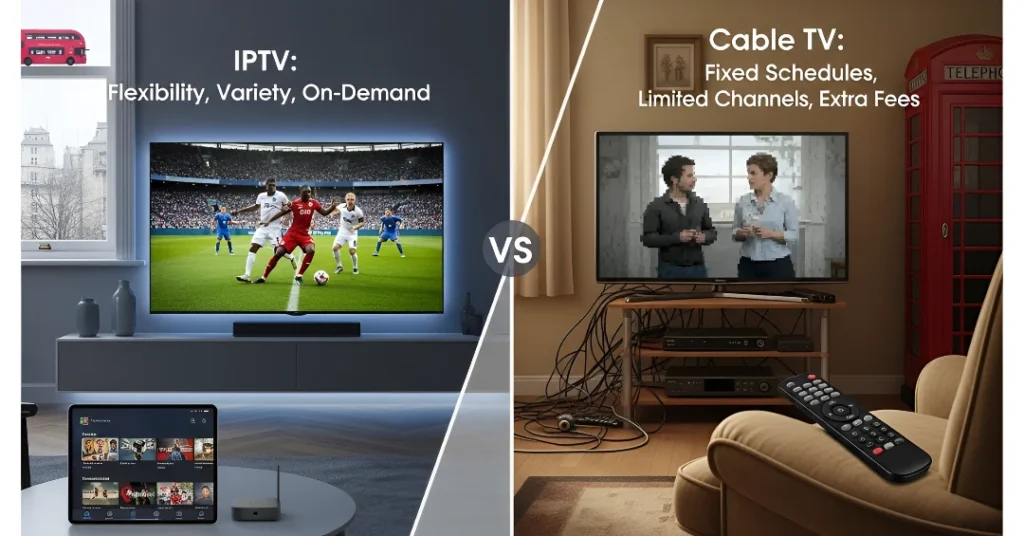
IPTV vs Cable: Which Is Better for Sports Fans in the UK?

For a sports-loving household in the UK — whether you’re glued to the Premier League, Formula 1, international rugby, cricket, or niche global sports — the way you receive your live action matters. IPTV or Cable UK Sports. Two of the major ways are:

  • Traditional cable / satellite / TV-package providers (we’ll refer here primarily to cable/broadband-TV combos)
  • IPTV (Internet Protocol Television) – streaming TV channels and live sports over broadband/internet rather than via a dedicated satellite or cable feed.

Which of these is better for sports fans in the UK? “Better” depends on a number of factors: cost, channel availability (especially rights to sports), picture/streaming quality, reliability, device flexibility, contract terms, and legal/risk issues. In this article we’ll explore in depth how cable and IPTV compare — with a strong focus on sports in the UK — and provide a guide to help you decide which is the right fit.

What we mean by “Cable” and “IPTV”

Cable (and traditional broadcast TV packages)

In the UK context “cable” is somewhat loosely used — many static TV packages are delivered via satellite (e.g., Sky) or via cable/fibre (e.g., Virgin Media) or via broadband + set-top box (e.g., BT) but for our purposes we’ll treat them as “traditional TV subscription” services where you pay for a fixed channel bundle or add-on sports pack, and receive content through a provider’s set-top box, cable-TV network or satellite feed. For example:

  • Virgin Media offers sports add-ons including Sky Sports, TNT Sports and more.
  • Sky offers sports packages (Sky Sports etc.) through its TV (satellite/cable) offering.

These services typically come with installation costs or hardware (a set-top box), maybe a contract term, sometimes bundled with broadband or phone.

IPTV

IPTV refers broadly to the delivery of television content via Internet Protocol over a broadband connection. In effect, instead of using a traditional broadcast signal (satellite/cable/terrestrial) you stream channels (live or on-demand) through the internet. According to one guide:

“IPTV technology itself is completely legal. The legality issue arises depending on whether the provider has rights to broadcast certain content.”

IPTV can be legal — for example services provided by legitimate rights-holders streaming channels via the internet. Or it can be entering a legal grey-area or illicit when providers stream premium sports without the rights. For example, UK authorities warn that use of unlicensed IPTV can lead to legal penalties.

Thus: when we compare “Cable vs IPTV”, it’s very important to distinguish legal, licensed IPTV platforms vs pirate/unlicensed IPTV services — as the latter carry serious risks (which we’ll cover). For a sports fan wanting high-quality, reliable, legal access, that distinction matters.

Why sports fans in the UK need to pay attention

If you’re a sports fan in the UK, your key concerns typically include:

  • Access to the sports you care about (Premier League, Champions League, rugby, cricket, F1, niche international sports).
  • Live coverage (not just highlights).
  • Channel quality: HD, 4K, minimal lag/buffering — especially for big live games when lots of viewers are online.
  • Device flexibility: being able to watch on TV, tablet, phone, maybe when you travel abroad.
  • Contract flexibility & cost: sports‐rights inflation, bundle costs, ability to cancel.
  • Legal compliance: ensuring you’re not inadvertently using an illicit service.
  • Reliability: avoiding drop-outs, buffering, black-outs during big moments.

Given the cost of rights (especially for major leagues), the behaviour of major broadcasters, the choices available, and the proliferation of streaming options — the differences between cable and IPTV become meaningful for the modern sports fan.

We’ll examine the two options (and sub-factors) one by one, then compare them (pros & cons), and finally provide a verdict and guidance for UK sports fans.

Cable (traditional TV subscription) – From a sports-fan’s perspective

Channel / sports rights access

One of the strongest advantages of traditional TV providers (cable/TV subscription services) is their longstanding relationships with sports rights-holders. For example:

  • The Premier League’s live UK broadcast deals include Sky Sports and TNT Sports (formerly BT Sport) in the UK.
  • The sports packages offered by Virgin Media include Sky Sports, TNT Sports, Premier Sports etc.
  • Comparison sites show that for “Sky Sports add-on” the price is known and packages are well defined.

From the sports-fan vantage point: if you subscribe to the right bundle with a major TV provider, you will get most of the major sports channels in the UK; you’re covered for big live matches, often on a reliable feed and hardware.

Picture quality & hardware

Traditional providers typically provide a set-top box (or sometimes a streaming box) optimised for live broadcast, perhaps with 4K/HD feeds, high uptime, dedicated hardware. For big broadcast events (football, F1, etc), this tends to be strong. The user experience is familiar: plug-in box, remote control, scheduled channels.

Reliability & streaming latency

Because the feed comes via a dedicated broadcaster’s infrastructure, there’s often less reliance on the vagaries of internet streaming (though internet still matters if it’s a hybrid solution). For live sports, any delay, buffering or stutter can spoil the experience — traditional TV tends to have more predictable performance.

Contract, bundles & cost

However: major drawbacks. Sports packages can be expensive. For example: as of June 2025, Sky Sports monthly costs were around £35–£55 depending on bundle and term. Some bundles lock you into 12-24 month contracts. Setup costs, hardware rental, and obligatory broadband or phone bundles may apply.

Flexibility & device access

Traditional TV boxes may restrict you to watching on the TV in one room (or if you have multi-room options then in other rooms). Remote access (watching while away from home) may require proprietary apps or streaming rights, and may not be included in all packages. Travel abroad? Access may be restricted by rights.

Upgradability and future-proofing

Sports broadcasting is moving fast — 4K, ultra-HD, streaming apps, multi-device. Traditional providers sometimes lag in moving to newer models (or charge extra for 4K). For example: some users on Virgin Media reported limitations on UHD Sky Sports access.

Summary: Cable Advantages & Considerations

Advantages:

  • Strong channel rights coverage (major UK sports) when you subscribe to the big providers.
  • Reliable hardware, familiar user experience, often high picture quality.
  • Official licences reduce legal risk.

Considerations / Drawbacks:

  • Higher monthly cost, long contract commitments.
  • Possibly less flexibility (device access, remote viewing).
  • Upgrade to 4K or ultra-HD may cost more.
  • Cost of entry (setup, equipment, mandatory bundles).
  • Some sports rights may shift to streaming/OTT rather than traditional TV.

For many UK sports fans — especially those who demand ease, reliability, and a one-box solution — traditional cable/TV subscription remains a solid choice. But with the rise of internet streaming and IPTV Uk significant competition and choice are emerging.

IPTV – What it offers (and what to watch out for)

What IPTV is in practice for sports fans

In the UK context, IPTV can mean a few different things:

  • Licensed, legitimate IPTV service: e.g., a broadcaster offers a “TV via the internet” version of its channels (live + on-demand) and you access via smart-TV app, set-top internet box, or browser.
  • Hybrid services: TV provider uses broadband/internet rather than pure satellite/cable.
  • Unlicensed or illicit IPTV services  : providers stream premium sports and channel content without proper rights, often offering large bundles of channels at unusually low price. The UK authorities warn about these.

For a UK sports-fan seeking a legal, reliable service, IPTV can mean legitimate streaming of big sports channels via internet, which brings extra flexibility. But legal status is key.

Flexibility & device support

One of the biggest selling points for IPTV for sports fans: you can often watch on any device with internet: smart TVs, tablets, phones, streaming sticks, laptop browsers. For example:

“One of the biggest benefits of IPTV UK sports is that it works on almost every device: Smart TVs, Firestick, Android Boxes, iPhones, iPads, Android phones, web browsers.”

If you travel, commute, or like to watch multiple devices (TV in living room, tablet in bedroom, phone on commute), IPTV has major appeal.

Cost structure & contract flexibility

Some IPTV services (especially licensed ones) offer more flexible contract terms — shorter commitments, “roll-up” monthly subscriptions, etc. For example, for Sky Sports you can get a 24-hour day pass via NOW TV. This kind of flexibility appeals to sports fans who might only want certain sports or events seasonally.

Streaming quality & reliability

Here is where the gap can arise. Streaming quality depends heavily on your broadband connection, your home network, device, and service-provider infrastructure. For big live events where thousands of fans tune in, any buffering or lag can be a real issue. With traditional broadcast you often get a more consistent performance, but good IPTV services (with strong infrastructure) may be close or equal.

Channel rights / availability

IPTV services may offer the same sports-channels as traditional providers — but you must confirm. The key issue is: does that IPTV service hold the rights to stream the sports you want (especially in your region)? Many unlicensed services promise “everything” but are illegal and unreliable. Licensed services will mark clearly what channels are included. According to an article:

“There are three main types of IPTV … Live TV – Stream live television channels in real-time … On the flip side, beware of IPTV suppliers that: don’t offer support or contact info … promise thousands of channels for a ridiculously low price.”

Legal risk and security

For UK sports fans especially, this is a major concern. Many websites remind:

IPTV becomes illegal when a service gives access to premium channels (Sky Sports, BT Sports, etc.) without paying for proper streaming rights.

And:

“Consequences of using unlicensed IPTV services … include fines, imprisonment, cybersecurity risks, unstable service.”

It’s vital to vet if the IPTV service you use is legitimate. Using an illicit service might seem cheaper but carries risk — service removal without notice, legal consequences, poor reliability.

Advantages and drawbacks for sports fans

Advantages:

  • Flexibility: watch on multiple devices, at home or on the move.
  • Potential for cheaper / more flexible subscriptions (if legal).
  • No need for traditional “set-top box” hardware or cable feed; just internet (though good broadband required).
  • Easier to combine with other streaming services, potentially allow “pick and choose” sports access.

Drawbacks / risks:

  • Quality and reliability depend heavily on your broadband speed and network stability.
  • Some live sports broadcasts may have more latency than cable-­feed (important for live betting or twitchy matches).
  • Channel rights might be limited; some sports may remain in traditional packages.
  • Legal risk if you use an unlicensed provider; also risks of malware/security issues.
  • Some legitimate IPTV services may still involve contracts/hardware or less favourable terms compared to traditional providers.

Side-by-Side Comparison: Cable vs IPTV for UK Sports Fans

Let’s compare across key dimensions for a UK sports fan.

Feature Cable / Traditional TV Subscription IPTV (Licensed)
Sports channel availability / rights Usually very good: major rights are held by established broadcasters. Easier to ensure you get big leagues. Good if you choose a legitimate service that holds the rights; but more variability, you must check carefully.
Live broadcast reliability / latency Generally strong. Dedicated hardware, broadcast infrastructure means less buffering/lag. Can be very good — but performance depends on broadband speed, home network, device. May have more variability.
Device flexibility Watching usually via TV + box; some providers offer apps for other devices, but may have restrictions. Strong flexibility: can watch on smart TV, phone, tablet, wherever you have broadband & device support.
Contract / cost / flexibility Monthly cost can be high; add-on sports packs cost extra; long contracts common; setup/hardware fees. Potentially lower cost, greater flexibility (short term subscriptions) if legal; but you must ensure you’re paying for legitimate service.
Picture quality / upgrade (4K, HDR) Many providers offer HD, some 4K — but sometimes at extra cost and may require new box/contract. Many legal IPTV services support HD/4K; but actual quality depends on your internet throughput & service’s technical setup.
Travel / remote access May have restrictions: rights may block access outside home or abroad; device support may be limited. Often strong remote access (apps, streaming) if rights cover it; you can potentially watch away from home more easily.
Legal / security risk Low (assuming you use a recognised provider with rights) Must verify legitimacy. Unlicensed services are illegal and carry risk of service removal, legal penalties, malware / security issues.
Upgrade / future-proofing Strong providers are investing in streaming/4K/next-gen; but traditional hardware may limit flexibility. IPTV is inherently “internet‐native” and tends to align with streaming trends, multi-device, global access.
Suitability for major, event-based sports Very good: big events, dedicated channels, predictable infrastructure. Potentially very good — but more dependent on network quality and rights availability.


Special consideration: The UK sports broadcasting landscape

To make an informed decision as a UK sports fan, you need to understand how the rights landscape works and how it is evolving.

Major rights deals in the UK

  • The Premier League: Live matches in the UK are currently broadcast by Sky Sports and TNT Sports. For example, Sky announced they will show a minimum of 215 Premier League matches per season from 2025/26 after recent new rights deals.
  • The broadcaster formerly known as BT Sport was rebranded as TNT Sports in the UK (February 2023 announcement).
  • TV providers such as Virgin Media list sports add-ons: Sky Sports, TNT Sports, Premier Sports etc.

What this means for choice

Because the major sports rights are concentrated in a few large broadcasters (Sky, TNT, etc.), if you go the cable/traditional route you get access via well-known providers. If you go IPTV, you must check whether the provider has access to the same channels/rights. If they don’t, you may miss the big games.

Moreover, rights are shifting: streaming (internet/OTT) becomes more relevant. That means the distinction between “traditional TV” and “internet streaming” blurs. Cable providers themselves now often provide streaming versions.

The growth of “cord-cutting” and internet delivery

One article notes:

“Cord cutting in the UK has accelerated, particularly among sports fans under 45. Why? Rising subscription fees, inflexible contracts, hidden costs (installation, set-top boxes).”

This is relevant: sports fans are increasingly open to internet‐delivered services, provided the service is reliable, includes the sports they want, and delivers good quality.

The legality issue: unlicensed IPTV & enforcement

A critical piece: The UK authorities (for example the Federation Against Copyright Theft / UK Intellectual Property Office) are cracking down on unlicensed IPTV services. For sports fans who might be tempted by “cheap IPTV” offers, this is a risk. For example:

“Watching content that’s broadcast without the copyright owner’s consent is illegal.”
“If you’re using an IPTV provider that gives premium channels without rights — you’re watching pirated content.”

Thus: being able to identify that your IPTV service is legitimate (rights-holding, licensed) is crucial, especially to avoid legal or reliability issues. IPTV or Cable UK Sports.

What sports fans really care about: Deep dive

Let’s break down the considerations specific to sports fans — not just casual TV watchers.

1. Live event quality & latency

For sports fans, especially live sports (football, rugby, F1, etc), live quality and low latency matter. A few seconds’ delay may matter for live betting or social commentary; buffering or lag during a key moment (goal, finish line) can ruin the experience.

  • Traditional TV services often have very low latency and are optimised for “big event” delivery.
  • IPTV, even legitimate, depends on your internet speed and network congestion. If your broadband is marginal, you may get stutter at peak time (big match nights).
  • If you’re using an IPTV service not built for scale (bearing in mind sports fans will all tune in at once) then you may get comparatively worse performance during big matches.

Conclusion: If you demand rock-solid live performance (no lag, no buffering) then cable/traditional still has the edge. But if your broadband is strong and the IPTV provider is good, you can get comparable performance.

2. Channel / rights coverage / breadth of sports

Sports fans rarely only watch one sport. You may want Premier League, Champions League, Formula 1, rugby union, cricket, eSports, international fixtures, lesser-covered sports. IPTV or Cable UK Sports.

  • Cable/traditional providers often bundle lots of sports channels and add-ons. For example Virgin Media lists Sky Sports, TNT Sports, Premier Sports etc.
  • IPTV might offer flexibility (subscribe to fewer channels) but you will need to check: does the service include all the channels you care about? Does it include pay-per-view events?
  • Some rights may remain exclusive to traditional broadcasters, or may not be available in certain streaming packages.

Thus: for full breadth of sports, traditional providers may have a slight advantage — unless the IPTV provider is equivalent.

3. Device access / multi-screen / portability

Modern sports fans expect flexibility: watch on the TV, on a tablet, while travelling, maybe cast to TV, maybe watch away from home.

  • IPTV shines here: device flexibility tends to be stronger, streaming to multiple devices, easier remote access.
  • Traditional providers are improving (many offer companion apps, remote streaming) but may still require set-top box and may restrict outside home or incur extra cost.

For a sports fan who cares about watching across devices, or on the move, IPTV has clear appeal — provided quality and rights are guaranteed.

4. Cost, contract & flexibility

Sports fans know costs can escalate: rights fees go up, packages get bundled with broadband, long contracts lock you in, hardware rental, price hikes after initial deal ends. IPTV or Cable UK Sports.

  • Traditional providers: high cost, often long contracts. For example: sports add-on may be £30+ per month.
  • IPTV: If legitimate, potentially more flexible, shorter term, maybe lower cost. But you must ensure you are still getting legal, rights-compliant service.

Thus: if you want flexibility, cost-control, ability to switch off after a season, IPTV may offer advantages — again provided you pick wisely.

5. Picture quality / upgrade to 4K / HDR

Many sports fans want ultra-HD, 4K, HDR — especially for F1, big football matches, where visual clarity enhances the experience.

  • Traditional providers increasingly offer 4K upgrade, but may charge extra or box-upgrade. For example, some users on Virgin Media complained about UHD access for Sky Sports.
  • IPTV services may natively support 4K if the broadband supports it and the provider streams in 4K. The limiting factor becomes your internet speed and your equipment.

So: both have potential, but the actual performance will depend on your setup (internet speed, TV, hardware) and the provider. IPTV or Cable UK Sports.

6. Legal & security risk

One area where IPTV has a big caveat: legality. Some sports-fans are tempted by cheap IPTV offerings that promise “all sports channels for £10/month” — but these often do not have proper licences.

  • UK government/rights-holders have taken action against illicit IPTV services; using them exposes you to fines, service disruption, malware risk.
  • Traditional providers are by definition licensed and less risky (assuming you stick to the major operators).
  • It’s absolutely crucial that any IPTV service you use is legitimate, licensed, transparent about channel rights.

For sports fans, the risk of picking an unlicensed service is significant: you might lose access for major matches, get slow/unstable streams, or face legal issues.

7. Upsides & downsides for big matches/events

If you’re a fan who watches major events (e.g., Champions League final, big boxing pay-per-view, F1 grand prix), then:

  • Traditional providers often have rights, robust broadcast, event-grade scale.
  • IPTV: could be good, but you must verify the event is included in your service, that the feed is up to scratch, that remote/streaming latency isn’t a problem.

If you’re a “hardcore sports fan” who never misses a major event, reliability might tip you toward a traditional provider unless you have a top-tier IPTV service.

Additional variables specific to the UK market

Broadband speed & infrastructure

In the UK, your IPTV experience will depend on your broadband connection. If you live in an area with slower speeds, high congestion (peak times), or unstable connection, you might encounter buffering or drops. Traditional cable/satellite might be more robust in such cases. Conversely, if you have a high-quality fibre connection (e.g., full fibre 1000 Mbps), IPTV will be much more viable.

Multi-room & household access

If you have a big household, multiple TVs, children or family who want to watch different sports at the same time — you’ll want a solution that supports multiple devices/streams. Many IPTV services offer multi-device streaming; traditional providers support multi-room boxes but sometimes at extra cost. IPTV or Cable UK Sports.

International travel & geo-restrictions

If you travel abroad frequently, you might want to watch UK-sports streams from abroad. IPTV (licensed) may offer apps/streams that work outside home (subject to rights). Traditional zones may restrict access (rights often limit access outside the UK). So IPTV has an edge for portability — but only if rights permit.

Bundles with broadband/phone

Many UK sports-TV subscriptions come bundled with broadband/phone. For example, entry into bundle might reduce cost of TV+sports. With traditional providers, you might end up paying for broadband you don’t need just to get the sports package. With IPTV you could pick a separate broadband provider and streaming service.

Future trends & streaming shift

Sports broadcasting is increasingly shifting toward streaming/OTT rather than purely cable/satellite. So the distinction between “TV provider” and “internet provider” is narrowing. For example, many traditional providers now offer “TV via broadband” options. The advantage for IPTV is that you’re already “streaming-native”. For sports fans who want to future‐proof, IPTV may have greater long-term flexibility.

Legal/rights changes

Sports rights change regularly. For example, big deals for Premier League, changes in operator names (BT Sport → TNT Sports). You should check which service holds the rights for the sports you care about — whichever delivery mechanism you choose. If you pick a delivery route that doesn’t carry the rights, you may miss your sport. For example: a provider might have “TV channels” but not the live sports rights for certain leagues.

Regional/local content

If you are in a specific region or want niche sports (say Scottish football, lower-tier leagues, regional rugby) you’ll need to check whether your provider (cable or IPTV) includes those channels. Sometimes traditional providers have “extras” (e.g., Premier Sports, niche regional channels) that may or may not be included in standard bundles. 

What happens in practice: Real-World Scenarios for UK Sports Fans

Let’s apply the comparison into some typical scenarios a UK sports fan might be in, and consider which delivery mechanism might suit them.

Scenario A: You’re a “big-event” sports fan

You want all the major football (Premier League, Champions League), F1, rugby, cricket, you watch live on TV in your living room, you want ultra-HD, minimal fuss, you’re willing to pay for the best.

Recommendation: Traditional cable/TV provider.
Why? The safe path: you’ll subscribe to a bundle with major rights, set-top box delivers reliably to your big TV, you get high quality, low latency, less risk of missing key matches. You may pay more, but you get “premium” coverage.

Scenario B: You’re a multi-device, flexible-viewer sports fan

You watch a lot of sports but you also like to watch on tablet/phone when commuting or travelling; maybe you don’t mind less “premium” hardware as long as you can watch on multiple screens; you have a good fibre broadband connection. IPTV or Cable UK Sports.

Recommendation: IPTV (licensed) becomes very competitive.
Why? Device flexibility, possibly lower cost, you can subscribe/unsubscribe more easily, you can watch away from home. Provided you choose a good service and your broadband is strong, you may get as good an experience as traditional.

Scenario C: Budget-conscious casual sports fan

You watch some sports (maybe Premier League, your favourite club) but cost matters, you don’t need ultra-HD, you’re fine with flexible access and fewer extras.

Recommendation: IPTV may offer best value — but key is to ensure the service is legitimate and covers the sports you want. You might alternatively pick a traditional provider but choose a minimal sports add-on.

Scenario D: You live in an area with poor broadband or prioritise reliability

If your broadband is inconsistent, or your household has heavy usage, or you prioritize “never miss a big game” more than device flexibility.

Recommendation: Traditional provider likely better. The dedicated infrastructure means less dependence on internet quality.

Scenario E: You often travel abroad, or watch sports while away

If you often travel, or want to watch UK sports while abroad, or across multiple devices and locations.

Recommendation: IPTV (licensed) likely offers edge — but check rights for abroad/remote viewing, device compatibility, and ensure connection quality. Traditional provider may restrict access when you’re outside “home”.

The Legal & Risk Dimension – A deeper look

This deserves its own section because for sports fans using IPTV, the legal risks are real. IPTV or Cable UK Sports.

IPTV legitimacy: what to look for

When evaluating an IPTV service (in the UK) for sports, ask:

  • Does the provider clearly state which channels/sports rights it holds?
  • Is the price suspiciously low (e.g., “1000 channels for £5/month” is a red flag)?
  • Are there transparent terms, contact info, customer support?
  • Does the service use legitimate apps/streams (not just side-loaded “Kodi add-ons”)?
  • Does the provider confirm licence/rights for sports broadcasts?
  • Are you getting hardware/box from credible vendor or just an internet feed?

UK enforcement & penalties

  • The UK government via the Intellectual Property Office has documented how illicit streaming devices (boxes) are used to access subscription TV/sports illegally.
  • Using or selling unlicensed IPTV services can lead to fines, device confiscation, internet service suspension.
  • UK trade/consumer authorities warn users of these risks.

For sports fans: what could go wrong

  • Service you pay for might be shut down without notice because rights owner takes down servers.
  • You may lose access exactly during a big match.
  • You could face legal or financial risk (especially if you are reselling or promoting an illicit service).
  • You might get malware, privacy/security issues if the service is dodgy.
  • You might miss certain rights (e.g., pay-per-view boxing events) if the service doesn’t have them.

Summary: risk mitigation

  • Stick to recognised providers (either cable/traditional or licensed IPTV).
  • If using IPTV, make sure rights are clearly stated and provider is credible.
  • Make sure your broadband/device setup is robust if you rely on streaming for major events.
  • Read terms of service. Be cautious with ultra-cheap “all sports” offers.
  • Understand that switching away may involve contract terms (for traditional) or instability (for unverified IPTV).

Cost considerations & Value for Money

Sports broadcasting rights are expensive, and those costs are passed on to consumers. IPTV or Cable UK Sports. For sports fans, value means: how much you pay vs how much you watch, plus quality, plus flexibility.

Typical costs for UK traditional providers

  • As of mid-2025, for Sky Sports add-on: around £26.99 to £35+ per month for a 30-day rolling option via NOW.
  • Bundle deals with TV + broadband + sports on 24-month contracts might result in £50-£70+ per month.
  • Additional costs for hardware, installation, set-top box rental, long contracts.

Potential cost benefits with IPTV

  • Monthly/short-term subscriptions might cost less.
  • You may be able to target only the sports channels you care about (rather than a large bundle).
  • Device flexibility may allow you to use existing hardware instead of renting a box.

Value for sports fans

  • If you watch a lot of live sports (every week) and need the “premium experience”, the higher cost may be justified.
  • If you watch sporadically or only certain leagues/events, a lower-cost, flexible solution might be more cost-effective.
  • Cost-effectiveness also depends on whether you need high-quality, low-latency feed — if you compromise here to save cost, the experience may degrade.

Hidden costs & bundle upsells

  • Traditional providers may raise prices after an introductory period.
  • Sports bundles may require you to take broadband/phone packages you don’t need.
  • With IPTV, while cost may be lower, reliability or rights may be compromised — so the “saving” may come at a quality cost.
  • Consumers should factor in their time (setting up, troubleshooting) and risk (for unlicensed IPTV) when assessing value.

Future-looking: Which way is the industry going?

As a sports fan planning ahead (for the next few years), what trends should you watch?

Streaming and internet delivery gaining ground

The broadcast industry is shifting: more content being delivered via streaming/OTT rather than purely satellite/cable. IPTV or Cable UK Sports. That bodes well for IPTV streaming-based sports delivery. Good broadband infrastructure means streaming becomes more viable.

Increased rights competition & fragmentation

Sports rights continue to be expensive and contested. We’re seeing more fragmentation (some rights go to streaming platforms). This means being locked into a traditional bundle may not guarantee full coverage of all sports; similarly, choosing an IPTV service that doesn’t adapt may leave you behind.

Device and user-experience innovations

VR/AR, 8K, multi-camera angles, interactive features — many of these are more convenient in internet-native platforms (IPTV/streaming) than legacy set-top box infrastructure. Sports fans might see additional features coming more quickly via streaming.

Consumer behaviour & flexibility

Consumers (especially younger sport-fans) are expecting flexibility: multi-device, no long contracts, pick & choose subscriptions. This favors IPTV / streaming solutions. One article:

“Cord cutting … sports fans under 45 … rising subscription fees, inflexible contracts…”

Legacy hardware and price pressures

Traditional TV providers will have to adapt (improve streaming options) or face pressure; sports fans may benefit from this competition with improved quality or lower prices. The margin for error (in terms of cost/premiums) shrinks. IPTV or Cable UK Sports.

In short: the trajectory suggests streaming/IPTV will grow stronger, and sports fans who position themselves with good broadband and flexible services may benefit — but the “safe” high-quality route may still be a traditional subscription for now.

Verdict: Which is “better” for UK sports fans?

So, after all this, what is the verdict? Is cable or IPTV better for sports fans in the UK?

There is no one-size-fits-all answer. It depends on your priorities, your broadband setup, your budget, your sports-interests. But here is a summary:

  • If you are a “hardcore” sports fan who watches most big events, demands high reliability, uses a big TV in the living room, wants minimal fuss — traditional cable/TV package is likely the safer, higher-quality route.
  • If you are a more flexible viewer, use multiple devices, travel, have good broadband, and care about cost and flexibility, then licensed IPTV is an excellent choice — possibly better value and more future-proof.
  • If your broadband quality is marginal, you want ultra-low latency for live events (especially for things like live betting) and you prioritise “never miss a thing”, then cable may still edge it.
  • Important caveat: If you go IPTV, make sure it’s legitimate. The risk of using unlicensed services is too high, especially for live sports.

My recommendation in one sentence

For most UK sports fans in 2025, a hybrid approach may be optimal: subscribe to a major provider for your “core” sports (Premier League, F1, etc) via a cable/TV package for reliability, and complement with a good IPTV / streaming service for flexibility (multi-device, travel, secondary sports) — assuming your broadband supports it. As streaming infrastructure improves and rights shift further to internet delivery, the balance may tip more strongly toward IPTV in coming years.

Looking ahead: What to watch

For sports fans keeping an eye on developments:

  • Monitor upcoming rights deals in the UK. If more rights move to streaming providers (internet-only) that may favour IPTV.
  • Monitor broadband upgrades in your area (full fibre, higher speeds). If your internet improves, streaming becomes more viable.
  • Keep an eye on contract terms/price for sports packages — rising costs may incentivise switching to flexible IPTV.
  • Watch for new service features: interactive sports, multi-angle streams, VR/AR, etc – where streaming (IPTV) might lead.
  • Watch regulatory/licence enforcement: make sure your service remains legitimate.

Conclusion

Choosing between IPTV and cable for sports in the UK comes down to your priorities: cost vs. reliability, flexibility vs. simplicity, device access vs. hardware box, streaming vs. broadcast infrastructure, risk vs. reassurance. IPTV or Cable UK Sports.

For a typical UK sports fan:

  • If you value “plug-in and forget” reliability for big matches on your big TV, a cable/traditional TV sports package remains very strong.
  • If you value access across devices, on the move, flexibility, and you have good broadband and are comfortable verifying service legitimacy — IPTV can offer as good (or better) value and experience.

In any case: check the sports you care about, check the provider’s rights, check your broadband/internet, check device support, and check the legal legitimacy of the service.

IPTV FREE TRIAL

Next-Gen IPTV UK: AV1, Wi-Fi 6 & Future-Proof Streaming

If you care about watching crisp 4K sport, seamless multi-room IPTV, or delivering thousands of simultaneous live streams for a local events league, the combination of modern codecs and modern Wi-Fi matters. Next-Gen IPTV Technology UK. AV1, a royalty-free video codec engineered for bandwidth efficiency, is now maturing into mass use. At the same time Wi-Fi 6 (and 6E) have become affordable in consumer routers, solving many wireless bottlenecks that used to throttle high bitrate streams in busy households.

Together these technologies let ISPs, platforms and households move from “best-effort” streaming to robust, multi-screen experiences — but only if you understand how to align codec, network and device capability. This guide explains how and why, with actional advice for UK operators and end users.

2. AV1: what it is and why it’s a game changer

The Alliance for Open Media (AOMedia) created the open, royalty-free video codec known as AV1. It aims to provide substantially better compression than H.264/AVC and competitive gains over HEVC/H.265 — meaning the same perceptual video quality at lower bitrates. For streaming services this translates to either improved quality at the same bandwidth or the same quality at less bandwidth — a win for both viewers and ISP capacity.

Why AV1 is important for IPTV:

  • Bandwidth efficiency: AV1 typically delivers 20–40% bitrate savings over H.264 for similar perceptual quality; compared with H.265 the benefits can still be meaningful depending on content and encoder maturity.
  • Royalty-free economics: Unlike HEVC (with complex licensing), AV1 is designed to reduce friction and cost for large-scale distribution.
  • Future-proofing: Major streamers and platform vendors are adopting AV1 encodes for high-resolution and HDR content, signalling long-term relevance.

However: AV1’s strengths arrive with operational considerations — encoding complexity and device decode support are the two biggest practical blockers. Modern encoders (SVT-AV1 and others) have narrowed the encoding time gap, and hardware decode is being added across chipsets — but you must plan for mixed device populations.

3. Real-world AV1 adoption & device support (what to expect in the UK)

AV1 adoption in the field follows a predictable cadence: cloud and server encoding first (platforms like YouTube, Netflix and Meta), then high-end devices (new smart TVs, SoCs, GPUs, and consoles), followed by mass market smartphones and low-cost set-top boxes. As of 2024–2025, AV1 hardware decode is present in many modern chips and some streaming devices; adoption is growing but not universal, so graceful fallback to H.264/H.265 remains necessary. Next-Gen IPTV Technology UK.

Practical implications for UK IPTV:

  • Hybrid delivery: Deliver AV1 for capable clients and H.264/H.265 for legacy devices.
  • Client probing: On session setup, clients should report capabilities so the origin CDN or packager can choose the right representation.
  • Progressive rollout: Start AV1 for high-value streams (4K, HDR) and expand as device telemetry shows uptake.

Data points to note: hardware AV1 decode gain accelerated in 2023–2024 with chipset upgrades in flagship phones and TV SoCs; still, only a minority of older STBs and low-cost Android boxes can decode AV1 in hardware, requiring software decoding or fallback. That means operators must keep adaptive bitstreams for several years.

4. Wi-Fi 6, 6E and the wireless bottleneck for IPTV in homes

The home wireless network is often the weakest link in multi-room IPTV. Even with gigabit broadband coming into the house, the path from a router to a TV may be congested: multiple devices, neighbouring networks, and distance reduce throughput and increase packet loss — which kills streaming quality.

Why Wi-Fi 6 helps

  • OFDMA and MU-MIMO allow simultaneous, more efficient multi-device scheduling. That matters in a home with multiple concurrent 4K streams or when gaming and streaming coexist.
  • Target Wake Time and improved QoS let routers better prioritise video traffic.
  • Higher sustained throughput on the same spectrum helps reduce artefacts from bitrate collapses during contention.

Wi-Fi 6E extends Wi-Fi into the 6 GHz band, offering cleaner channels and less interference — ideal for ultra-high-bitrate streams and future-proofing. In crowded urban areas (flats and student housing), 6E can dramatically reduce co-channel contention.

From a deployment perspective, a household using multiple 4K AV1 streams should consider Wi-Fi 6 or wired Ethernet for primary STBs/TVs; cheaper “AC” routers may struggle as client counts grow. Next-Gen IPTV Technology UK. Ofcom’s Connected Nations and usage reports show increasing take-up of faster fixed broadband in the UK, but internal home wireless remains a crucial constraint to address.

5. Broadband realities in the UK: backbone, last mile and device contention

Across the UK, fixed broadband availability and speeds have improved substantially — median speeds and fiber rollouts are up — but average household circumstances vary. According to Ofcom’s Connected Nations and Online Nation reports, adoption of higher-speed fixed broadband has increased, yet affordability and last-mile quality are still real concerns for many households. These differences matter for IPTV planning: a theoretical gigabit package is only useful if the in-home network can deliver reliably to multiple screens.

A few practical planning numbers:

  • 4K HEVC/AV1 live stream: assume 10–25 Mbps per stream depending on encoding profile and scene complexity (AV1 can sit on the lower end for equivalent quality).
  • Household planning: a family with two simultaneous 4K streams + gaming + video calls should plan for a minimum of 120–200 Mbps of sustained capacity and robust Wi-Fi or wired distribution.
  • Burst tolerance: choose encoders and ABR ladders that avoid bitrate spikes beyond consumer connections’ capacity.

ISPs and content providers must coordinate: CDN peering, intelligent ABR sizing, and local edge caches mitigate the risk of mid-stream rebuffering even on variable last-mile links.

6. Streaming protocols & low-latency delivery for live IPTV (CMAF, LL-HLS, DASH, WebRTC)

Today’s IPTV is not just VOD; sports, news and interactive content demand low latency and high reliability. The industry converges around several protocol choices:

  • CMAF (Common Media Application Format) with low-latency DASH or LL-HLS combines adaptive bitrate delivery with segment structures that enable sub-2–8 second latencies while remaining CDN-scalable. Apple’s LL-HLS and CMAF extensions have shown latency reductions to 2–8 seconds for many deployments.
  • Low-Latency HLS (LL-HLS) uses partial segments and preload hints to reduce startup and live latency while remaining compatible with the HLS ecosystem.
  • WebRTC provides ultra-low latency (<1 s) but historically scales less economically for very large audiences; it’s ideal for interactive or low-audience live uses (examples: video conferencing, betting odds, real-time auctions).
  • Low-Latency DASH (LL-DASH) is the counterpart for the DASH ecosystem, leveraging CMAF fragments for quicker deliveries.

For IPTV operators: choose CMAF-based packaging and support both LL-HLS and LL-DASH where possible. Next-Gen IPTV Technology UK. Use WebRTC for scenarios requiring millisecond latency, but reserve it for targeted, small-scale interactions or hybrid architectures (e.g., WebRTC to edges that then relay via LL-HLS to larger audience subsets).

7. Encoding strategies: VBR, ABR ladders, and quality targets for AV1 streams

Creating an ABR ladder for AV1 requires care: while AV1 reduces bitrate for a given perceptual quality, its complexity means encoding presets and CRF/bitrate targets must be tuned.

Recommendations:

  • Two-stream strategy: provide an AV1 high-efficiency ladder and an H.264/H.265 compatibility ladder. Probe clients at session start, then serve the optimal ladder.
  • Per-title encoding: for on-demand and key events, use per-title/per-pass encodes to optimise the ladder based on content complexity.
  • VBR with ceiling: use VBR for efficiency but cap the peak bitrate to avoid saturating home links (especially for live events where everyone’s bitrate might spike).
  • Segment durations: short CMAF fragments (e.g., 0.5–2 s) help low-latency delivery and quicker bitrate switching but increase protocol overhead.

Quality targets (examples to start from — tune with A/B testing):

  • 4K HDR AV1 main stream: 12–25 Mbps (scene dependent)
  • 1080p AV1: 3–7 Mbps
  • 720p AV1: 1.5–3.5 Mbps

These are starting points; content types with high motion (sports) will need more bitrate for the same perceived quality than talking-head programs.

8. CDN, edge compute and multicast/unicast tradeoffs for IPTV providers

Scale is the decisive factor. Traditional IPTV in operator networks could use multicast across managed access networks (efficient for live channels). OTT distribution typically uses unicast via CDNs — flexible but bandwidth-heavy at scale.

Hybrid strategies:

  • Managed ISPs/operators: continue using multicast across their own access networks (e.g., IPTV over GPON/EPON) where supported, especially for linear TV channels. For OTT content, push popular streams into edge caches to reduce backbone transit.
  • CDN + edge compute: place AV1 transcode/packaging at the edge to reduce origin load and to serve tailored ABR profiles to local device mixes.
  • Multicast-ABR (RTP/HTTP hybrid) experiments and standards are emerging (e.g., SRT, RIST for contribution; Multicast ABR research) — these can reduce duplicated unicast traffic on local networks and are promising for telco-grade deployments.

For UK operators, leveraging local PoPs and direct peering with major CDNs is crucial to reduce cross-city transit and keep latency tight for live events. Next-Gen IPTV Technology UK. The Ofcom push for wider fiber rollouts also helps reduce the difference between theoretical and achievable capacity in many areas.

9. End-user hardware: smart TVs, STBs, streaming sticks and chipset expectations

From a household perspective, device capability is the gatekeeper for AV1 adoption:

  • Smart TVs & SoCs: modern TV SoCs (2022→2025 models) increasingly include AV1 hardware decode. Before rolling out AV1 streams widely, check the installed base of TV models among subscribers.
  • Streaming sticks & boxes: many recent streaming devices (some Chromecast with Google TV variants, Fire TV 4K Max, etc.) support AV1. Low-cost generic Android boxes may not.
  • Gaming consoles: newer consoles support AV1 decode, giving another route for IPTV viewers.
  • Set-top boxes (operator-supplied): for operator-controlled STBs, you can mandate hardware with AV1 decode — a clear way to accelerate in-home efficiency.

Operators: when issuing STBs, specify AV1 decode (and hardware DRM support) to avoid long tail device fragmentation. For BYO device markets, provide compatibility lists and graceful fallbacks.

10. Power users & BYO-router setups: Wi-Fi tuning and wired best practices

Many households can get excellent IPTV performance with modest changes:

  • Prefer wired Ethernet for primary TVs/STBs when possible — a single GigE link removes wireless contention and jitter.
  • If using Wi-Fi: upgrade to a Wi-Fi 6 mesh or router with QoS and Airtime Fairness. Put STBs/TVs on separate SSIDs or VLANs and prioritise video traffic.
  • Use 5 GHz (or 6 GHz) band for high-bandwidth streams; keep 2.4 GHz for IoT and low-bandwidth clients.
  • Channel planning & auto-optimisation: choose routers that can auto-select channels and steer clients to less crowded bands (6E is a major win where available).
  • MTU & bufferbloat: check MTU settings and use active queue management (AQM) to reduce latency under load — bufferbloat can cause spikes and rebuffer events even when bandwidth is sufficient.

These are practical steps families and student households can implement to dramatically improve streaming resilience.

11. Security, DRM and rights management with next-gen codecs

AV1 is codec-agnostic regarding DRM — you still need robust encryption, key delivery and platform DRM (Widevine, PlayReady, FairPlay) to protect premium content. Next-Gen IPTV Technology UK. For IPTV operators:

  • Integrate DRM with your packager so AV1 variants are protected identically to H.264/H.265 streams.
  • Secure STBs with signed firmware and secure boot to prevent content theft.
  • Monitor watermarking and forensic flags for compliance in live sporting rights agreements.

Remember: rights holders treat the codec as irrelevant — they want secure, auditable delivery irrespective of compression format.

12. Migration planning: how ISPs and operators can roll out AV1 + Wi-Fi 6 readiness

A phased migration reduces risk:

  1. Inventory devices: collect telemetry to segment the install base by AV1 capability.
  2. Pilot AV1 for VOD & archive content: validate encoding parameters and client behavior.
  3. Enable dual-stack manifests: provide AV1 and H.264/H.265 renditions simultaneously in manifests.
  4. Test low-latency CMAF workflows for live streams on a small scale before full rollouts.
  5. Offer AV1-capable STBs to high-value subscribers and incentivise firmware updates.
  6. Educate customers about router upgrades and recommend Wi-Fi 6 kits for multi-room households.

Operational notes: measure QoE (startup time, rebuffering ratio, MOS) and ABR ladder behaviour; use telemetry to shrink older ladders as AV1 adoption rises. Consider partnerships with hardware vendors to subsidise AV1-capable boxes or Wi-Fi 6 upgrades for churn-reduction. Next-Gen IPTV Technology UK. 

13. Cost vs benefit: bandwidth savings, carbon and license savings with AV1

AV1’s bandwidth savings produce direct OPEX reductions for ISPs and CDNs (fewer bits across transit and cache layers) and indirect carbon savings from reduced network transmission. Because AV1 is royalty-free, it simplifies licensing compared to HEVC’s complex patent pools — this matters for large scale OTT platforms negotiating long-term cost models. However, encoding cost (CPU hours) may be higher for AV1 unless using hardware encoders or optimized software encoders (SVT-AV1 improvements have helped here).

The business case typically looks like:

  • Short term: increased encoding cost and client-fragmentation overhead.
  • Medium term: bitrate savings reduce CDN and transit bills; improved user QoE reduces churn.
  • Long term: widespread hardware decode and mature encoders tilt the economics strongly in favour of AV1.

14. Emerging tech to watch (Wi-Fi 7, AV2, neural compression, integrated silicon)

Technology doesn’t stand still:

  • Wi-Fi 7 promises multi-Gbit/s multi-channel aggregation and lower latency — it will make ultra-high-bitrate in-home streaming trivial once consumer devices adopt it.
  • AV2 / future codecs will push compression further, possibly leveraging machine learning (neural codecs) — stay informed but avoid premature switches.
  • Integrated silicon (SoCs with native AV1/AV2 encode/decode + hardware DRM) will simplify operator STB procurement and reduce software decode fallbacks.

Operators and integrators should adopt a “wait and migrate” strategy: validate new tech on pilot channels, design ABR and manifesting systems for codec flexibility, and plan FY hardware refresh cycles around SoC roadmaps.

15. Practical checklist for families, students and early-adopter households in the UK

If you want robust IPTV now and to be ready for the AV1 era:

  1. Check device compatibility: look up your TV/STB/streamer model for AV1 decode. If none, plan to use wired Ethernet or upgrade the device.
  2. Upgrade Wi-Fi: buy a Wi-Fi 6 (or 6E where available and supported) router or mesh system if you have multiple simultaneous HD/4K streams.
  3. Prefer Ethernet for main TVs: run a wired link to the main set where possible.
  4. Manage roommates’ traffic: use router QoS or VLANs to prioritise streaming during peak times.
  5. Choose ISPs/CDNs that support edge caching: this improves live event reliability in busy homes. Check provider claims and local peerings.
  6. For operators: adopt hybrid ABR ladders and enable manifest negotiation so clients pick AV1 when capable.

16. Conclusion — five pragmatic steps to future-proof your IPTV experience

  1. Adopt AV1 gradually — start with VOD and premium 4K streams while maintaining compatibility ladders.
  2. Invest in Wi-Fi 6/6E for the home — it’s the most cost-effective way to improve in-home resilience today.
  3. Design for low latency using CMAF + LL-HLS/LL-DASH for live IPTV and reserve WebRTC for ultra-low-latency interactive use cases.
  4. Prioritise device telemetry and graceful fallbacks — use client capability signalling to choose codecs and renditions.
  5. Plan migrations around hardware refresh cycles and use edge CDNs to minimise backbone load and reduce viewer latency.

Follow these steps and you’ll be well positioned for the next decade of IPTV in the UK: better quality, lower bandwidth costs and happier viewers. Next-Gen IPTV Technology UK.

17. FAQs

Q1: Is AV1 already widely supported on UK smart TVs?
Support varies by model and vintage. Many 2022–2025 flagship smart TV SoCs include AV1 hardware decode, but older or budget models may not — operators should expect a mixed device base and provide fallbacks.

Q2: Do I need Wi-Fi 6 to watch 4K IPTV?
Not strictly — wired Ethernet will always do. Wi-Fi 6 makes wireless multi-stream households far more reliable, so for families with multiple simultaneous UHD streams, Wi-Fi 6 is highly recommended.

Q3: Will AV1 reduce my data usage?
Yes — AV1’s efficiency can reduce data usage for equivalent quality, which is good for both customer data caps and ISP transit costs. Exact savings depend on content type and encoder configuration.

Q4: Which streaming protocol should IPTV providers use for live sports?
CMAF-based LL-HLS or LL-DASH are the practical choices for broad device support and CDN scalability; WebRTC is suitable for ultra-low latency interactive scenarios but requires different scaling strategies.

Q5: How soon should ISPs require AV1-capable STBs?
Tie STB replacement cycles to churn and upgrade opportunities. For high-value tiers and new customers, offering AV1-capable STBs now is a competitive differentiator. Widespread mandatory replacement is best phased over multiple years as device adoption grows.

Selected references & further reading (sources that informed this guide)

  • AV1 overview and adoption notes — Wikipedia / AOMedia summaries.
  • AV1 hardware decode adoption statistics and device support analysis.
  • Netflix & major streamers’ AV1 rollout and device lists.
  • Ofcom Connected Nations & Online Nation reports (UK broadband and coverage).
  • Apple documentation on Low-Latency HLS and CMAF; Cloudinary/Harmonic guides on low latency streaming.                                                                                                                                                                                                                           IPTV FREE TRIAL

Save £1,000 a Year: How IPTV Replaces Expensive Cable in the UK

1. Why £1,000? The promise and the reality

Many people assume cable or satellite bundles are the only way to get “full TV” — live news, box sets, films and sport — and accept the price. But bundles are designed to sell convenience and “all in one” simplicity. IPTV Replaces Costly Cable. If you look at what you actually watch and replace unwanted channels with targeted streaming services and short-term passes for sport, the savings stack up quickly.

Example claim: “Save £1,000 a year” is realistic when:

  • you’re currently on a premium bundle (e.g., Sky + wide channel packs + broadband) costing £80–£120 per month, and
  • you switch to standalone broadband (roughly £25–£40/month depending on speed) + a mix of subscription apps that fit your viewing habits (often £5–£20/month each), and
  • you avoid paying for year-round premium sports subscriptions by using short-term passes or alternative providers.

I’ll show worked numeric examples below so you can see the math step-by-step.

2. How IPTV replaces cable — the components explained

IPTV” here means legal internet-delivered TV (apps and services authorised to show the content). The approach breaks a traditional bundle into modular parts you can mix and match:

  1. Free catch-up & public services
  • BBC iPlayer, ITVX, All 4, My5 — free and often the first stop for soaps, drama, news and local programming.
  1. Subscription video-on-demand (SVOD)
  • Netflix, Disney+, Amazon Prime Video, Apple TV+ — excellent for box sets and films. Prices vary; choose plans that match how you watch.
  1. Live TV OTT / transactional apps
  • NOW (for Sky content), Discovery+/TNT Sports, Sky Stream et al. These provide live channels without a dish.
  1. FAST channels (free ad-supported)
  • Pluto TV, Samsung TV Plus, Rakuten channels — free linear channels that replicate “channel surfing” without a subscription.
  1. Short-term sports passes
  • Day / week / month passes for big events (NOW Sports passes are an example) — pay for sport only when you need it.
  1. Hardware & network
  • Smart TV or inexpensive streaming stick (Fire TV Stick, Chromecast, Roku, Apple TV), and a reliable broadband connection.

When combined, these components can replace a single expensive bundle but at much lower cost because you only pay for what you actually use.

3. Typical household cost comparisons (with worked examples)

Below are specific, conservative examples showing how monthly and annual savings add up. I will do the arithmetic step-by-step.

Example A — Casual household (light viewer)

  • Current cable/satellite bundle: £60 per month.
  • Switch to IPTV: broadband £30 + Netflix £7 = £37 per month.

Monthly saving calculation:

  1. Subtract monthly IPTV cost from current bundle:
    60 − 37 = 23 (pounds per month saved).
  2. Annual saving = 23 × 12. Compute digit by digit:
    23 × 12 = (20 × 12) + (3 × 12) = 240 + 36 = 276.
    Annual saving = £276.

This household saves a tidy sum; not £1,000 but meaningful. IPTV Replaces Costly Cable.

Example B — Family with kids (common, mid-range scenario)

  • Current Sky Q + Cinema + Kids bundle: £80 per month.
  • Switch to IPTV: broadband £30 + Disney+ £7.99 + Netflix (Standard) £10.99 = monthly total ≈ £48.98 (round to £49).

Monthly saving calculation:

  1. 80 − 49 = 31 (pounds per month saved).
  2. Annual saving = 31 × 12 = (30 × 12) + (1 × 12) = 360 + 12 = 372.
    Annual saving = £372.

Again useful but under £1,000. IPTV Replaces Costly Cable. Add more savings by replacing broadband deal or removing extra subscriptions.

Example C — Sports fan (targeted plan to reach ~£1,000)

  • Current setup: Sky Sports + satellite every month costs ≈ £120 per month (this is a higher-end bundle including broadband and premium sports).
  • IPTV replacement plan: broadband £36/month + select SVODs £12/month + NOW Sports Month Pass only during 9 months of the season (we’ll count this as seasonal cost), and Discovery+ for Champions League at £7/month.

Let’s break it down into monthly averaged annual cost:

First compute typical yearly costs for the IPTV route:

  • Broadband: £36 × 12 = compute: 36 × 12 = (30 × 12) + (6 × 12) = 360 + 72 = 432. → £432/year.
  • SVODs (average): £12 × 12 = (10 × 12) + (2 × 12) = 120 + 24 = 144. → £144/year.
  • Discovery+: £7 × 12 = (7 × 10) + (7 × 2) = 70 + 14 = 84. → £84/year.
  • NOW Sports Month Pass seasonal: £35 × 9 months = (30 × 9) + (5 × 9) = 270 + 45 = 315. → £315/year.

Now sum IPTV annual cost: 432 + 144 + 84 + 315 = stepwise:

  • 432 + 144 = 576.
  • 576 + 84 = 660.
  • 660 + 315 = 975.
    Total IPTV annual cost = £975.

Compare to current bundle:

  • Current Sky bundle (example) at £120 per month = 120 × 12 = (100 × 12) + (20 × 12) = 1200 + 240 = 1440.
    Current annual cost = £1,440.

Annual saving = 1,440 − 975 = compute:
1,440 − 975 = 465 (first 1,440 − 900 = 540; 540 − 75 = 465).
Annual saving = £465.

This particular configuration saves £465, not £1,000. To reach £1,000 you need either a more expensive current bundle or stricter cost cutting on the IPTV side. Here’s a configuration that does reach ~£1,000.

Example D — Aggressive savings scenario (how to reach ~£1,000)

  • Current premium bundle: £160 per month (this could be a heavy Sky + Sky Sports + premium broadband + multiroom boxes). Annual cost = 160 × 12 = (100 × 12) + (60 × 12) = 1200 + 720 = 1920. → £1,920/year.
  • IPTV replacement: broadband £36/month + essential SVODs £15/month + seasonal NOW Sports only 6 months at £35/month.

Compute annual IPTV cost:

  • Broadband: 36 × 12 = 432.
  • SVODs: 15 × 12 = 180.
  • NOW seasonal: 35 × 6 = 210.
    Sum: 432 + 180 = 612; 612 + 210 = 822.
    Total IPTV annual cost = £822.

Annual saving = 1920 − 822 = compute:

  • 1920 − 800 = 1120; 1120 − 22 = 1098.
    Annual saving ≈ £1,098.

This is a realistic pathway to £1,000+ if you start from a high-cost legacy bundle and move to an efficient, seasonal IPTV strategy.

Takeaway on numbers

  • If you’re on a mid-range bundle (£60–£90) you’ll likely save £200–£500/year by switching.
  • If you’re on a premium sports + multiroom bundle (£120–£160) and you use seasonal passes and cut unnecessary channels, you can save £800–£1,200+/year.

Use your current bill to calculate your personal saving: subtract the estimated IPTV annual cost (broadband + chosen apps + seasonal passes) from your current annual spend.

4. Step-by-step migration plan (audit → test → switch)

Switching without pain requires organisation. Follow this controlled plan:

 1 — Audit your viewing habits (30–60 minutes)

  • List the channels and services you regularly watch over 4 weeks.
  • Note “must-have” items (e.g., one specific channel or sport).
  • Identify rarely used channels (these are prime targets for cutting).

 2 — Check your contract & exit terms

  • Note your current contract end date and early-exit penalties. It almost always pays to wait until contract end to avoid heavy fees.

 3 — Confirm broadband adequacy

  • Run a speed test during peak hours (evening). You want at least 25 Mbps per HD stream; 50–100 Mbps for multi-device households.

 4 — Pick devices

  • If your TV is new and supports apps, try them. Otherwise buy a low-cost Fire TV Stick or Chromecast per TV.

 5 — Build your IPTV starter pack

  • Install free catch-up apps (iPlayer, ITVX, All 4).
  • Trial one SVOD at a time (choose a month each).
  • For sports, trial a day / month pass for a big match.

 6 — Run a one-month trial period

  • Use only your new IPTV stack and track satisfaction. Use a calendar to mark trial end dates.

 7 — Cancel legacy services at contract end

  • Cancel Sky/Virgin/BT TV at the right time and return any rental boxes.

 8 — Optimize & iterate

  • If buffering occurs, fix router, wired connections, or upgrade broadband.
  • Rotate subscriptions seasonally.

5. Sports and special cases: covering the content people worry about most

Sports fragmentation is the main reason people stick with legacy providers. IPTV Replaces Costly Cable. Here’s how to keep fans happy while cutting costs.

 A — Seasonal passes

  • Buy NOW Sports month passes for heavy football months.
  • Add Discovery+ for Champions League or TNT Sports coverage when needed.
  • Use Amazon Prime for selected live coverage (e.g., some Premier League or special events).

 B — Mix free with paid

  • Use BBC/ITV for highlights and free coverage.
  • Combine one paid sports provider for the most important fixtures rather than all available services.

 C — Shared access

  • Split the cost among friends/family when permissible under provider terms (check T&Cs). For example, one household buys the sports pass that others use on occasion.

 D — Local options and pubs

  • For big finals, watch with friends at a pub that has the match or in a signed public viewing. It can be cheaper and social.

6. Devices, broadband and quality settings: what to buy and why

Recommended devices (budget to premium)

  • Budget, effective: Amazon Fire TV Stick 4K Max — low cost, wide app support.
  • Simple & universal: Chromecast with Google TV — clean UI and Google integration.
  • Power user: Apple TV 4K or Nvidia Shield — best for 4K, Dolby Atmos and Plex servers.

Network setup

  • Ethernet for main living room TV (always preferable).
  • Mesh Wi-Fi for multiroom households — reduces buffering and dropouts.
  • Router QoS: Set QoS to prioritise streaming traffic.
  • DNS: Consider reputable DNS (e.g., Google 8.8.8.8) if you need faster resolution.

Quality settings in apps

  • Reduce resolution when bandwidth is tight (switch from 4K to 1080p).
  • Increase buffer size if the app supports it to avoid short glitches.
  • Turn on hardware acceleration if available on device.

7. Parental controls, multi-user profiles and family features

One big advantage of IPTV is excellent profile and parental control tools:

  • Create kid profiles on Netflix/Disney+ with age limits.
  • Use iPlayer Kids and YouTube Kids for younger audiences.
  • Set purchase PINs to avoid accidental purchases.
  • For device-level controls, use Amazon Household, Google Family Link, or router level access controls.

These features often exceed legacy provider parental controls in flexibility and clarity.

8. FAST channels, ad-supported options and getting extra value

FAST channels are free linear channels funded by ads. IPTV Replaces Costly Cable. They’re growing rapidly and provide:

  • Free movie channels, news, and niche content (documentaries, classic TV).
  • A way to replicate “channel surfing” without a subscription.
  • Additional, zero-cost content that complements paid SVODs.

Use FAST channels to replace low-value paid channel packs and save money while keeping variety.

9. Legal safety: avoid pirate IPTV and stay protected

Do not use illegal IPTV. Pirate services promise hundreds of premium channels for tiny fees, but they come with:

  • Legal risk — takedowns, fines and prosecutions for operators and sometimes buyers.
  • Malware and security threats via sideloaded apps.
  • No support, unstable streams and missing channels at crucial moments.

Stick with licensed providers and apps from official app stores (Google Play, Amazon Appstore, Apple App Store, or the TV manufacturer). IPTV Replaces Costly Cable. An offer is most likely fraudulent if it appears too good to be true.

10. Real-world case studies (detailed breakdowns)

 1 — The commuter couple (London)

  • Before: Virgin bundle £65/month.
  • After: Broadband £30 + Netflix £7 + free catch-up apps.
  • Result: Save £28/month → £336/year. Pay only for what they use and gained flexibility to cancel Netflix during travel seasons.

 2 — The family with teen athletes (Manchester)

  • Before: Sky Q with kids pack + Sports = £110/month.
  • IPTV plan: Broadband £36, Disney+ + Netflix £19 combined, NOW Sports month passes for 6 months = £35×6=210/year. Annual IPTV cost = 36×12 + 19×12 + 210 = 432 + 228 + 210 = 870.
  • Before annual: 110×12 = 1320.
  • Saving: 1320 − 870 = 450/year. Family still has live sport during season and a massive library of kids’ content.

 3 — The heavy sports devotee — hitting £1,000+

  • Before: Premium Sky + multiroom + sports + broadband = £160/month → £1,920/year.
  • IPTV plan: Fibre broadband £36, two SVODs £20, Discovery+ £7, NOW Sports only 6 months at £35 → total annual 432 + 240 + 84 + 210 = 966.
  • Saving: 1920 − 966 = 954. Add a further £50+ saving by negotiating a cheaper broadband deal or sharing an SVOD and you exceed £1,000.

11. Advanced savings strategies and bill management tips

  • Annual vs monthly billing: Many SVODs offer cheaper annual rates — if you’re a heavy user, annual saves money over monthly.
  • Promotional switching: Use free trials and promotional offers responsibly — set calendar reminders to cancel before billed.
  • Bundled broadband only: If your ISP offers excellent broadband + TV app bundles (without forcing expensive channel packs), it can still be a deal — just avoid unnecessary extras.
  • Price monitoring tools: Use a subscriptions spreadsheet or apps to track renewal dates and total spend.
  • Family sharing: Use family plans on Netflix/Disney+ to reduce per-person costs.
  • Device consolidation: Use a single high-quality streaming stick per TV rather than renting multiple set-top boxes.

12. Common problems, fixes and troubleshooting checklist

Buffering / freezing

  • Check speed (Speedtest) and avoid Wi-Fi where possible.
  • Use Ethernet or mesh.
  • Lower stream resolution or increase buffer size.

App crashes / missing apps

  • Update device firmware; if the TV is old, use a Fire TV Stick or Chromecast.

Login or geo-block errors

  • Some UK services require a UK IP or TV licence (BBC iPlayer). Check T&Cs when abroad.

Subscription confusion

  • Keep a calendar of trials; disable auto-renew where necessary.

13. Final checklist and next steps

  1. Audit current TV spend and list must-have channels.
  2. Check contract end dates and avoid exit fees.
  3. Confirm broadband speed and upgrade if needed.
  4. Buy/prepare devices for new IPTV setup.
  5. Install free catch-up apps and trial crucial SVODs.
  6. Plan sports access seasonally.
  7. Run a one-month test and then cancel legacy service at the right time.
  8. Track spending and iterate every 6–12 months.

14. FAQs

Q: Will I lose Sky channels if I switch to IPTV?
A: Some Sky content (Sky Originals, continuous Sky Sports) is tied to Sky or their OTT apps (NOW, Sky Stream). You can access many Sky shows via NOW or Sky Stream without a full Sky satellite contract, often at lower short-term cost.

Q: How much broadband speed do I need for 4K?
A: Aim for 25 Mbps or more per 4K stream; 50–100 Mbps for multi-device households.

Q: Is IPTV legal?
A: Yes — licensed apps and services (iPlayer, Netflix, NOW, Disney+) are legal. Avoid services that resell pirated streams.

Q: How soon will I see savings?
A: After your legacy contract ends and you switch, you’ll see immediate monthly savings. Annual savings depend on how aggressive you are with seasonal passes and cutting unwanted services.

Conclusion — is £1,000 realistic for you?

Yes — if you start from a high-cost legacy bundle and adopt a deliberate IPTV strategy that:

  • keeps broadband but removes expensive channel bundles
  • uses free catch-up apps and selected SVODs,
  • replaces year-round sports subscriptions with seasonal passes, and
  • optimises devices and network for reliable playback.

For many UK households, saving £300–£600/year is realistically immediate. IPTV Replaces Costly Cable. For heavy sports households or those on premium multiroom Sky/Virgin bundles, £1,000+ savings are entirely achievable with disciplined changes.

IPTV FREE TRIAL

Movies, Sports, & More — IPTV UK Has You Covered

Introduction: A New Way to Watch

Television in the UK has always been more than background noise — it’s part of the national culture. From family movie nights to the drama of a live football match, TV brings people together. But over the past decade, the way we watch has changed dramatically. We’ve shifted from fixed schedules and bulky satellite dishes to flexible, internet-powered platforms.

At the heart of this change lies IPTV UK (Internet Protocol Television). Unlike traditional broadcasters, IPTV doesn’t tie you to a rigid programme timetable or limited channel lineup. Instead, it transforms your living room into a global entertainment hub, offering endless movies, live sports, documentaries, kids’ shows, and more. Whether you’re craving the latest Hollywood blockbuster, following the Premier League, or watching nature unfold in high-definition documentaries, IPTV UK has you covered.

This article takes a deep dive into why IPTV UK is revolutionising home entertainment, how it works, and what makes it a superior choice for households across Britain.

What Makes IPTV Different?

Most people grew up with either terrestrial television, satellite, or cable. These systems broadcast content to everyone at the same time — a “one-size-fits-all” model. IPTV flips this idea on its head by streaming shows and films directly over the internet. Instead of tuning in at a specific time, you choose what you want to watch, when you want it.

The Core Features of IPTV UK

  • Live TV – Stream channels in real time, from news to sports.

  • Video on Demand (VOD) – Pick from a massive catalogue of films, dramas, and shows.

  • Catch-Up TV – Watch programmes you missed over the past week.

  • Pause and Rewind – Total control over live broadcasts.

  • Multi-Device Access – TVs, laptops, tablets, and smartphones are all fair game.

This flexibility explains why IPTV is increasingly viewed as the future of UK television.

Movies at Your Fingertips

If you love films, IPTV UK turns your home into a cinema.

1. Endless Libraries

Unlike traditional TV, which might air a handful of films each night, IPTV platforms offer thousands of movies in one place. From golden classics like Casablanca to the latest releases from Marvel or Pixar, the choice is unmatched.

2. Genres for Every Mood

Want a late-night thriller? A Sunday rom-com? A documentary to spark debate? IPTV categorises films by genre, language, and even mood, making discovery easy.

3. Global Cinema

The UK is a multicultural society, and IPTV caters to this by offering world cinema. Bollywood musicals, Spanish dramas, Korean thrillers, and French romance films are all available with a click.

4. A True Theatre Experience

Many services now stream in HD, 4K, and even Dolby Atmos sound. Pair this with a decent TV and soundbar, and you’re no longer missing the cinema experience.

Sports Without Boundaries

Sports are one of the strongest reasons people still pay for expensive cable or satellite bundles. IPTV UK eliminates that need.

1. Premier League and Beyond

Football fans can stream live Premier League matches, IPTV UK movies sports UEFA competitions, and international fixtures. Rugby, cricket, tennis, golf, and athletics are also widely available.

2. Multiple Angles and Highlights

Some IPTV providers offer multi-angle camera views and instant replays, bringing fans closer to the action.

3. Time Zone Doesn’t Matter

If you’re a fan of American basketball or UFC fights in Asia, IPTV UK ensures you don’t have to stay awake at 3 a.m. Catch the replays when it suits you.

4. Multi-Screen Sports

Watch a football game on your TV while following F1 qualifying on your tablet. For die-hard fans, IPTV makes multitasking easy.

Documentaries: Knowledge On-Demand

Beyond the excitement of movies and sports, IPTV UK is a goldmine for knowledge seekers.

  • Nature Documentaries – Explore the savannahs of Africa or the Arctic ice caps in crystal-clear HD.

  • History Programmes – Relive ancient civilizations, world wars, and revolutions with rich storytelling.

  • Science & Tech – Keep up with innovations shaping tomorrow.

  • Lifestyle Content – Cooking shows, travel series, and health documentaries are just a click away.

With IPTV, documentaries are not occasional broadcasts — they’re available any time, all the time.

Entertainment for the Whole Family

Traditional television often forced families to compromise. IPTV UK removes that problem.

  • Kids: Safe, educational, and fun content. Many platforms include parental controls.

  • Teens: Music channels, trending dramas, eSports, and anime.

  • Parents: Movies, fitness videos, IPTV UK movies sports cooking shows, and live events.

  • Grandparents: Classic programmes, news, and accessible viewing with subtitles and simple menus.

No more fighting over the remote — IPTV personalises entertainment for every family member.

Accessibility and Inclusivity

IPTV UK is built for everyone, regardless of ability.

  • Closed Captions – For hearing-impaired audiences.

  • Audio Descriptions – Narration of visuals for visually impaired viewers.

  • Multi-Language Options – Catering to multilingual households across Britain.

  • User-Friendly Interfaces – Larger fonts, simple navigation, and voice control make IPTV easy for older users.

This inclusivity gives IPTV an edge over traditional broadcasters.

Comparing IPTV UK with Traditional TV

Here’s a quick breakdown:

Feature Cable/Satellite IPTV UK
Content Delivery Satellite/cable lines Internet connection
Choice Limited bundles Vast libraries + live TV
Flexibility Fixed schedules On-demand, catch-up, pause, rewind
Devices TV only Multi-device access
Costs High monthly fees Flexible packages
Global Content Limited Worldwide access

The difference is clear: IPTV UK provides more choice, more flexibility, and more value.

Behind the Scenes: How IPTV Works

For the average user, IPTV is plug-and-play. But under the hood, the system is sophisticated:

  1. CDNs (Content Delivery Networks) distribute shows to local servers, ensuring smooth streaming.

  2. Adaptive Bitrate Streaming adjusts video quality depending on internet speed.

  3. Compression (H.265, H.264) ensures high-quality visuals without lag.

  4. Smart Apps & Boxes make the interface simple for users.

As the UK rolls out faster broadband and 5G networks, IPTV streaming quality will only improve.

Affordability of IPTV UK

One of the most appealing aspects is cost.

  • Traditional Packages: £60–£100 monthly, IPTV UK movies sports with channels you might never watch.

  • IPTV Packages: £10–£40 monthly, tailored to your needs.

  • Pay-Per-View: Some platforms allow you to only pay for big matches or blockbuster films.

Households can save money while gaining more content.

Legitimacy and Safety

Not all IPTV services are legal. To avoid issues:

  • Choose licensed providers regulated under Ofcom.

  • Avoid “grey market” services that may carry malware.

  • Look for GDPR compliance to protect your data.

A legitimate IPTV UK provider guarantees a safe, high-quality experience.

The Future of IPTV in the UK

The growth of IPTV is only beginning. Expect:

  • 5G Streaming – Buffer-free, ultra-HD anywhere.

  • AI Personalisation – Recommendations based on your habits.

  • Cloud DVR – Recording shows without physical devices.

  • Immersive Viewing – Virtual reality sports or augmented-reality concerts.

  • Interactive Content – Polls, audience participation, and real-time chat features.

The living room of the future will be smarter, more interactive, and more global.

Tips for the Best IPTV Experience

  1. Use a strong internet connection (25 Mbps minimum for HD, 50 Mbps for 4K).

  2. Prefer wired connections over Wi-Fi for main TVs.

  3. Test services with free trials before committing.

  4. Explore parental controls for kids.

  5. Pair with a smart TV or streaming device for the best results.

Conclusion: IPTV UK Truly Has You Covered

Whether it’s a thrilling blockbuster, a must-watch live football match, or a relaxing documentary, IPTV UK delivers it all. With endless variety, interactive features, multi-device flexibility, and affordability, it’s clear that IPTV is not just the present — it’s the future of home entertainment.

For families, sports fans, film enthusiasts, and knowledge seekers, IPTV UK provides something no traditional broadcaster can: total control, unlimited choice, and global access right from your living room.

So next time you wonder what to watch, remember — IPTV UK has you covered.

IPTV FREE TRAIL

IPTV UK: The Future of Television in Your Living Room

Introduction

Television has always been more than just a device in the living room; it has been a cultural hub. From the first black-and-white broadcasts in the UK during the 1930s to the explosion of colour television in the 1960s and the digital revolution of the early 2000s, each era reshaped how families consumed entertainment. But none of these shifts compares to the rise of IPTV (Internet Protocol Television) — a technological leap that is redefining television altogether.

IPTV UK represents the next chapter in this evolution. No longer bound by broadcast towers, satellites, or rigid schedules, IPTV brings unparalleled variety, interactivity, and convenience right into the living room. It blends the traditional joy of sitting together on the sofa with the cutting-edge advantages of on-demand streaming and global accessibility.

In this article, we’ll explore how IPTV UK works, why it’s the future of television, its advantages over cable and satellite, and how it transforms the way families experience entertainment in their homes.

What is IPTV UK?

IPTV (Internet Protocol Television) delivers television content through the internet rather than terrestrial signals, satellite dishes, or cable networks. Instead of broadcasting every programme simultaneously and leaving viewers to tune in, IPTV transmits shows and films only when requested by the viewer.

This enables features that traditional broadcasting cannot match:

  • Live TV – Watch programmes as they air, from news to sports.

  • Catch-up TV – Access shows you missed within the last 7–30 days.

  • Video on Demand (VOD) – Instantly browse and play from huge libraries of films, dramas, and documentaries.

  • Multi-device streaming – Watch not just on your TV, but also on laptops, tablets, and smartphones.

The result? A television experience that is smarter, faster, and more personalised than anything cable or satellite has offered.

Why IPTV is the Future of Television

Television in the UK is evolving because viewer expectations are changing. Modern audiences demand choice, flexibility, affordability, and interactivity. IPTV meets these demands.

Unlimited Choice – Thousands of channels, local and global, plus vast on-demand libraries.

  1. Flexibility – Watch anytime, anywhere, on any device.

  2. Personalisation – Smart recommendations tailored to your taste.

  3. Cost-effectiveness – Only pay for the packages you need.

  4. Innovation – Features like pause, rewind, multi-screen viewing, and cloud DVR.

IPTV UK vs Traditional Television

To appreciate IPTV’s strengths, let’s compare it with older platforms:

Feature Cable/Satellite TV IPTV UK
Delivery Through physical infrastructure (satellite dish, coaxial cable) Through the internet (IP networks)
Content Variety Dozens to hundreds of channels Thousands of channels + VOD libraries
Schedules Fixed programming On-demand, catch-up, live TV
Flexibility TV-only access Multi-device access
Interactivity Limited Pause, rewind, record, personal recommendations
Cost High monthly bundles Scalable, affordable options

Clearly, IPTV UK isn’t just competing with traditional TV — it’s replacing it.

Key Features of IPTV UK

1. On-Demand Entertainment

Gone are the days of waiting for your favourite movie to air. IPTV offers vast libraries of films, dramas, and documentaries that you can play instantly.

2. Global Reach

From Bollywood films to Turkish dramas, American blockbusters to Japanese anime, IPTV UK brings the world into your living room.

3. Interactive Viewing

Pause live TV, rewind to watch again, or record your favourite series to the cloud. IPTV puts you in control.

4. Multi-Device Streaming

Watch on the living room TV, or continue on your tablet in bed, or on your smartphone while commuting.

5. Personal Profiles

Each family member can create their own profile, complete with watchlists and tailored recommendations.

6. Parental Controls

Parents can create safe profiles for kids, with strict filters for age-appropriate content.

IPTV for Families

One of the biggest strengths of IPTV UK is its ability to serve everyone in the household.

  • Kids: Cartoons, educational shows, and child-friendly channels.

  • Teenagers: Popular dramas, music videos, sports highlights, and eSports.

  • Parents: Lifestyle programmes, news, movies, and series.

  • Grandparents: Classic films, accessible interfaces, and subtitled content.

The traditional fight for the remote becomes irrelevant when everyone can watch their preferred content on their own device.

Accessibility and Inclusivity

IPTV UK isn’t just flexible; it’s also inclusive. Features include:

  • Subtitles and closed captions for hearing-impaired viewers.

  • Audio descriptions for the visually impaired.

  • Voice control for easier navigation.

  • Customisable interfaces with larger fonts or simple layouts for elderly users.

  • Multi-language support for multicultural households.

This inclusivity makes IPTV more adaptable than traditional platforms.

The Technology Behind IPTV

IPTV might feel effortless, but it relies on advanced technology:

  1. Content Delivery Networks (CDNs) – Distributed servers ensure fast, buffer-free streaming across regions.

  2. Adaptive Bitrate Streaming – Adjusts video quality based on your internet speed.

  3. Compression Algorithms (H.264/H.265) – High-quality video without overwhelming bandwidth.

  4. Apps and Set-Top Boxes – User-friendly devices that make IPTV plug-and-play.

As broadband speeds improve in the UK (especially with 5G), IPTV will only become faster and smoother.

Cost Benefits of IPTV UK

Cable and satellite bundles often cost £60–£100 per month, with many channels you never watch. IPTV is more cost-effective:

  • Basic Plans: £10–£15 per month.

  • Premium Sports or Movies: £25–£40.

  • Free/Ad-Supported Options: Offered by some providers.

Because IPTV is scalable, households only pay for what they want, saving money while enjoying better variety.

Security and Legality

Not all IPTV services are legitimate. To stay safe:

  • Choose licensed IPTV providers that comply with Ofcom.

  • Avoid illegal “grey market” IPTV, which can expose you to malware or legal risks.

  • Check for GDPR-compliant providers that protect your personal data.

A legitimate IPTV UK service ensures both safety and reliability.

The Future of IPTV in the UK

IPTV is still evolving, with innovations on the horizon:

  • 5G Integration – Ultra-fast, buffer-free streaming on the go.

  • Cloud DVR – Record shows without physical devices.

  • Artificial Intelligence – Smarter, personalised recommendations.

  • Interactive TV – Real-time polls, fan chats, and choose-your-own-adventure shows.

  • Virtual & Augmented Reality – Imagine watching football matches from a VR seat inside the stadium.

The living room of the future will be more immersive and interactive than ever.

IPTV UK: Changing the Living Room

The living room has always been a symbol of togetherness. IPTV UK doesn’t just replace traditional TV; it enhances the communal viewing experience:

  • Families can gather to watch live sports together on the big screen.

  • Parents can relax with movies while kids enjoy cartoons on tablets.

  • Guests can join in with interactive features during live events.

It combines the classic family tradition of watching TV together with the flexibility of modern streaming.

Tips to Make the Most of IPTV

  1. Ensure your broadband is at least 25 Mbps for smooth HD/4K streaming.

  2. Use wired Ethernet for your primary IPTV box to reduce buffering.

  3. Explore free trials before committing to packages.

  4. Create individual profiles for each household member.

  5. Pair IPTV with smart speakers for voice control.

Conclusion

IPTV UK: The Future of Television in Your Living Room isn’t just a catchy phrase — it’s a reality unfolding today. By merging traditional television with internet-powered flexibility, IPTV offers more channels, better personalisation, and global content than ever before.

From live sports and international dramas to kids’ cartoons and documentaries, IPTV UK future television, IPTV transforms the living room into a global entertainment hub. It’s cost-effective, inclusive, and designed for the multi-device households of the future.

As broadband infrastructure and IPTV platforms continue to advance, the UK is stepping into a new era where television isn’t limited by time, place, or channel count. Instead, it’s an interactive, global, and deeply personal experience.

The living room has always been where families come together — and with IPTV UK, the future of television has truly arrived.

IPTV FREE TRAIL

Flawless Streaming Endless Choices — Experience IPTV UK

Introduction

Television has always been more than just a screen in the living room; it has been a cultural hub, a source of entertainment, and a bridge connecting people to the wider world. From the black-and-white broadcasts of the mid-20th century to the explosion of color programming and later the rise of cable and satellite TV, every era brought new possibilities. Today, we stand at the cusp of yet another transformation: the age of IPTV UK.

With its promise of flawless streaming and endless choices, IPTV UK is redefining how households in the United Kingdom experience television. It goes beyond merely delivering content; it reshapes lifestyles, expands horizons, and ensures that entertainment is tailored to individual preferences.

This in-depth article (≈3000 words) will guide you through what makes IPTV UK revolutionary — from its technology and features to its impact on families, businesses, and future trends.

1. What is IPTV? The Basics Explained

IPTV stands for Internet Protocol Television. Unlike traditional broadcast systems that transmit content via satellite or cable, IPTV providers delivers media using internet protocols. This means your favorite shows, live sports, or movies reach your screen through a broadband connection.

How IPTV Differs From Traditional TV

  • Traditional TV: Channels are broadcasted at fixed times. If you miss the program, it’s gone unless repeated.

  • Streaming Apps: Require separate subscriptions and offer only selected content libraries.

  • IPTV UK: Combines the best of both worlds — live channels, on-demand content, and flexibility, all through a single platform.

For viewers, this translates into freedom: watch what you want, when you want, and on whichever device you prefer.

2. The Promise of Flawless Streaming

One of the biggest pain points in online streaming is buffering. Nobody wants their weekend movie marathon or live football match spoiled by lag. IPTV UK services prioritizes seamless playback with robust infrastructure.

Why IPTV UK Streaming Feels Effortless:

  1. High-speed servers strategically located across regions.

  2. Adaptive bitrate streaming, which automatically adjusts video quality to match your internet speed.

  3. Content Delivery Networks (CDNs) that reduce latency by bringing media closer to the viewer.

  4. Compression technology that preserves quality while reducing bandwidth usage.

This ensures whether you’re watching a high-octane action film in 4K or a nail-biting cricket match, the experience is smooth and interruption-free.

3. Endless Choices: The True Power of IPTV UK

What truly sets IPTV UK apart is the sheer scale and diversity of content available. Unlike traditional TV that offers limited programming, IPTV UK caters to every niche imaginable.

Categories That Define Endless Choices

  • Movies: From Hollywood blockbusters and British indie gems to Bollywood dramas and global cinema.

  • Sports: Football, cricket, rugby, tennis, UFC, Formula 1, golf — all covered live.

  • News: Local UK updates plus international coverage from CNN, BBC, Al Jazeera, and more.

  • Documentaries: Explore history, science, space, wildlife, and culture through top channels.

  • Kids’ Programming: Cartoons, animated movies, and educational content.

  • Lifestyle & Reality TV: Cooking shows, travel series, DIY content, and competitions.

  • Music: Global music stations, live concerts, and curated playlists.

The phrase “something for everyone” is not just a promise — it’s a reality with IPTV UK.

4. IPTV UK vs. Traditional TV: A Side-by-Side Look

Feature Traditional TV IPTV UK
Channels Limited by provider Thousands worldwide
Flexibility Fixed schedules Watch anytime, anywhere
Devices TV only Smart TVs, mobiles, laptops, consoles
On-demand content Rare Vast libraries
Cost Often high Affordable, transparent packages
Personalization Minimal Tailored to user preferences

It’s clear that IPTV UK isn’t just a replacement for traditional TV — it’s a significant upgrade.

5. Features That Make IPTV UK Stand Out

Beyond variety, IPTV UK excels with a suite of features designed for modern audiences.

  • Electronic Program Guide (EPG): Browse schedules, plan recordings, and never miss a favorite show.

  • Catch-Up TV: Missed yesterday’s football game? Replay it anytime.

  • Parental Controls: Ensure children only access age-appropriate content.

  • Multi-Device Access: Stream on smart TVs, smartphones, laptops, or tablets.

  • User-Friendly Interface: Intuitive menus and simple navigation.

  • Multi-Language Options: Subtitles and audio tracks to cater to diverse communities.

These features combine convenience with control, making IPTV UK a powerful entertainment solution.

6. IPTV UK for Families: Uniting Diverse Tastes

In households, entertainment preferences often clash — kids want cartoons, parents want dramas, and teenagers want sports. IPTV UK providers solves this by offering multi-device streaming and vast choices.

  • Parents: Access to news, documentaries, and dramas.

  • Kids: Safe channels with cartoons and learning programs.

  • Teens & Young Adults: Movies, music, esports, and live sports.

Instead of juggling multiple subscriptions, IPTV UK centralizes everything into one service.

7. IPTV UK for Sports Fans

Sports are not just entertainment; they are passion. IPTV UK recognizes this and provides fans with comprehensive sports coverage.

  • Football: Premier League, Champions League, La Liga, Bundesliga, Serie A.

  • Cricket: Ashes, IPL, World Cup.

  • Rugby & Tennis: Six Nations, Wimbledon, French Open.

  • Other Sports: Formula 1, UFC, boxing, golf, basketball.

No matter your sport, IPTV UK ensures you don’t miss a single moment.

8. IPTV UK for Movie Buffs

For movie lovers, IPTV UK is a dream come true. It combines live movie channels with vast on-demand libraries.

  • Latest releases in HD or 4K.

  • Classic collections from British cinema to Hollywood legends.

  • Foreign films from France, India, Korea, and beyond.

With flexible viewing, you can start a film on your TV, pause it, and finish it on your mobile later.

9. Documentaries & Educational Content

Entertainment isn’t just about fun — it’s also about learning. IPTV UK offers thousands of hours of documentaries covering:

  • Nature & wildlife (National Geographic, Discovery).

  • Science & space (NASA TV, BBC Earth).

  • History & culture (History Channel, Arte).

It’s a platform where curiosity meets convenience.

10. IPTV UK for Businesses

Beyond homes, IPTV UK has practical applications in businesses.

  • Hotels: Guests enjoy personalized entertainment.

  • Cafés & Bars: Stream live sports to attract crowds.

  • Offices: Keep employees informed with news or motivational media.

It’s not just a household solution — it’s a commercial asset.

11. Affordability & Value for Money

Traditional TV packages can be expensive, often with hidden charges. IPTV UK simplifies this by offering:

  • Affordable subscription plans.

  • Transparent pricing.

  • No bulky hardware rentals.

This makes premium entertainment accessible to more people.

12. Accessibility & Inclusivity

Entertainment should be universal. IPTV UK integrates features like:

  • Subtitles and captions for the hearing-impaired.

  • Multi-language dubbing for multicultural homes.

  • Device flexibility, ensuring inclusivity for all ages and needs.

13. Security & Reliability

With encrypted streams and secure servers, IPTV UK ensures that your viewing experience is safe from unauthorized access. Reliability is built into its very design.

14. The Cultural Impact of IPTV UK

IPTV is more than technology — it’s shaping culture. Families watch together more often. Migrants in the UK can access channels from their home countries, preserving cultural connections. Younger audiences discover documentaries or global news they may never have accessed before.

15. The Future of IPTV in the UK

With 5G and fiber internet expanding rapidly, the future looks brighter:

  • VR & AR integration for immersive experiences.

  • AI-powered recommendations to personalize content.

  • Interactive TV features, like real-time polls and live chats.

IPTV UK is not just keeping pace — it’s setting the pace.

16. Tips for the Best IPTV Experience

  • Ensure broadband speed of at least 10 Mbps.

  • Use wired connections for stable streaming.

  • Keep devices updated.

  • Explore parental controls if kids are in the household.

17. Why Choose IPTV UK?

If you’re tired of limitations, high costs, and juggling multiple subscriptions, IPTV UK offers the all-in-one solution: flawless streaming, endless choices, anytime and anywhere.

Conclusion

Television is no longer about waiting for scheduled broadcasts. With IPTV UK, flawless streaming endless choices the power shifts to the viewer. From movies and sports to documentaries and kids’ content, the platform delivers a complete entertainment solution tailored to every preference.

It’s affordable, inclusive, secure, and future-ready. Above all, it’s entertainment without compromise — a seamless blend of technology and content that transforms living rooms across the UK.

The future of television has already arrived. With flawless streaming and endless choices, IPTV UK streaming ensures that your screen becomes a gateway to the world.

Free Iptv Trial

Why IPTV Is Better Than Cable TV in the UK

The media and entertainment landscape is evolving rapidly. Traditional methods of receiving television content, such as cable or satellite TV, are being challenged by Internet Protocol Television (IPTV). IPTV refers to the delivery of TV content over internet protocol networks. Rather than using traditional cable networks or satellite, IPTV uses broadband or fibre internet to stream television content. In the UK, IPTV has been growing in popularity, and in many respects, it offers advantages over traditional cable TV. This article examines why IPTV may be the superior choice for many viewers in the UK today.

1. Definitions & Key Differences

  • Cable TV: Traditional television services delivered through coaxial or fibre-optic cables, often requiring a physical line into the home and set-top box equipment. Channels are broadcast in fixed line-ups, and much content is scheduled; viewers watch what is set, when it is set, unless there is a DVR/PVR or on-demand add-on. Cable providers often tie customers into contracts, and there may be extra fees for premium channels, HD/4K content, or for set-top box rental.

  • IPTV: Internet Protocol Television delivers TV content over an IP network (i.e. via broadband internet). IPTV services can include live TV channels, catch-up services, Video on Demand (VOD), interactive features (pause/rewind live, record in the cloud, etc.), international channel options, customized channel packages, multiple devices, and often more flexibility on pricing. The quality depends largely on internet speed, network reliability, and the infrastructure of the IPTV provider.

2. The UK Context: What Cable TV Looks Like

To understand why UK IPTV is attractive, it’s useful to look at how cable/traditional television works in the UK.

  • Major players like Sky, Virgin Media, BT TV, etc., have long dominated with packages including many channels, sports, movies, and extras. These often involve substantial subscription fees, sometimes with installation charges, and set-top boxes.

  • The UK also has free-to-air broadcasting (BBC, ITV, Channel 4, Channel 5) and digital terrestrial services (Free view) for many households, but for more premium or specialized content, or sports, consumers pay extra.

  • Many cable/satellite providers have started offering hybrid services (internet + TV) or adding on-demand and streaming apps to retain customers. But often, traditional cable remains less flexible and can involve long contracts, less ability to tailor subscriptions, and sometimes higher costs especially for sports or premium movie channels.

3. Advantages of IPTV over Cable TV

Here are the main areas in which IPTV tends to outperform traditional cable TV, especially in the UK.

Content Variety & Flexibility

  • More Channels, More Choices: IPTV often brings international channels, niche content (foreign languages, specific genres, independent channels) plus premium sports, movies, etc. Users are not restricted strictly by geography in some cases (depending on licensing).

  • VOD / Catch-Up: Rather than being tied to schedules, IPTV gives you the ability to watch what you want, when you want. If you miss a programmer on broadcast, many IPTV services allow catch-up or on-demand access.

  • Customizations: Subscribers can often pick and choose what packages or channels they want, avoiding paying for channels they never watch. IPTV providers often offer flexible tiered plans.

Cost-Effectiveness

  • Traditional cable usually involves higher base subscription costs, plus any upgrades for HD/4K, premium channels, and equipment or rental fees. Installation and physical infrastructure maintenance add to operational costs.

  • IPTV leverages existing internet infrastructure, which reduces overhead. Many IPTV providers have more transparent pricing and often no long-term commitments. This is appealing in the UK, where many households are mindful of monthly bills.

  • Avoiding hardware rental: IPTV often doesn’t require a specialist set-top box (beyond maybe a streaming device or smart TV), which means fewer extra charges.

User Control, On-Demand & Interactivity

  • Pause, Rewind, Record Live TV: IPTV UK allows users to pause or rewind live broadcasts, record shows in the cloud, etc. Cable sometimes offers DVR/PVR, but with constraints, extra fees, etc.

  • Interactive Features: Search, recommendations, integrated guides, integration with other apps, ability to choose subtitles or multiple audio tracks, maybe even stream comments or integrate with other digital services. These features tend to be more modern and responsive in IPTV platforms compared to many cable provider UI systems.

Device Compatibility & Portability

  • IPTV works across multiple devices: smart TVs, smartphones, tablets, PCs, streaming sticks (e.g. Fire Stick), etc. You can watch in different rooms, on the go, or even away from home, depending on rights/licensing.

  • Cable TV is much more tied down: set-top box(s), physical connections. Limited ability to view outside the home unless the provider has specific streaming apps (which may be restricted).

Picture / Streaming Quality

  • IPTV, with good internet speed and bandwidth, can deliver HD, Full HD, and increasingly 4K streams. Some providers may even support adaptive streaming (adjusting quality based on network conditions) to minimize buffering.

  • Cable TV also offers high definition and sometimes 4K. But it can suffer from limitations: signal degradation, less frequent upgrades of infrastructure, and more constrained by physical cable / cable network capacity.

Ease of Setup & Maintenance

  • You often just need a broadband connection and perhaps an IPTV app on a smart TV or a streaming stick. No engineer visit, no cable lines to run, no bulky set-top boxes. This lowers the friction for users to get started.

  • Maintenance is also easier: updates are mostly software-based; new features, new channels, or content can be added centrally without needing hardware deployment.

4. Legal, Ethical & Practical Considerations

While IPTV has a lot of advantages, it’s important to understand legal and ethical dimensions, especially in the UK.

  • Legitimacy of the IPTV Service: Not all IPTV services are legal. Some providers distribute content without the proper licensing, violating copyright laws. Using such services exposes both providers and users to legal risks.

  • Regulation & Licensing: Legal IPTV providers must secure rights/permits, conform to UK broadcasting regulation bodies copyright laws etc. This ensures safety, reliability, and that content creators are compensated fairly.

  • Security & Privacy: Illegal IPTV services may compromise users’ security, exposing them to malware, identity theft, data harvesting, or poor data protection practices.

  • Performance & Infrastructure Considerations: IPTV depends heavily on the quality of your internet connection (broadband speed, latency, stability). In areas with slower or less reliable internet, the experience may degrade. Also, ISPs may have bandwidth caps or traffic shaping policies that affect streaming.

  • Consumer Rights and Support: Legal, reputable IPTV providers offer customer service, technical support, clear contracts; illegal ones generally do not.

  • Cost of Licensing & Content Rights: For IPTV services to be sustainable legally, they must acquire licences, which can be expensive, especially for live sports/events. This cost can translate to higher prices for consumers or limit availability of certain content.

5. Drawbacks or Challenges of IPTV (vs Cable)

To give a balanced view, here are some of the drawbacks or challenges IPTV faces in comparison with cable:

  • Dependence on Internet Quality: If your broadband internet is slow, has high latency, or is unstable, IPTV will suffer: buffering, lag, poor video quality. Cable TV (from coaxial cable or fibre to the home in a cable network) can be more stable in such cases.

  • Potential for Legal Issues: As mentioned, many IPTV offerings in the marketplace are not fully legal; distinguishing legitimate vs illegal services can sometimes be tricky for consumers. Using illegal IPTV can bring legal consequences.

  • Licensing Restrictions: Even legal IPTV services may be restricted by licensing to certain regions for certain programming. Some premium events or channels (e.g. sports) still have exclusive broadcast deals with cable/satellite providers. Making IPTV packages less competitive in those specific areas.

  • Customer Support & Reliability: Cable providers often have long-standing infrastructure and professional customer support. Some IPTV providers especially smaller ones may have less reliable service or less robust support.

  • Latency / Live Sports or Events: For live events (especially sports), latency (delay) may be higher on IPTV, meaning the stream lags behind real-time broadcast. For fast-paced events, this can matter.

  • Fragmentation of Services & Apps: With IPTV, you may need multiple subscriptions/apps or devices. Sometimes content is split across sources, which can reduce convenience.

6. Future Trends & What to Expect in the UK

Looking forward, IPTV is likely to grow further in the UK, pushed by several trends:

  1. Increasing Broadband Speeds & Fibre Rollout
    As the UK continues improving broadband infrastructure (fibre-to-premises, faster speeds, lower latency), more households will have the internet quality needed for high-quality IPTV streaming.

  2. Consumer Demand for On-Demand, Flexible Services
    Younger viewers especially expect content on their terms: watch when they want, pause, rewind, stream on mobile, etc. IPTV is better positioned for that kind of demand than traditional cable packages.

  3. Hybrid & OTT (Over-the-Top) Services
    Many cable or satellite providers are themselves adopting streaming / IPTV / hybrid models, offering apps, OTT add-ons. So the line between “IPTV” and “traditional TV” will blur.

  4. Regulatory Pressure on Illegal Streaming
    The UK government, Ofcom, FACT (Federation Against Copyright Theft), and other bodies are increasing enforcement against illegal IPTV. Consumers are more aware of legal risks. Legitimate IPTV providers will gain trust and expand market share.

  5. More Customised and Niche Content
    As market competition increases, IPTV providers will probably offer more niche content, more personalised experiences, maybe even integration of AI-based recommendations, virtual reality, etc.

  6. Consolidation & Bundling
    We might see more bundling of IPTV with broadband, or packages that combine streaming, gaming, mobile, etc., making IPTV services even more cost-effective.

7. Conclusion

For many UK viewers, IPTV offers compelling advantages over traditional cable TV: greater flexibility, more content choice. Better user control, multi-device compatibility, and often lower overall cost. Especially for people who do not need all the premium channels or don’t watch on a fixed schedule.

In summary: if you have reliable high-speed internet, want freedom in what, how, and when you watch, and prefer lower or more transparent costs, then IPTV is likely a better option than cable TV in the UK. For viewers strongly tied to live sports broadcasts or premium channels through exclusive rights. Cable might still hold some edge — but that advantage is shrinking steadily.

FREE TRAIL IPTV

AV1, Wi-Fi 6 & Future-Proofing Your UK IPTV Setup

The world of IPTV (Internet Protocol Television) in the UK is evolving at breakneck speed. UK IPTV Future Tech . It’s no longer just about switching from satellite to streaming — it’s about building a home setup that can handle tomorrow’s content demands. With 4K UHD streams now mainstream, 8K on the horizon, and sports shifting to ultra-low-latency streaming, UK households must think carefully about how to future-proof their IPTV setups

Two technologies are at the heart of this transformation: AV1 (the next-generation video codec) and Wi-Fi 6 (the latest wireless standard). Together, they’re reshaping how efficiently we can stream, how many devices we can connect, and how smooth our viewing experience will be.

This in-depth 5,000-word guide breaks down everything you need to know about AV1, Wi-Fi 6, and how to build an IPTV setup that will serve you well into the 2030s.

📌 Key Takeaways

  • AV1 is replacing older codecs (H.264, HEVC), offering 30–50% better compression — essential for 4K/8K IPTV.
  • Wi-Fi 6 and Wi-Fi 6E dramatically improve wireless streaming, handling dozens of devices without congestion.
  • Future-proofing your IPTV setup means upgrading hardware gradually: smart TVs, streaming sticks, routers, broadband.
  • UK IPTV services (Sky Stream, NOW, BBC iPlayer, Netflix, Amazon Prime, Disney+) are already adopting AV1 and preparing for 5G/Wi-Fi 6 ecosystems.
  • The next decade of IPTV will depend on AV1 adoption, broadband rollout, and smart integration of AI and network optimisation.

1. The Challenge of Future-Proofing IPTV

Why Future-Proofing Matters

IPTV is no longer static. Each year brings:

  • Higher video resolutions (HD → 4K → 8K).
  • Higher frame rates (30fps → 60fps → 120fps for sports).
  • Immersive audio (Dolby Atmos, DTS:X).
  • Multiple simultaneous streams per household.

If your setup lags behind, you’ll face:

  • Buffering during live events.
  • Poor picture quality.
  • Laggy connections when multiple devices compete for bandwidth.
  • Incompatibility with newer apps or codecs.

Future-proofing ensures your IPTV investment lasts longer, adapts faster, and costs less over time. UK IPTV Future Tech.

2. Understanding AV1: The Codec of the Future

What Is AV1?

  • AV1 (AOMedia Video 1) is a royalty-free video codec developed by the Alliance for Open Media (AOMedia).
  • Backed by major players: Google, Netflix, Amazon, Microsoft, Apple, Samsung, Intel.
  • Designed as the successor to H.264 (AVC) and H.265 (HEVC).

Why AV1 Matters for IPTV

  • Compression Efficiency: 30–50% smaller files than H.264 at the same quality.
  • Better Quality: Especially for 4K/8K, HDR, and high-motion sports.
  • Royalty-Free: Lower licensing costs → faster adoption by streaming platforms.
  • Energy Efficiency: Less bandwidth needed = lower energy use on mobile and servers.

Who’s Using AV1 in the UK (2025)?

  • YouTube: Already streams in AV1 by default where supported.
  • Netflix: Rolling out AV1 for 4K/UHD streams on supported devices.
  • Amazon Prime Video: Gradual rollout for Fire TV and Android apps.
  • BBC iPlayer: Testing AV1 for UHD content (like Wimbledon and Premier League).
  • Sky Stream: Expected to adopt AV1 by 2026 as standard for UHD/8K delivery.

AV1 vs. Older Codecs

Codec Release Year Efficiency Licensing Usage Today
H.264 (AVC) 2003 Low Royalty-based Still common in HD streams
H.265 (HEVC) 2013 Medium Royalty-based 4K broadcasts, Blu-rays
VP9 2013 Medium Royalty-free YouTube 4K
AV1 2018 High Royalty-free Netflix, YouTube, Prime, BBC testing

📌 In short: AV1 is the codec future of IPTV — and if your device doesn’t support it, you’ll fall behind. UK IPTV Future Tech.

3. Wi-Fi 6 & Wi-Fi 6E: The Backbone of IPTV

What Is Wi-Fi 6?

  • Wi-Fi 6 (802.11ax) is the latest wireless networking standard, succeeding Wi-Fi 5 (802.11ac).
  • Launched 2019, mainstream adoption in 2023–2025.

Advantages of Wi-Fi 6

  • Higher speeds: Up to 9.6 Gbps.
  • Better device handling: Supports dozens of connected devices without slowdown.
  • Lower latency: Perfect for live IPTV and gaming.
  • Improved range: Stronger coverage across larger homes.

Wi-Fi 6E Upgrade

  • Expands into the 6 GHz spectrum.
  • Less interference, cleaner bandwidth.
  • Ideal for UHD streaming in congested urban areas.

Why IPTV Needs Wi-Fi 6

  • Multiple streams: Families streaming Sky Sports in 4K, Netflix in UHD, and YouTube simultaneously.
  • Smart home growth: IoT devices + IPTV put pressure on older routers.
  • Mobile streaming: Phones/tablets benefit from faster, more stable Wi-Fi.

📌 A Wi-Fi 6 router is now essential if you want to future-proof your IPTV setup in the UK.

4. Building a Future-Proof IPTV Setup in the UK

Here’s a roadmap for upgrading your IPTV hardware step by step.

1. Smart TV or Streaming Device

  • Look for AV1 hardware decoding support.
  • 2024–25 TVs from Samsung, LG, Sony all support AV1.
  • Streaming sticks: Amazon Fire Stick 4K Max (2023+), Chromecast with Google TV, Nvidia Shield 2023+.

2. Router

  • Minimum: Wi-Fi 6 (AX) router.
  • Best: Wi-Fi 6E for interference-free UHD streaming.
  • Examples: Netgear Nighthawk AX12, Asus RT-AXE7800.

3. Broadband

  • 25 Mbps per 4K stream recommended.
  • Families: 100–500 Mbps fibre ensures multiple UHD streams.
  • Virgin Media, BT Full Fibre, Hyperoptic lead UK rollouts.

4. Audio-Visual Chain

  • HDMI 2.1 (for 4K/120Hz sports & future 8K).
  • Sound systems with Dolby Atmos support.

5. Backup Connectivity

  • 5G router or tethering option in case broadband drops.

5. IPTV Services Preparing for the Future

Sky Stream

  • Moving entirely to IP delivery.
  • UHD + HDR standard.
  • Likely AV1 adoption by 2026.

BBC iPlayer

  • UHD live events (Wimbledon, Euro 2024).
  • Testing AV1 for wider rollout.

Netflix

  • Already AV1-enabled on most 4K devices.
  • Pioneering AI-driven bitstream optimisation.

Amazon Prime Video

  • Streaming live Premier League in UHD.
  • Fire TV hardware supports AV1 decoding.

Disney+

  • Prioritising AV1 for bandwidth savings.
  • Rolling out UHD across mobile networks with AV1 + 5G.

6. The Role of 5G in IPTV Future-Proofing

  • Fallback to 5G broadband ensures continuous IPTV even if fibre fails.
  • 5G complements Wi-Fi 6 for mobile UHD streaming.
  • Operators like EE and Three bundling IPTV with 5G home broadband.

7. Common Pitfalls in IPTV Future-Proofing

  • Buying a cheap TV/box without AV1 support → won’t handle future UHD.
  • Using ISP default routers → poor Wi-Fi for multiple 4K streams.
  • Underestimating bandwidth needs → fibre upgrades may be required.
  • Ignoring TV Licence rules → still applies for live IPTV and iPlayer.

8. Looking Ahead: 2025–2035 IPTV Roadmap

  • 2025–27: AV1 becomes standard for all major UK streaming services.
  • 2026–28: Wi-Fi 7 emerges, offering 30Gbps+ speeds.
  • 2028–30: 8K streaming mainstream for films and sports.
  • 2030–35: Hybrid IPTV + holographic/VR experiences powered by fibre + 6G.

✅ Final Recommendations

  • Buy AV1-capable devices now (smart TVs, Fire Stick 4K Max, Chromecast, Nvidia Shield).
  • Upgrade to Wi-Fi 6E routers for stable UHD streaming in busy homes.
  • Choose fibre broadband (100 Mbps+) to prepare for multiple 4K streams.
  • Bundle IPTV with 5G if you want mobile reliability.
  • Check TV Licence compliance if you watch live IPTV or iPlayer.

Closing Thoughts

The IPTV revolution in the UK is entering its most exciting phase. With AV1 enabling efficient UHD/8K video, Wi-Fi 6 delivering flawless multi-device streaming, and 5G ensuring mobility, the future of TV is fast, wireless, and crystal clear. UK IPTV Future Tech.

Future-proofing isn’t about spending big today — it’s about making smart upgrades that will keep your setup compatible for the next decade. For UK households, that means investing in AV1-ready devices, upgrading Wi-Fi infrastructure, and embracing next-gen broadband.

IPTV FREE TRIAL

How to Set Up IPTV in the UK for Buffer-Free Streaming

Introduction

IPTV is at the center of the rapidly changing television environment in the UK.. More people are cutting ties with traditional cable or satellite services and moving to IPTV for a flexible and affordable streaming experience. But one issue stands in the way: buffering. Nothing ruins a night of entertainment like constant freezing or endless loading. Everything you need to know to set up IPTV in the UK for buffer-free, seamless streaming will be covered in this article. IPTV Setup Buffer-Free.

Understanding IPTV Basics

IPTV vs Traditional TV

Unlike satellite or cable, IPTV delivers television through the internet. This means your shows, sports, and movies stream directly via broadband, just like Netflix or YouTube. No dish or coaxial cable is required.

How IPTV Works

IPTV services typically provide subscribers with a playlist link or login credentials. These credentials are then loaded into an IPTV app or player on a device such as a Smart TV, Firestick, or Android TV box. From there, you can access live TV, on-demand films, and even catch-up services.

Legal Aspects of IPTV in the UK

Licensed vs Unlicensed IPTV Services

Not all IPTV services are equal. Legal operations are carried out by licensed IPTV platforms such as Virgin Media, BT TV, and Sky Go. However, many third-party providers offer cheaper options without proper broadcasting rights.

Risks of Illegal IPTV Use

Using unlicensed services may save money, but it carries legal and security risks. Authorities in the UK have cracked down on illegal IPTV boxes and services. Aside from legal trouble, these services are prone to instability and poor streaming quality.

Why Buffer-Free Streaming Matters

Impact of Buffering on User Experience

Buffering disrupts the flow of live sports, delays your favorite shows, and makes binge-watching frustrating. Even if you pay for IPTV subscription, a poor setup will ruin your experience.

Common Causes of Buffering

The main culprits include weak internet, overloaded servers, ISP throttling, and poorly optimized devices. Fortunately, each of these can be fixed with the right setup.

Internet Requirements for IPTV

Minimum Speeds for SD, HD, and 4K

  • SD streaming: At least 10 Mbps
  • HD streaming: 25 Mbps minimum
  • 4K streaming: 50 Mbps or higher

Choosing the Right Broadband Provider

IPTV Providers such as BT, Virgin, and Sky generally offer high-speed plans across the UK. Look for fiber-optic broadband if available in your area. IPTV Setup Buffer-Free.

Importance of Wired vs Wireless Connections

A wired Ethernet connection provides stability and reduces latency. If you must use Wi-Fi, stick to the 5GHz band for faster speeds.

Choosing the Best IPTV Provider

Key Features to Look For

Look for providers with stable UK-based servers, 24/7 customer support, electronic program guides (EPG), and VOD libraries.

Comparing Popular IPTV Services in the UK

Some providers offer sports-focused packages, while others specialize in entertainment. Prior to committing, always try a short-term subscription.

Red Flags to Avoid

Stay away from services with no customer support, free trials requiring full payment details, or frequent server downtime.

Selecting the Right IPTV Device

Smart TVs

Most modern Smart TVs allow app installation directly, making them a convenient choice.

Android TV Boxes

Boxes like Nvidia Shield or Xiaomi Mi Box offer high performance with more customization.

Amazon Firestick

One of the most widely used IPTV devices in the UK is the Firestick, which is both reasonably priced and easy to use.

MAG Boxes and Other Devices

These dedicated IPTV devices often provide smoother experiences but can be more expensive.

Installing IPTV Apps

IPTV Smarters Pro

User-friendly with EPG and multi-screen options.

TiviMate

Perfect for Android TV and Firestick users.

GSE Smart IPTV

Great for iOS devices with advanced playlist features.

Other Recommended Apps

OTT Navigator, Perfect Player, and XCIPTV are also widely used.

Setting Up IPTV Step by Step

  1. Subscribe to a reliable IPTV service.
  2. Download a compatible IPTV app.
  3. Enter M3U playlist or Xtream Codes credentials.
  4. Load channels and wait for them to sync.
  5. Configure EPG for live schedules.
  6. Test streaming to ensure smooth playback.

Optimizing Your Home Network

Router Placement Tips

Your router should be placed in the middle, away from obstructions like walls.

Using Ethernet for Stability

For optimal dependability, use an Ethernet cable to connect your IPTV device straight to the router.

Managing Bandwidth Usage

Pause large downloads, limit connected devices, and use QoS settings on your router.

Using a VPN for IPTV in the UK

Why You Need a VPN

Some ISPs throttle IPTV traffic, slowing it down intentionally. By concealing your activities, a VPN guarantees more fluid streams.

Best VPNs for IPTV Streaming

Top choices include ExpressVPN, NordVPN, and Surfshark.

Setting Up a VPN on Devices

Most VPNs offer apps for Firestick, Android, Windows, and even routers.

Troubleshooting Buffering Issues

Quick Fixes for Buffering

Reinstall the IPTV free trial app after clearing your cache and restarting your device.

Adjusting Streaming Quality

For reliable playback, drop from 4K to 1080p if your speed fluctuates.

Clearing Cache and Restarting Devices

To renew connections, periodically restart your router and clean the cache in your IPTV app.

Advanced Tips for Buffer-Free IPTV

Custom DNS Settings

Use Google DNS or Cloudflare DNS for faster server responses.

IPTV-Optimized Routers

Routers like Asus RT-AX series offer advanced features for streaming stability.

Scheduled Router Reboots

Automating router restarts prevents connection drops and keeps speeds consistent.

Maintaining IPTV Performance

Regular Updates for Apps and Devices

For problem repairs, always upgrade your IPTV apps to the most recent version.

Cleaning Device Storage

Low storage can slow down streaming apps. Delete unused apps regularly.

Monitoring ISP Throttling

If you notice speed drops at peak times . Use a VPN or contact your ISP.

Conclusion

Setting up IPTV in the UK for buffer-free streaming isn’t as complex as it seems. With the right provider, reliable internet, proper device setup, and smart troubleshooting, you can enjoy a seamless streaming experience. By following the steps outlined here. You’ll eliminate buffering frustrations and enjoy non-stop entertainment. IPTV Setup Buffer-Free.

FAQs

  1. What internet speed is best for IPTV in the UK?
    At least 25 Mbps for HD and 50 Mbps for 4K streaming.
  2. Is IPTV legal in the UK?
    Licensed IPTV services are legal. Unlicensed ones can be risky and illegal.
  3. Do I need a VPN for IPTV?
    Yes, a VPN can bypass ISP throttling and improve streaming stability.
  4. Which device is best for IPTV?
    Amazon Firestick and Android TV boxes are the most popular and reliable.
  5. How do I stop buffering on IPTV permanently?
    Use a wired connection, choose a good provider, optimize network settings, and use a VPN.