IPTV Entertainment Revolution: The End of Traditional TV

1. What IPTV means (and what it doesn’t)

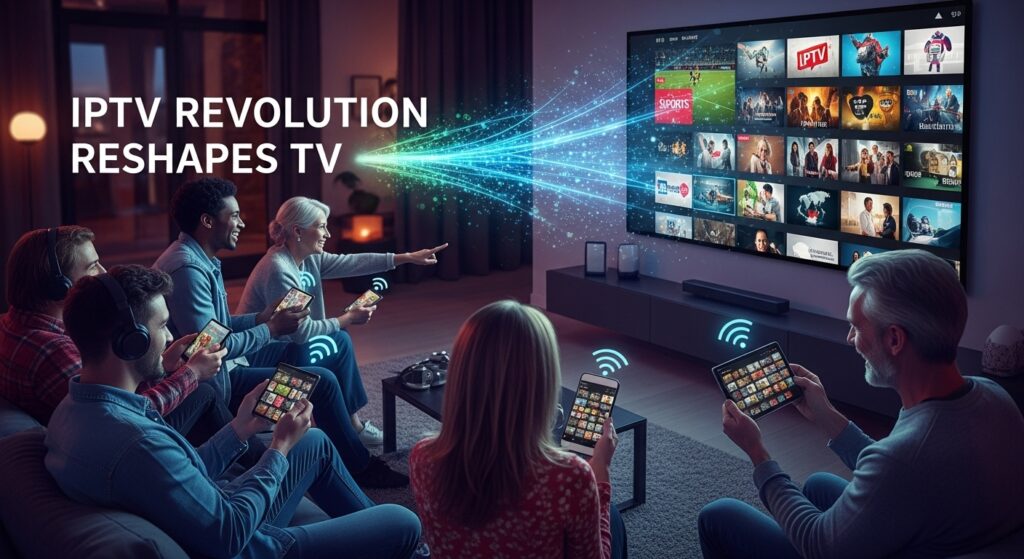
IPTV stands for Internet Protocol Television — that is, delivering television content over IP networks (your broadband) rather than by satellite or traditional cable. That alone doesn’t make a service legal or illegal. The crucial factor is content rights: a legitimate iptv subscription sold in the United Kingdom will have rights to provide channels and catch-up programming; pirate playlists do not. IPTV Revolution Reshapes TV.

Common forms of iptv you’ll see in the UK:

  • Broadcaster apps (BBC iPlayer, ITVX, All 4) — IP-delivered and legal.
  • OTT SVOD platforms (Netflix, Amazon Prime Video, Disney+) — IP-delivered shows and movies under license.
  • ISP-managed IPTV (BT TV, Sky Stream, Virgin) — formal IPTV services by broadband providers.
  • Licensed IPTV providers — companies that resell licensed feeds or curate channel bundles.
  • Front-end players (IPTV Smarters Pro, TiviMate, IPTV Pro) — apps that play the streams you feed them (M3U, Xtream). These players are neutral tools; their legality depends on the content source.

So, IPTV is a delivery method plus an ecosystem of services and players. It’s not inherently “pirate” — but the open nature of the internet makes piracy a temptation for some sellers and buyers. We’ll cover how to avoid that later. IPTV Revolution Reshapes TV.

2. Why traditional TV models are under pressure

Several long-term trends have made linear cable and satellite bundles increasingly unattractive:

  • Cost creep — bundles grew, prices rose, and many households ended up paying for hundreds of channels they never watched.
  • Consumer control — viewers want to choose shows and watch on their terms: on-demand, on mobile, across devices.
  • Better broadband — fibre and full-fibre upgrades provide the bandwidth needed for stable HD and 4K streaming.
  • Device ubiquity — Smart TVs, Fire Sticks, Chromecast, and Android TV boxes are cheap and intuitive.
  • Modularity — services such as NOW allow buying month-by-month passes for sports or entertainment, avoiding year-long contracts.
  • Advertising & FAST channels — Free Ad-supported streaming TV (FAST) fills gaps with themed channels people like, without subscription costs.

Consequently, paying a single large monthly fee for an entire bundle increasingly feels inefficient compared with targeted iptv subscriptions and a mix of free/paid apps.

3. The technical foundations of IPTV

IPTV’s user experience depends on several key technologies:

  • Adaptive Bitrate Streaming (ABR): automatically adjusts video quality to your current bandwidth to minimise buffering.
  • Codecs (HEVC, H.265; AV1 emerging): more efficient codecs let providers deliver high-quality 4K at lower bitrates.
  • DRM (Widevine, PlayReady): required for high-quality/4K playback in many official apps.
  • CDNs (Content Delivery Networks): deliver streams from nearby servers to reduce latency and packet loss.
  • Front-ends & EPGs: TiviMate and IPTV Smarters Pro provide a traditional TV-like guide for playlists and provider feeds.
  • Network essentials: good router, QoS, Ethernet/5GHz Wi-Fi, and adequate broadband (25–50 Mbps per 4K stream recommended).

If these technical pieces are in place, IPTV can match or exceed the reliability and quality of traditional broadcast systems. IPTV Revolution Reshapes TV.

4. What UK viewers actually gain — benefits explained

Choice & customisation
Rather than paying for a hundred unused channels, you can pick a few iptv subscriptions and free apps that match your tastes. Need sport only for six months a year? Buy a NOW Sports pass when the season starts.

Cost control
By rotating subscriptions and using free services (BBC iPlayer, ITVX, All 4), many UK households cut annual TV costs significantly.

Portability
Watch on a Smart TV at home, then continue on your phone or tablet — ideal for commuters and students.

Better discovery & UX
Modern players and recommendation engines surface relevant shows quickly; front-ends allow favourites and custom EPGs.

Future-proofing
With codec support like AV1 and HEVC, modern devices will handle higher-quality streams for years to come.

Multi-device & multi-user
Most services offer multiple profiles and parallel streams, letting families watch different content at the same time.

5. Devices, apps and the modern IP stack

Devices that matter

  • Amazon Fire TV Stick 4K Max — best value with broad app support.
  • Chromecast with Google TV — clean UI, great for Android users.
  • NVIDIA Shield TV — power user choice: AV1/HEVC support, Plex server features.
  • Smart TVs (Samsung, LG, Sony) — convenience, built-in apps.

Apps & players

  • Native apps: Netflix, BBC iPlayer, Amazon Prime, Disney+, NOW — preferred for DRM and 4K.
  • Front-ends: IPTV Smarters Pro, TiviMate, Perfect Player — used with licensed M3U/Xtream providers.
  • Media servers: Plex or Jellyfin for local libraries and enhanced streaming.

Network setup

  • Use Ethernet for the main living room TV when possible.
  • For Wi-Fi, prefer 5GHz bands and Wi-Fi 6 routers for multiple concurrent streams.
  • Configure router QoS to prioritise streaming device traffic in busy households.

6. Legal and safety essentials (TV Licence, piracy risks)

TV Licence basics (UK)
If you watch or record live TV on any channel or device, including via IPTV UK , you need a valid TV Licence. Using BBC iPlayer (live or catch-up) also requires a licence. If you only watch on-demand subscription services (Netflix, Amazon Prime) and never watch live or iPlayer, you may not need a licence — but many households blend services and need to check.

Piracy risks
“Cheap” iptv subscriptions sold via social media often redistribute copyrighted channels without permission. Risks for buyers include:

  • Malware and compromised devices (pre-loaded “jailbroken” sticks).
  • Sudden service shutdowns and no refunds.
  • Possible legal exposure and financial fraud.

How to stay safe

  • Use apps from official app stores.
  • Prefer reputable providers (company details, invoices, card payments).
  • Avoid pre-loaded devices and anonymous social-media sellers.
  • Keep device firmware up-to-date and use strong payment methods (card/PayPal).

7. Business models: subscriptions, FAST, and modular passes

The IPTV ecosystem supports multiple monetisation strategies:

  • SVOD (Subscription Video on Demand) — Netflix-style monthly plans.
  • AVOD (Ad-supported Video on Demand)/FAST — Pluto TV, Tubi: free to watch, ad-supported channels.
  • TVOD (Transactional VOD) — pay-per-view or rental of new releases.
  • Modular passes — NOW-style temporary passes for specific content (sports, cinema).
  • Licensed IPTV resellers — curate licensed bundles for niche audiences (regional channels, foreign language content).

This model diversity is core to the “end” of one-size-fits-all cable: consumers mix and match to their needs. IPTV Revolution Reshapes TV.

8. How to evaluate iptv providers — a practical checklist

When you evaluate a potential iptv subscription or provider, use this checklist:

  1. Company transparency — registered UK/EU company details, postal address and contact.
  2. Payment options — card or PayPal (not crypto/gift cards only).
  3. Proof of rights — can they demonstrate distributor agreements or reseller contracts?
  4. Trial availability — legitimate iptv uk free trial with clear cancellation.
  5. App distribution — presence on official app stores or support for mainstream players (TiviMate, IPTV Smarters).
  6. Refund & terms — clear cancellation/refund policies.
  7. Independent reviews — look for reviews outside vendor channels.
  8. No forced sideloading — avoid providers pushing unknown APKs.

If any of these raise concerns, step away.

9. Step-by-step migration guide

Below is a practical weekend plan to transition from traditional TV to a modern, legal IPTV-first setup. Follow step-by-step to minimise disruption and keep everything legal. IPTV Revolution Reshapes TV.

Step 1 — Audit your viewing

Write down your must-watch shows: live sport, morning news, kids’ channels, favourite drama series. Note who watches what and when. This tells you which services are essential.

Step 2 — Map rights and services

Research where your must-watch content lives: Premier League may be split across Sky/Now/Peacock or Amazon; some tournaments are DAZN or BT. Create a simple table: Content → Rights Holder → App needed.

Step 3 — Check your network & device readiness

Run a speed test at your TV location. Target: 20–30 Mbps for HD streams or 25–50 Mbps for reliable 4K. Check if your TV supports needed apps. If not, buy an affordable Fire TV Stick 4K Max or Chromecast with Google TV.

Step 4 — Install legal free apps

Install BBC iPlayer, ITVX, All 4, My5 and Freeview Play. These free catch-up apps cover a lot of ground. Log in and test live/catch-up playback.

Step 5 — Try paid pillars with trials

Use iptv uk free trial offers or short monthly plans for Netflix, Prime Video, Disney+ depending on your needs. Create profiles, set parental controls, test device compatibility.

Step 6 — Choose a sport strategy

If you’re a seasonal sports fan, use NOW passes or rights-holder event passes. If you need constant Sky Sports access, evaluate Sky Stream or Sky subscription packages.

Step 7 — Add a front-end if you need centralisation

If you want a single guide across sources and a centralised EPG, install TiviMate (Android TV) or IPTV Smarters Pro (Fire/Android). Only add content from licensed providers or official portals — do not import unknown M3U files from social ads.

Step 8 — Improve reliability

Prefer Ethernet for the main TV; if impossible, use a Wi-Fi 6 router or mesh. Set QoS for streaming devices and reduce heavy background downloads during peak viewing.

Step 9 — Test under real conditions

Watch live programs and sports during evening peak hours to ensure streams remain stable. If you encounter buffering, increase buffer size (in players), or move to Ethernet.

Step 10 — Cancel legacy services cautiously

Only cancel satellite/cable once you confirm your new setup reliably meets needs. Keep a short overlap of services to avoid loss of access during fine-tuning.

Ongoing maintenance

  • Monthly: update apps, clear caches.
  • Quarterly: re-evaluate subscriptions and rotate trials to save money.
  • Annually: check codec/DRM requirements if upgrading to 4K.

This approach minimises surprises and keeps your household streaming legally and with confidence. IPTV Revolution Reshapes TV.

10. Troubleshooting & optimisation tips

Buffering — use Ethernet, 5GHz Wi-Fi, and close background downloads. Enable ABR and moderate buffer values in players.
App crashes — clear cache, update app/firmware, reinstall.
No 4K / DRM issues — ensure device supports Widevine L1 or other DRM the service requires; use native apps for 4K where possible.
IPTV playlist problems — if a channel drops often, ask provider for alternate endpoints or test during off-peak.
Slow remote control or UI lag — reboot device, disable background apps, or use a faster device (Shield vs budget stick).

11. The future: where IPTV is heading by 2025 and beyond

Expect these trends:

  • More modular rights — short-term passes and event-based pricing become the norm.
  • Improved codecs — AV1 adoption reduces bandwidth needs for 4K and HDR.
  • Smarter aggregation — universal search and payment in a single UI, combined billing for multiple services.
  • FAST expansion — ad-supported channels grow as an alternative for cost-sensitive viewers.
  • AI-powered discovery — personalised bundles and recommendations made by smarter systems.

Together, these shifts deepen the disruption to traditional TV models.

12. Conclusion: what households should do now

IPTV is not an experiment — it’s a mature ecosystem ready for most UK homes. To benefit:

  1. Audit what you watch.
  2. Test with iptv uk free trial offers and free catch-up apps.
  3. Use devices that support modern codecs and DRM for 4K if you want the best picture.
  4. Choose licensed providers and avoid pre-loaded sticks and anonymous sellers.
  5. Prioritise network reliability (Ethernet, Wi-Fi 6, QoS).
  6. Rotate subscriptions and use short passes to lower annual costs.

If you follow a careful plan, you’ll likely pay less and enjoy more — and you’ll be prepared for the next phase of streaming innovation. IPTV Revolution Reshapes TV.

13. FAQs

Q1 — Is IPTV legal in the UK?
Yes — legal when the provider has distribution rights. Use official apps (iPlayer, Netflix) or licensed iptv subscriptions.

Q2 — Do I need a TV Licence to use IPTV?
If you watch live TV or BBC iPlayer, yes. On-demand-only services like Netflix generally don’t require a licence — but many households mix services, so check TV Licensing guidance.

Q3 — Are IPTV players like IPTV Smarters Pro illegal?
No — they are neutral players. Legality depends on the content source you load.

Q4 — How much broadband do I need?
Plan ~8–12 Mbps per HD stream, and 25–50 Mbps per 4K stream. For multiple simultaneous streams, multiply accordingly and add headroom.

Q5 — Can I keep my Sky content without a long contract?
Yes — NOW (Sky’s passes) offers month-by-month access to many Sky channels including sports, without long contracts.

Is IPTV Legal in the UK? What You Need to Know

1 — What “IPTV” actually means

IPTV stands for Internet Protocol Television — delivering TV and video services over the internet rather than by satellite or cable. UK IPTV Legality Guide. “IPTV” is a catch-all term in the UK that includes:

  • Official broadcaster apps (BBC iPlayer, ITVX, All 4) and Freeview Play;
  • OTT subscription services (Netflix, Disney+, Amazon Prime Video; these are IP-delivered but licensed);
  • ISP-managed IPTV (set-top boxes and bundles from BT, Virgin, Sky in IP form);
  • Third-party IPTV providers who sell playlists (M3U/Xtream) or pre-configured “IPTV subscriptions” and boxes.

The legal question is not the delivery method (IP) but whether the service has the rights to provide that content in the UK. If it does — the IPTV service is legal. If it doesn’t — it’s illegal and risky.

2 — The legal test: why some IPTV is lawful and some not

There are two separate legal issues for consumers:

  1. Copyright / distribution rights: Rights-holders (broadcasters, studios, sports leagues) license content. A legitimate IPTV provider obtains distribution rights (or buys licensed feeds) and pays rights-holders. Services that redistribute pay channels without permission commit copyright infringement and other offences.
  2. Television licensing: In the UK you must hold a TV Licence to watch or record live TV on any device (including IPTV) and to use BBC iPlayer. If you only use on-demand, subscription VOD (e.g., Netflix) and never watch live broadcasts or iPlayer, you may not need a TV licence — but check the official guidance.

So legal IPTV = licensed content + (where applicable) correct TV licence.

3 — UK rules & key sources you should know

  • TV Licence requirement: Watching live TV (including IPTV live channels) or BBC iPlayer requires a TV Licence in the UK. Official guidance from TV Licensing explains who needs one and the consequences.
  • Copyright enforcement and anti-piracy: UK anti-piracy organisations (FACT and others) and police have been actively targeting illegal IPTV sellers and networks. Recent enforcement operations have targeted tens of suppliers and sellers.
  • Ofcom’s role: Ofcom regulates broadcasting and on-demand programme services; some internet-delivered channels accessed via IPTV may fall outside Ofcom regulation depending on origin, but other obligations (advertising rules, accessibility) can apply. Operators need to understand Ofcom rules for UK distribution.

These are the load-bearing facts: TV Licence rules, copyright/licence requirements, and active enforcement in the UK.

4 — How to spot illegal IPTV providers

Before buying any iptv subscription or iptv uk free trial, check for these warning signs:

  • Extremely low price for premium channels (e.g., “all Sky Sports + movies for £5/month”): if it looks too good to be true, it probably is.
  • Anonymous seller details: no company name, no UK address, only social-media DMs.
  • Payment by gift cards or crypto only: this is often used to avoid traceability.
  • Jailbroken / pre-loaded boxes sold as “fully loaded” — preinstalled illegal apps or APKs.
  • No official app in major app stores: the app isn’t in Amazon Appstore, Google Play or TV platform stores.
  • Constant server/playlist changes: feeds disappear, and the seller keeps swapping URLs.
  • Poor refunds and weird T&Cs.

If you see several of these, do not buy. Instead, pick reputable iptv uk providers or mainstream services. UK IPTV Legality Guide.

5 — Practical step-by-step: How to choose, trial and use IPTV legally in the UK

Below is a detailed, practical roadmap you can follow when evaluating any IPTV UK option — whether you want a cheap iptv subscription, an iptv uk free trial, or an iptv service for your household.

A — Define your needs (10 minutes)

Write down what you actually watch:

  • Live sport? (Which leagues/events?)
  • UK shows / catch-up? (BBC, ITV, Channel 4)
  • Box sets & films (Netflix, Prime, Disney+)
  • Kids channels, local/regional channels

Why this matters: sport and first-run movies are almost always behind expensive rights, so if sport is essential you’ll probably need an official sports subscription (NOW, Sky, TNT/DAZN/BT Sport depending on rights).

B — Start with official, licensed sources

Install & test the free, legal apps: BBC iPlayer, ITVX, All 4, My5, Freeview Play. These are free and secure. Next, trial mainstream paid apps — Netflix, Amazon Prime Video, Disney+, NOW — many offer free or low-cost trials or rolling passes (e.g., NOW’s month-by-month passes). This combination often covers most viewing needs for families without iptv subscription risks.

Check whether your ISP offers managed IPTV bundles (BT, Virgin, etc.). ISP bundles may be slightly pricier but include support, multi-room boxes and licensed channel lineups.

C — If you still need channels not covered, evaluate secondary legal options (1–2 hours)

If after core services you still need access to specific premium channels, compare:

  • NOW (Sky passes) for Sky content;
  • BritBox for British dramas;
  • One-off or seasonal sports passes (many rights-holders or services offer tournament passes).
    Search for “iptv uk free trial” only on known providers’ official pages and sign up with a credit card for protection. Avoid third-party “trial” offers on social media pages. UK IPTV Legality Guide.

D — Considering a third-party IPTV provider

If you consider an independent iptv provider (M3U/Xtream playlist), follow this checklist:

  1. Company identity: Is there a registered company, contact email, phone and address? Check domain WHOIS, trust signals, and reviews on independent forums (not just the seller’s posts).
  2. Payment transparency: Do they accept traceable payments (card/PayPal) and provide invoices/receipts? Avoid crypto-only.
  3. Proof of licensing: Ask for written confirmation that they have rights to the channels they sell in the UK. Many legal resellers will show licensing agreements or legitimate wholesale partners. If they can’t (or won’t) supply any proof, don’t buy.
  4. App distribution: Legitimate services often distribute apps via official stores or support standard IPTV players (e.g., TiviMate, IPTV Smarters Pro) without instructing you to sideload dubious APKs.
  5. Customer support & refund policy: Is there live support, and what’s their refund process? Legal companies usually have formal T&Cs and UK/EU consumer protections.
  6. Trial & cancellation: A legitimate iptv uk free trial will be time-limited and require a proper sign-up; ensure cancellation is simple and refunds are possible for faults.
  7. Technical testing: Before committing, ask for a free test playlist or short trial on your device (Firestick, Android box, Smart TV). Evaluate stream reliability and picture quality.
  8. Security checks: Don’t sideload suspicious APKs. If they ask you to install unknown software outside official app stores, refuse.

E — Device & security readiness 

  • Use supported players (TiviMate, IPTV Smarters Pro, Smart IPTV) that don’t come from unknown sites — these players are legal front-ends. However, remember the app is legal only if the content source is legal.
  • Keep device firmware updated. Avoid “jailbroken” Firesticks sold by third parties.
  • Use strong, unique passwords and enable two-factor authentication on accounts where possible.

F — Compliance: TV Licence and regional rules

  • If you watch live TV channels via your IPTV service or use BBC iPlayer, ensure you hold a UK TV Licence. Failure risks fines. Confirm via TV Licensing guidance.

G — If you discover you bought an illegal feed

  • Stop using the service.
  • Request a formal refund (if possible) and document all communications.
  • If you believe you were defrauded, report the seller to your bank/PayPal and to anti-piracy agencies (FACT) and local police. Don’t attempt to redistribute or resell access.

H — Ongoing hygiene

  • Re-run the playlist/test channels occasionally.
  • Keep apps & firmware updated.
  • Monitor payment card statements for unknown charges.
  • If you want better protection on shared/public Wi-Fi, use a reputable VPN — but remember VPNs do not legalise access to unlicensed streams and some providers block VPN usage.

This step-by-step will help you find a legal iptv subscription or iptv service that matches your needs, avoid illegal iptv uk free trial traps, and keep devices safe. UK IPTV Legality Guide.

6 — Common buyer questions & clarification

  • Is “iptv uk free trial” legitimate? Yes — for reputable providers (NOW, BritBox trials). But third-party trial offers on social media often lead to rip-offs.
  • Is using IPTV Smarters Pro or TiviMate illegal? No — they are media players/front-ends. Legality depends on the source playlist. If you load a pirate M3U, you’re using illegal content.
  • What is a “jailbroken Firestick”? A Firestick modified and preloaded with pirate apps — these devices are often central to enforcement actions and should be avoided.
  • Can I be prosecuted for watching illegal IPTV? Enforcement mainly targets sellers/operators. Ordinary viewers are less likely to be criminally prosecuted solely for viewing, but risks exist (especially for users who redistribute, facilitate, or sell access). Also, device sellers/organisers have been prosecuted.

7 — Enforcement examples & what authorities are doing

  • FACT and UK police have targeted dozens of illegal suppliers in coordinated operations and served cease-and-desist notices. Enforcement remains active and has led to website shutdowns and prosecutions.
  • High-profile sentences have been handed down in the UK for people selling illegal IPTV boxes or running pirate networks; courts have imposed significant custodial sentences and asset seizures in notable cases. These examples show authorities take commercial piracy seriously.

8 — Security & privacy risks from illegal IPTV suppliers

Beyond legal exposure, illegal services commonly expose users to:

  • Malware / spyware bundled in APKs or pre-loaded boxes;
  • Credential theft and financial fraud via hidden malware;
  • No refunds and data exposure when services shut down;
  • Router / network compromise in poorly secured box firmware.

These risks mean buying a “cheap” illegal iptv subscription can cost much more than a legitimate monthly subscription in the long run.

9 — Best legal alternatives in the UK

If you want legal, reliable options for iptv uk and similar functionality, choose from:

  • Free catch-up & live: BBC iPlayer, ITVX, All 4, My5, Freeview Play.
  • On-demand pillars: Netflix, Amazon Prime Video, Disney+.
  • Modular Sky content: NOW (monthly passes for Entertainment, Cinema, Sports).
  • Sports: buy official sports apps/passes from rights holders or use NOW/BT/DAZN depending on competitions.
  • ISP bundles: consider BT, Virgin, Sky where you want one-bill and multi-room boxes.
  • Legal IPTV players for licensed playlists: TiviMate, IPTV Smarters (with licensed provider playlists only).

These options are secure, updated, and avoid enforcement risk. UK IPTV Legality Guide.

10 — Quick checklist before you buy an  IPTV subscription or device

  • Is the seller a registered company with contact details? ✅
  • Are payments traceable and refundable? ✅
  • Is the service available on official app stores? ✅
  • Do you need a TV Licence for the content? ✅
  • Have you tested a trial on your device? ✅
  • Are you avoiding preloaded/jailbroken devices? ✅

If you answer “no” to any of the above, walk away.

11 — Conclusion

IPTV itself is a neutral delivery method — legal when the provider has the rights to distribute the channels and when you comply with TV Licence rules in the UK. The problem is a thriving illegal market of cheap, unlicensed IPTV subscriptions and pre-loaded boxes. To stay legal and safe:

  • Prefer official apps and reputable iptv subscription services;
  • Vet third-party providers carefully (company details, invoices, official app distribution);
  • Don’t buy “jailbroken” sticks, and don’t sideload unknown APKs;
  • Keep devices patched and hold a TV Licence if you watch live TV/ BBC iPlayer;
  • Report suspicious sellers to anti-piracy bodies (FACT) or your ISP.

If you want, I can: (a) produce a printable one-page “buy safe” checklist you can take to a seller; (b) audit a specific IPTV supplier’s website for red flags; or (c) create a concise buyer’s email you can send to a supplier asking for proof of rights/licensing. UK IPTV Legality Guide.

Authoritative sources and further reading

  • TV Licensing — Do I need a TV Licence? (official guidance).
  • Ofcom: Information on Internet Protocol TV and on-demand regulation.
  • FACT (Federation Against Copyright Theft) enforcement summaries and consumer warnings.
  • UK police and court press releases on IPTV-related prosecutions.

FAQs

Q1 — Is it legal to use IPTV Smarters Pro or TiviMate?
A: Yes — they are players. Legality depends on the playlist/provider you load.

Q2 — Can I use a VPN to hide illegal IPTV use?
A: A VPN may hide traffic, but it does not make illegal content legal — and providers can block VPNs. Don’t use a VPN to access pirated streams.

Q3 — What if I already bought a “cheap IPTV” subscription?
A: Stop using it, request a refund, document communications, consider reporting seller to authorities if you suspect fraud, and switch to legal services.

Q4 — Are there trustworthy “iptv uk free trials”?
A: Yes — reputable providers (NOW, BritBox, some ISPs) offer trials. Always use promotions from the official provider website.

Q5 — Will enforcement target users?
A: Enforcement primarily targets operators and sellers. Users face security risks and loss of service; repeat offenders who redistribute or profit may face legal consequences.                                                                                                                                                                                                                                                                                             IPTV FREE TRIAL