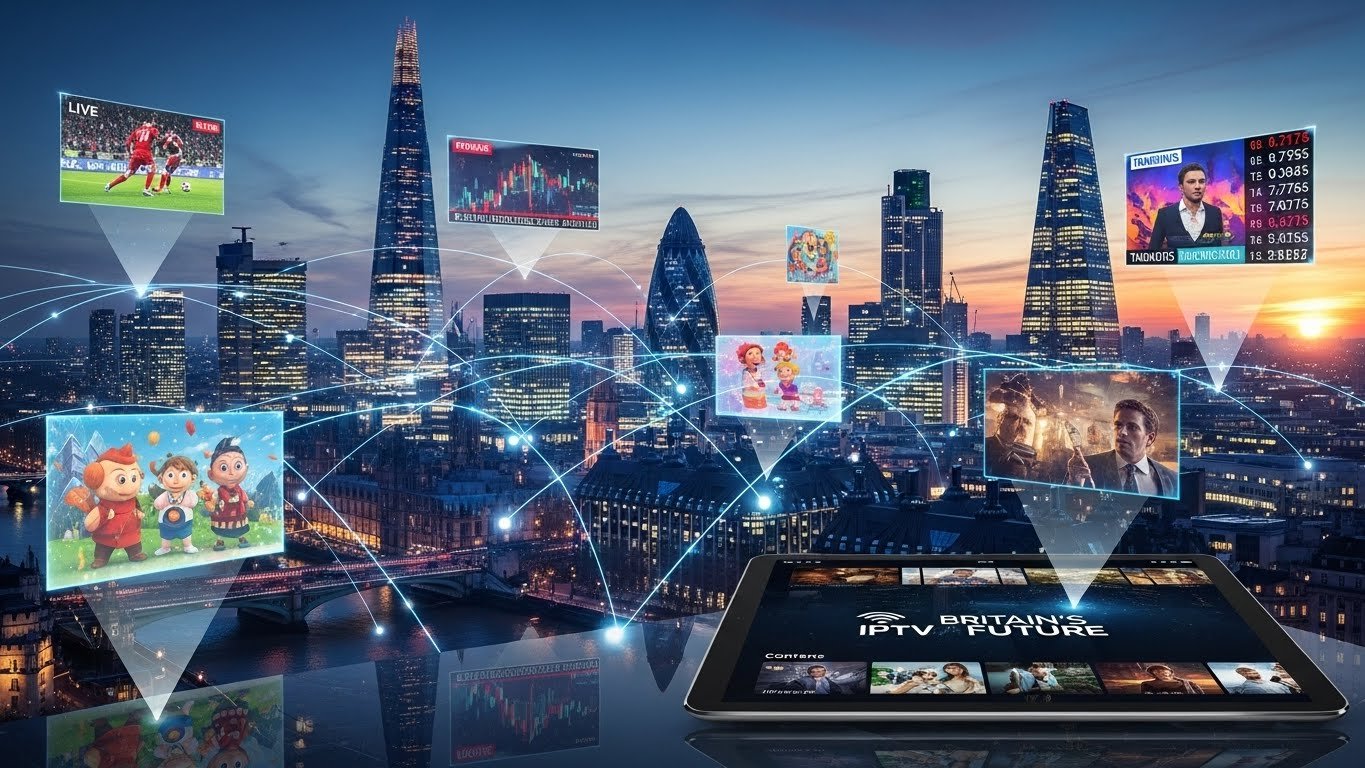
IPTV UK: The Future of Television in Britain

IPTV (Internet Protocol Television) is reshaping how people in the United Kingdom watch video. Rather than depending solely on terrestrial, satellite, or cable, IPTV delivers live channels and on-demand libraries over broadband. For viewers in the UK, that change matters because it shifts control — of what you watch, where you watch it, and how it’s monetised — from distribution networks to internet platforms and app ecosystems. As a result, the future of television in Britain will be defined by technology (better codecs, faster broadband), business models (bundles, aggregators, ad-supported tiers), regulation (Ofcom and copyright enforcement), and consumer choice (from licensed OTT services to a thriving — and sometimes illicit — IPTV ecosystem). Britain’s IPTV Future.

What is IPTV and why it matters for Britain

IPTV describes the technical delivery method: video packets sent over IP networks to set-top devices, smart TVs, apps and browsers. It can carry live channels (linear TV), catch-up and VOD libraries, and DVR/time-shifted content. Importantly, IPTV itself is neither legal nor illegal — legality depends on whether the service holds rights to the content it distributes. A licensed IPTV subscription from a broadcaster or aggregator is lawful; an unauthorised service that streams premium pay channels without licences is not.

Why it matters in the UK:

  • Broadband penetration and smart TV adoption make IPTV practical for most households; the infrastructure exists to support mass migration.
  • Younger audiences are already migrating away from linear TV to online video platforms, which favours IPTV and streaming models. Ofcom’s recent reporting shows online video growth and changing viewing habits.
  • IPTV enables new business models: single-app aggregators that combine multiple sources, ad-supported tiers, micro-subscriptions, or hybrid bundles that mix broadcaster apps with third-party content.

These forces together mean IPTV is not just a niche alternative — it’s becoming a mainstream way Britons access TV and video.

The current UK landscape

To understand the future, start with now. In 2024–2025, the UK media market showed modest growth driven by online video. Ofcom’s Media Nations 2025 highlights that online platforms are an increasingly dominant part of viewing and that total industry revenue rose modestly — factors that favour IPTV and OTT expansion.

At the same time, enforcement against illegal IPTV operations has been active: UK police, specialist units (PIPCU), and industry groups (FACT) have conducted raids, seized servers, and pursued prosecutions in 2024–2025, showing authorities treat large-scale piracy seriously. Recent seizures and arrests in 2025 demonstrate that illicit IPTV operations remain a target. These actions matter because they change the risk calculus for consumers and intermediaries.

Finally, global IPTV market research points to strong growth overall — the IPTV market is expanding rapidly worldwide as broadband and smart devices proliferate — which indicates investment and competitive pressure will continue into 2025 and beyond.

How consumers are changing TV: three big trends

  1. From channels to experiences
    Linear channel schedules are being replaced by curated experiences: personalised queues, algorithmic recommendations, multisource search and bundles stitched together inside a single app or aggregator. Consumers increasingly pick services based on UX, EPG quality, and device support (e.g., IPTV Smarters Pro compatibility).
  2. Hybrid monetisation
    Subscriptions remain important (multiple iptv subscriptions per household is not unusual), but ad-supported tiers, promotional trials (iptv uk free trial) and short-term passes are gaining ground. Aggregators may offer lower entry prices in exchange for ads or revenue sharing with content owners.
  3. Device and platform diversity
    TV is no longer a single screen: smart TVs, Fire Sticks, Android TV boxes, Apple TV, phones, and browsers all play a part. Device compatibility and the ability to sideload or integrate with players like IPTV Smarters decides which IPTV providers reach the largest audience.

These trends combine to make TV more flexible but also more complex for consumers.

Business models: aggregators, broadcasters, and the grey market

Four archetypes will coexist:

  • Broadcaster/OTT official services: BBC iPlayer, ITVX, Sky’s streaming; licensed, regulated, and trusted. They will continue to anchor much viewing.
  • Licensed aggregators: Services that secure rights and bundle channels into a simplified subscription. These can be attractive if they truly hold licences for the offered channels.
  • Independent OTT and niche streamers: Vertical/playlists focusing on sport, film, kids, or international channels. They may combine with larger platforms through deals.
  • Grey-market resellers and pirate IPTV: Cheap bundles that include premium pay channels without rights. These services are unstable, risky, and targeted by enforcement. Recent UK raids and server seizures reinforce the legal risk.

For mainstream UK viewers, the safest long-term route is licensed services and reputable aggregators; the grey market remains tempting on price but carries legal and security downsides.

Regulation, enforcement, and consumer protection

Ofcom remains the primary regulator for broadcasting and on-demand services in the UK, and its Media Nations work informs policy discussions. Meanwhile, criminal and civil enforcement (City of London Police, PIPCU, FACT, and others) target large-scale piracy operations and facilitators, including data centres, payment processors, and device sellers. These agencies have achieved seizures and prosecutions in 2024–2025, signalling continued prioritisation. Britain’s IPTV Future.

What this means for consumers:

  • If a service can’t show clear rights or a UK business presence, be sceptical.
  • Payment via traceable, consumer-protected methods (card, PayPal) is safer than anonymous methods.
  • Reporting suspicious services to Action Fraud, FACT, or the police helps enforcement and protects others.

Technology drivers shaping IPTV’s future

  1. Broadband upgrades and low latency
    Wider gigabit broadband and faster home Wi-Fi (Wi-Fi 6/6E/7) lower barriers for high-bitrate streaming and multiple simultaneous streams in a household.
  2. Better codecs and streaming tech
    Wider H.265/HEVC decoding and emerging codecs (AV1) improve efficiency, allowing 4K streams at sensible bitrates. Low-latency CMAF and chunked-encoding improve live sports delivery.
  3. Cloud and edge delivery
    Edge caching and CDN sophistication mean smoother playback and localized content delivery — critical for congested sporting events.
  4. Interoperability and standard APIs
    Growth of standardised service APIs (EPG, authentication tokens, DRM) will make it easier for legitimate IPTV providers to authorise and protect content across devices.

These technologies will make IPTV more robust and mainstream.

Risks and threats: piracy, malware, and privacy

While IPTV’s technological improvements are positive, risks persist:

  • Illicit services: Cheap, unrealistic bundles are often unlawful and may disappear suddenly, leaving consumers out of pocket. Enforcement actions through 2025 show operators can be traced and prosecuted.
  • Malicious apps and pre-loaded boxes: Some grey-market devices and APKs carry malware, spyware, or intrusive permissions. Consumers sideloading APKs (rather than using official stores) should check sources and avoid modified apps.
  • Data and payment fraud: Shady providers may collect and reuse payment or personal details — prefer card or PayPal and carefully read privacy policies.
  • DRM and georestrictions: Legitimate rights management may block certain streams outside agreed territories, impacting cross-border viewing.

Consumers must balance price against the legal and security risks of low-cost suppliers. Britain’s IPTV Future.

Opportunities for content creators and UK industry

IPTV growth isn’t only a threat — it’s an opportunity:

  • New distribution channels: Creators can reach niche UK audiences through dedicated IPTV channels or aggregation deals with platforms.
  • Innovative ad models: Dynamic ad insertion during IPTV streams enables targeted, addressable advertising, which can be more valuable than conventional ad spots.
  • Flexible windows and monetisation: IPTV allows combination of subscription (SVoD), transactional VOD, and ad-supported tiers to maximise revenue.
  • Local language and cultural content: Aggregators can package British, regional and diaspora content more easily than traditional linear approaches.

For rights owners and broadcasters, the challenge is to adapt commercial models while protecting revenue and rights. Britain’s IPTV Future.

What viewers should do today (practical guidance)

  • Prefer licensed, transparent providers and confirm device compatibility.
  • Use IPTV UK free trial offers to evaluate UX, EPG accuracy, stream stability and device support, but read cancellation terms carefully.
  • Install players from official app stores (e.g., IPTV Smarters Pro from verified sources) and avoid cracked APKs.
  • Use wired Ethernet for high-bitrate streams and a modern router for Wi-Fi.
  • Pay with methods that offer consumer protection and keep records.
  • Report scams or suspicious services to authorities.

 Step-by-Step Walkthrough: Choosing and Starting a Safe IPTV UK Subscription

(Full, practical walkthrough you can follow today.)

  1. Define needs and priorities
    Write down the channels and content types you cannot live without (e.g., BBC, ITV, specific sports leagues). Decide how many simultaneous streams you need — this determines whether a single-device Fire Stick or a multi-stream household plan is required. Note device preferences (Smart TV, Android TV, Apple TV, phone).
  2. Research providers
    Compile a shortlist of 3–5 providers that claim to meet your needs. Use reputable review sites, community forums, and the provider’s own documentation. Look for transparency: company address, clear terms, privacy policy, and licensing statements. Exclude suppliers that insist on cash/crypto only or won’t provide verifiable contact details.
  3. Check device support
    Confirm the provider supports your device(s) and player apps — for example, does it provide M3U/Xtream credentials compatible with IPTV Smarters Pro, TiviMate, or a native tvOS/AndroidTV app? If sideloading is required, ask for checksums and official installation instructions.
  4. Trial and test
    Take advantage of IPTV UK free trial offers. Prefer trials that don’t auto-charge or require extensive personal data. Use the trial to check: channel availability, EPG alignment to UK time, stream quality at peak times, and simultaneous streaming. Test on the device you use most (TV, Fire Stick, phone) and during varied times of day.

This step-by-step approach balances convenience, price and legal safety so you can benefit from IPTV in the United Kingdom without unnecessary risk. Britain’s IPTV Future.

Future scenarios: what might Britain’s TV look like in 5 years?

  1. Aggregator dominance with licensed bundles.
    Major aggregators may package broadcaster apps and third-party services into single UX experiences with unified billing — think “app stores” for television.
  2. Event-level fragmentation with day-passes.
    Live sports might become more fragmented but easier to access via event-level passes or micro-subscriptions, allowing consumers flexibility.
  3. Regulated hybrid models.
    Ofcom and rights holders could push for stronger protections and standardised APIs for EPGs, DRM, and authentication — enabling safer, interoperable IPTV services.
  4. Greater convergence of social and broadcast video.
    Short-form platforms (YouTube, TikTok) will continue to capture attention, pushing broadcasters to combine editorially strong long-form programming with social distribution.
  5. Continued enforcement against piracy.
    As illicit IPTV operators adapt, law enforcement and industry coalitions will continue technical and legal responses — meaning the grey market may shrink but also become more covert.

Conclusion — balancing freedom, choice and responsibility

IPTV is a transformational technology for the UK. It offers more choice, flexible monetisation, and new ways for creators to reach audiences. Yet, it also brings risk — especially when low-cost, unauthorised services try to capture market share. For viewers in Britain. The sensible path forward in 2025 is to embrace licensed. Transparent IPTV subscriptions where practical; to use trials wisely (iptv uk free trial); to choose devices and players that are secure and well-supported (examples: Fire TV Stick, Android TV/NVIDIA Shield, Apple TV, Smart TVs with official apps, and trusted players like IPTV Smarters Pro where available); and to prioritise safety in payments and device hygiene. Britain’s IPTV Future.

Retirees, Students, Families: Why IPTV Works for Every UK Household

Television in the United Kingdom has never been more diverse, flexible, or affordable than it is today — and much of that transformation is thanks to IPTV (Internet Protocol Television). IPTV for Every Household. From retirees seeking simplicity and familiar favourites, to students on tight budgets, to busy families juggling multiple screens — IPTV has proven itself the universal entertainment solution for every type of UK household.

In this comprehensive guide, we’ll explore why IPTV works so well for retirees, students, and families, how it compares to traditional TV options, and why it’s becoming the go-to choice for millions of British viewers.

1. Understanding IPTV: A Quick Refresher

Before diving into how IPTV benefits different groups, let’s clarify what it actually is.

IPTV (Internet Protocol Television) is a digital television service delivered through the internet rather than traditional broadcast methods such as terrestrial (Freeview), cable, or satellite (Sky, Virgin, BT TV).

Instead of tuning into pre-set broadcast channels, IPTV streams content directly over a broadband connection. This allows for live TV, video on demand (VOD), and time-shifted viewing (catch-up TV) — all in one place.

1.1 How IPTV Works

  • IPTV uses your home internet (Wi-Fi or Ethernet) to stream television.
  • You access channels and shows via an IPTV box , smart TV app, mobile app, or streaming stick (like Amazon Fire TV or Android Box).
  • The content is sent in digital packets via IP — the same technology that powers websites, video calls, and online gaming.

This flexibility allows IPTV to adapt to nearly any lifestyle, which is precisely why it fits retirees, students, and families so perfectly.

2. Why IPTV Is Ideal for Retirees

Retirement offers the gift of time — time to enjoy hobbies, relax, and rediscover entertainment. IPTV for Every Household. IPTV caters to retirees by combining simplicity, affordability, and endless variety.

2.1 Simple to Use

Modern IPTV platforms are designed with user-friendly interfaces. Retirees can access:

  • Live TV with a familiar channel guide.
  • On-demand films and catch-up TV without technical hassle.
  • Voice search and large, clear menus.

Devices like Amazon Fire Stick and Android IPTV boxes make navigation intuitive, and many services even include support for remote assistance, where a family member can help configure the setup remotely.

2.2 Affordable Entertainment

Many retirees live on fixed incomes, making IPTV’s affordability a major advantage.

Unlike Sky or Virgin packages that can cost £60–£100 per month, IPTV subscriptions often range from £10–£30 monthly.
For that, users get:

  • Hundreds of live channels (UK and international)
  • Premium movies and sports
  • No long-term contracts
  • No hidden fees or installation costs

2.3 Access to Classic and New Content

Retirees love that IPTV combines nostalgia and novelty. They can revisit old favourites — from BBC dramas and classic IPTV soaps to vintage comedies — while also exploring new Netflix-style series, international films, or niche interests like gardening and travel documentaries.

2.4 Custom Viewing Experience

Features like pause live TV, rewind, and catch-up for missed episodes ensure retirees never miss a moment.
Plus, many IPTV services allow users to:

  • Adjust subtitles
  • Change playback speed
  • Customise picture settings for eyesight comfort

This personalization is far beyond what traditional broadcast TV can offer.

3. IPTV for Students: The Smart, Budget-Friendly Choice

University students in the UK live fast, flexible lives — often moving between accommodations, sharing spaces, and managing tight budgets. IPTV perfectly suits this lifestyle.

3.1 No Contracts, No Hardware Hassle

Most IPTV subscriptions are month-to-month, meaning students can subscribe during term time and pause during holidays. There’s no need for satellite dishes, TV licences (in some cases), or installation engineers.

Students can stream directly on:

  • Laptops and tablets
  • Smartphones
  • Smart TVs or portable streaming sticks

This mobility means they can watch anywhere — dorms, shared houses, or even while travelling.

3.2 Affordable and Flexible

With IPTV, students can enjoy premium entertainment at a fraction of the cost. Services start as low as £10 per month, giving access to sports, movies, live news, and even international channels for those studying abroad in the UK.

3.3 Perfect for Shared Living

In shared flats or student houses, everyone has different tastes. IPTV supports multiple devices and user profiles, so:

  • One student can watch live football.
  • Another can stream an anime series.
  • Someone else can catch up on BBC iPlayer.

No more fighting over the remote — and no separate accounts needed.

3.4 Access to Global Content

For international students, IPTV offers access to home-country channels, news, and cultural programming.
This helps them stay connected to their roots while adapting to British culture — something traditional UK cable TV rarely offers.

4. Families Love IPTV: Flexible, Modern, and Kid-Friendly

For UK families balancing work, school, and play, IPTV brings convenience and choice under one roof.

4.1 One Subscription, Multiple Users

Modern IPTV services support multi-device streaming, meaning Mum can watch a drama in the living room, Dad can catch sports in the study, and the kids can enjoy cartoons on their tablets — all simultaneously.

4.2 Parental Controls and Safe Viewing

Family safety is crucial. IPTV includes built-in parental control features to block inappropriate content or set time limits for children.
Parents can:

  • Create PIN-protected profiles
  • Restrict adult channels
  • Monitor viewing history

This control provides peace of mind for parents without stifling children’s entertainment choices.

4.3 Educational and Family-Oriented Content

Beyond entertainment, IPTV offers educational channels, documentaries, and language learning apps.
Services like Discovery+, National Geographic, or dedicated kids’ sections make IPTV both fun and informative.

4.4 Saving Money for Families

Traditional TV bundles can quickly add up with sports, kids, and movie packages. IPTV’s flexibility means:

  • Pay only for what you watch
  • Cancel anytime
  • No costly hardware or engineer visits

Families can also integrate free platforms like BBC iPlayer, ITVX, and All 4 into their IPTV setup , creating a hybrid ecosystem that feels both comprehensive and cost-effective.

5. Comparing IPTV vs Traditional Cable/Satellite

To understand IPTV’s rise, let’s compare it with older technologies like Sky, Virgin, and Freeview.

Feature IPTV Cable/Satellite TV
Delivery Method Internet (via broadband) Physical cable or satellite dish
Setup Cost Minimal (often plug-and-play) Installation fees, dish/cable setup
Monthly Cost £10–£30 typical £60–£100+
Contracts Usually flexible/monthly 12–24 month contracts
Device Compatibility Smart TVs, phones, tablets, PCs Limited to set-top boxes
Channel Variety UK + international + niche Mainly regional
On-Demand & Catch-up Integrated seamlessly Often app-based and fragmented
Mobility Watch anywhere Restricted to home setup

Clearly, IPTV outshines cable and satellite in cost, flexibility, and versatility — especially for younger and more connected audiences.

6. Legal and Licensing Considerations

While IPTV is perfectly legal, viewers must ensure they’re using legitimate providers that hold rights to the content they stream. IPTV for Every Household.

Free or “unofficial” IPTV services that broadcast copyrighted material without permission may violate UK laws and expose users to risks such as malware or fines.

Always choose licensed, reputable IPTV services or official apps like:

  • BBC iPlayer
  • NOW TV
  • Amazon Prime Video
  • Netflix
  • Plex, Stremium, or TiviMate (for legal IPTV playlists)

If you’re watching live BBC channels, you still need a TV Licence, even via IPTV. IPTV for Every Household. But if you only watch on-demand, licence rules may differ.

7. Internet Requirements and Technical Tips

IPTV thrives on a stable internet connection.
For smooth HD or 4K playback, consider:

Quality Minimum Internet Speed
SD (480p) 3–5 Mbps
HD (720p–1080p) 10–15 Mbps
4K UHD 25 Mbps+

Tips:

  • Use Ethernet (wired) connections for main TVs.
  • Invest in a Wi-Fi 6 router for strong signal coverage.
  • Avoid simultaneous heavy downloads during streaming.

8. Future of IPTV in the UK

With the rollout of full-fibre broadband across the UK and 5G expansion, IPTV will soon dominate home entertainment.

Trends shaping the future include:

  • AI-powered recommendations
  • Interactive viewing (polls, live chats)
  • Cloud DVRs replacing physical recorders
  • Ad-free custom packages
  • Integration with smart home devices

By 2030, experts predict IPTV will replace cable TV entirely for most UK households — just as streaming replaced DVDs.

9. Real UK Scenarios

Retiree Example:

Margaret, a 72-year-old in Devon, swapped her Sky package for IPTV.
She saves £55 monthly and enjoys on-demand gardening shows, BBC catch-up, and live news. “It’s simpler and clearer — I can watch what I want, when I want.”

Student Example:

Liam, a 20-year-old in Manchester, uses IPTV on his laptop.
“No dish, no bill shock — and I can pause my subscription during summer holidays,” he says.

Family Example:

The Shah family in Birmingham uses IPTV to watch sports, kids’ shows, and Bollywood films — all under one £25 plan.
“It fits everyone’s taste,” says Mrs. Shah. “And we’re saving over £600 a year compared to Virgin.”

10. Conclusion: IPTV — The Universal Solution for Every UK Home

Whether you’re a retiree seeking simplicity, a student chasing savings, or a family needing flexibility, IPTV delivers unmatched value.

It’s affordable, adaptable, and accessible — perfectly tuned to modern UK lifestyles.

With IPTV, entertainment is no longer tied to a cable or a contract — it’s wherever, whenever, and however you want it. IPTV for Every Household.

IPTV FREE TRIAL

The Ultimate Guide to IPTV in the UK

Television has undergone a dramatic transformation in the last two decades. Complete UK IPTV Guide. From the early days of analogue broadcasts to digital switchover, and now to internet-based streaming, the UK viewing landscape has never been more diverse or accessible. At the heart of this revolution lies IPTV (Internet Protocol Television) — a technology that has quietly, yet powerfully, reshaped how millions of Britons watch TV.

In this comprehensive 5,000-word guide, we’ll break down everything you need to know about IPTV in the UK — what it is, how it works, the benefits and drawbacks, the best services, legal considerations, and what the future holds for streaming-based television. Whether you’re a family thinking of cutting the cord, a sports fan chasing HD live matches, or a retiree looking for affordable entertainment, this is your complete IPTV handbook for 2025.

1. What Is IPTV? Understanding the Basics

1.1 The Definition

IPTV (Internet Protocol Television) refers to the delivery of television programmes, movies, and live broadcasts over the internet rather than through traditional terrestrial, cable, or satellite formats.

In simple terms, IPTV uses your broadband connection to stream content directly to your TV, smartphone, tablet, or computer. This means you’re no longer limited to specific broadcast times or cable connections — you can watch what you want, when you want, from anywhere with internet access.

1.2 The Key Difference from Traditional TV

Traditional TV relies on broadcast signals transmitted via:

  • Terrestrial networks (like Freeview)
  • Satellite (like Sky)
  • Cable (like Virgin Media)

IPTV, however, streams over the internet — no dish, coaxial cable, or aerial required.

This distinction makes IPTV uk more flexible, interactive, and scalable, allowing users to enjoy not just live television but also:

  • Video on Demand (VOD): Watch movies, box sets, and shows anytime.
  • Time-shifted TV: Catch up on missed programmes.
  • Live Streaming: Enjoy real-time broadcasts of sports, news, and events.

2. How IPTV Works: The Technical Breakdown

While IPTV may sound complex, the underlying system is straightforward once broken into parts.

2.1 The Process Step by Step

  1. Content Acquisition – Broadcasters and IPTV providers obtain TV programmes and films through licences or partnerships.
  2. Encoding & Compression – The content is converted into digital data packets suitable for streaming.
  3. Transmission – These packets are sent via the internet using a Content Delivery Network (CDN).
  4. Playback – The IPTV app or device decodes the packets and plays them on your screen in real-time.

2.2 The Types of IPTV Services

There are three main types of IPTV services in the UK:

Type Description Examples
Live IPTV Real-time streaming of TV channels over the internet BBC iPlayer live, Sky Go, Pluto TV
VOD (Video on Demand) Choose any show or movie to watch at any time Netflix, Disney+, Amazon Prime Video
Time-Shifted TV Replay recently aired shows ITVX, All 4, BBC iPlayer catch-up

Most IPTV providers offer a combination of all three for a complete experience.

3. Why IPTV Is Growing So Fast in the UK

The UK has become one of Europe’s most mature IPTV markets, with millions of users now relying on it as their main source of entertainment. There are several reasons for this rapid growth.

3.1 High-Speed Internet Access

With the rollout of fibre broadband and 5G mobile networks, UK households now enjoy faster, more reliable internet connections — making HD and even 4K streaming smooth and stable.

3.2 Demand for Flexibility

Traditional TV schedules no longer fit modern lifestyles. People want to watch content on their own terms, across multiple devices. IPTV enables on-demand and multi-device streaming, making it ideal for the modern, mobile UK viewer.

3.3 Cost Efficiency

IPTV subscriptions often cost a fraction of cable or satellite packages. While Sky or Virgin may charge £60–£100/month, IPTV services can range from £10–£30/month with similar — or greater — content offerings.

3.4 Global and Niche Content

Unlike traditional TV, IPTV gives access to international channels, niche genres, and special-interest content that’s often unavailable elsewhere — from sports leagues to foreign dramas.

3.5 The “Cord Cutting” Movement

A growing number of UK households are “cutting the cord” — cancelling expensive Sky and Virgin contracts in favour of IPTV, streaming boxes, and apps. This trend mirrors what’s already happened in the US and is accelerating as more UK viewers discover IPTV’s advantages.

4. Types of IPTV Devices and Apps

IPTV can be accessed through a wide variety of devices. Here’s an overview:

4.1 Smart TVs

Most new Smart TVs (Samsung, LG, Sony, etc.) have IPTV apps pre-installed or available for download — such as TiviMate, Smart IPTV, IPTV Smarters , or Perfect Player.

4.2 Streaming Devices

Compact, affordable, and portable — these are among the most popular ways to access IPTV:

  • Amazon Fire Stick / Fire TV
  • Apple TV
  • NVIDIA Shield
  • Android TV Boxes
  • Chromecast with Google TV

4.3 Mobile and Desktop Apps

IPTV apps are available for:

  • Android / iOS smartphones
  • Windows / macOS PCs
  • Web browsers (for direct access via URLs or M3U links)

4.4 Set-Top Boxes

Some users prefer dedicated IPTV boxes that support EPG (Electronic Programme Guides), HD/4K output, and parental controls.

5. Legal vs Illegal IPTV: What You Need to Know

5.1 Legal IPTV

Legal IPTV services are fully licensed to distribute the content they offer. Examples include:

  • BBC iPlayer
  • ITVX
  • All 4
  • NOW TV
  • Amazon Prime Video
  • Netflix
  • Pluto TV
  • Samsung TV Plus

These services operate within UK broadcasting and copyright laws.

5.2 Illegal IPTV

Unlicensed IPTV providers often sell access to premium channels (like Sky Sports or BT Sport) at low prices without permission. These illegal IPTV services:

  • Stream pirated content.
  • Expose users to malware or phishing attacks.
  • Can result in fines or legal action under the UK’s Copyright, Designs and Patents Act 1988.

5.3 How to Spot Illegal IPTV

Red flags include:

  • Offers of “All Sky Sports channels for £10/month”.
  • Payment only via Bitcoin or PayPal “friends and family”.
  • No verifiable company information or contact details.
  • Poor-quality streams or frequent outages.

Tip: Always choose licensed IPTV platforms to ensure safety, reliability, and legality.

6. IPTV and the UK TV Licence

The TV Licence remains a key consideration for UK viewers, even those using IPTV. Complete UK IPTV Guide.

6.1 When You Need a Licence

A current TV license is required if you:

  • Watch or record live TV on any channel (even via IPTV).
  • Watch BBC iPlayer, whether live or on demand.

6.2 When You Don’t

If you only stream on-demand content from services like Netflix, Disney+, or Amazon Prime (not live channels), a TV Licence is not required.

For example:

Watching Netflix = No licence needed.
Watching BBC News live on IPTV = Licence required.

7. Advantages of IPTV for UK Households

7.1 Cost Savings

With IPTV, you can ditch costly long-term contracts. Monthly subscriptions offer flexibility, often including thousands of channels and on-demand titles for under £30.

7.2 Accessibility Across Devices

Watch on your Smart TV, tablet, phone, or even while commuting — IPTV moves with you.

7.3 Personalised Viewing

Unlike traditional TV, IPTV platforms offer recommendation algorithms, watchlists, and profiles, tailoring entertainment to your tastes.

7.4 On-Demand Convenience

Pause, rewind, or replay shows instantly. Missed a match? Watch it later with catch-up TV.

7.5 Global Content

Access channels and shows from around the world — great for multilingual households or expats living in the UK.

7.6 Interactive Features

IPTV isn’t just passive viewing — it offers interactive guides, real-time stats for sports fans, and even in-app chat options during live events.

8. Disadvantages and Limitations

No technology is perfect. Complete UK IPTV Guide. IPTV does have some potential drawbacks.

8.1 Internet Dependency

Streaming quality depends entirely on your internet speed and stability. A weak connection means buffering and interruptions.

8.2 Legal Grey Areas

Some IPTV services operate in legally uncertain zones — making it crucial to choose verified providers.

8.3 Variable Quality

Unlike cable or satellite, IPTV providers vary widely in quality, reliability, and customer support.

8.4 Device Compatibility

Some apps may not work on older Smart TVs or unsupported devices.

9. Best Legal IPTV and Streaming Platforms in the UK (2025)

Platform Type Key Features Price
BBC iPlayer Free IPTV Live & on-demand BBC content Free (TV Licence required)
ITVX Free + Premium ITV channels, movies, catch-up Free / £5.99 per month (ad-free)
All 4 (Channel 4) Free Catch-up & exclusive UK series Free
NOW TV Paid Sky Sports, Cinema, Entertainment From £9.99/month
Pluto TV Free IPTV 250+ live channels Free
Samsung TV Plus Free IPTV Built-in to Samsung TVs Free
Freeview Play Free Combines live & catch-up Free
Amazon Prime Video Paid VOD Global content + originals £8.99/month
Netflix / Disney+ Paid VOD Premium global entertainment From £4.99/month

These services are legal, stable, and widely available across the UK.

10. Internet Speed and Equipment Recommendations

To enjoy smooth IPTV streaming , consider the following:

Video Quality Recommended Speed
Standard Definition (SD) 3–5 Mbps
High Definition (HD) 10–15 Mbps
4K Ultra HD 25 Mbps+

10.1 Equipment Tips

  • Router: Opt for a dual-band or Wi-Fi 6 router for stronger connections.
  • Ethernet: Use a wired connection for main TVs.
  • VPN (optional): Some use VPNs for privacy or accessing region-locked content — ensure your IPTV provider allows this.

11. The Future of IPTV in the UK

IPTV’s future is bright. Complete UK IPTV Guide. The UK is embracing full-fibre broadband and smart home integration, both of which favour internet-based entertainment.

11.1 Emerging Trends

  • AV1 & HEVC codecs: Better compression for smoother 4K streaming.
  • AI-driven recommendations: Smarter content discovery.
  • Cloud DVRs: Record shows without needing hardware.
  • Voice control: Alexa, Siri, and Google Assistant integration.
  • Interactive Sports: Real-time stats and multiple camera angles.

11.2 The Decline of Traditional TV

With satellite TV subscriptions falling year-on-year, IPTV is poised to become the primary mode of television delivery in the UK within the next decade.

12. IPTV FAQs

Q1: Is IPTV legal in the UK?

Yes, as long as you use licensed services that own or have permission to stream their content.

Q2: Do I need a TV Licence for IPTV?

Only if you watch live broadcasts or BBC iPlayer.

Q3: Can I watch IPTV on multiple devices?

Yes. Most IPTV services support simultaneous streaming across several devices.

Q4: Is IPTV better than Sky or Virgin?

For flexibility and cost, yes. However, traditional providers still offer exclusive sports and ultra-HD content that may appeal to some users.

13. Conclusion: IPTV Is the Future of UK Television

The evolution from analogue to internet streaming has transformed not only how we watch TV — but what we expect from it. IPTV offers  freedom, affordability, and variety, meeting the needs of modern British households like never before.

Whether you’re cutting the cord to save money, seeking global content, or simply craving a smarter way to watch, IPTV is your gateway to the future of entertainment.

It’s television without limits — and the UK is already tuning in. Complete UK IPTV Guide.

IPTV FREE TRIAL

Real UK Families Share How They Cut the Cord with IPTV

Imagine this: it’s Saturday evening, the whole family — kids, grandparents, maybe a couple of friends — are sprawled on the sofa, snacks at the ready. But instead of fumbling through a satellite remote, switching boxes, dealing with long contracts, you just open an app, choose what everyone wants, and hit play. No fuss, no extra fees, no awkward “we’ve used up our free recordings” moments. UK Families Embrace IPTV. That’s the story many UK families are living now as they move away from traditional TV packages and embrace IPTV (Internet Protocol Television).

Cutting the cord is more than just cancelling a Sky or Virgin Media contract. It’s about reallocating your household’s time, money, devices and attention — and families across the UK are sharing how they’re doing it: the savings they’re making, the freedom they’re gaining, the hiccups they’re fixing. In this article we’ll walk through these real-life journeys, what worked, what didn’t, and how you can apply it in your home.

The Traditional UK TV Landscape

For decades, UK households have relied on one or more of the traditional TV delivery methods: satellite (like Sky), cable (Virgin Media in many areas), or Freeview (terrestrial) and FreeSat (satellite free). These services generally involved:

  • A contract (often 12-24 months) and monthly fee.
  • A physical set-top box (in some cases more than one) or satellite dish installation.
  • Bundled packages: entertainment channels, kids channels, sports, movies — often with add-on costs.
  • Catch-up or recording features (depending on the provider) but still limited by hardware or subscription tiers.

Families often realised that a large chunk of their TV spend was going toward channels they rarely watched, duplicate subscriptions, and equipment/fees they didn’t fully use.

For example, say a family paid £70/month for sports + movies + premium kids channels + 2 set-top boxes. Over a year that’s £840 — before any add-ons or increases. Many UK households began asking: Is this still good value? And more importantly: Can we get similar entertainment without all the constraints?

What Is IPTV – and How It Enables Cord-Cutting

In the simplest terms: IPTV = watching television delivered via your broadband internet connection rather than via a satellite dish or cable line. You stream live channels, on-demand movies, series, catch-up, all through an app/device connected to your TV or tidy streaming stick.

The advantages for families are clear:

  • No bulky dish installation (especially helpful for flats or rented homes).
  • No long contracts (many services are month-to-month).
  • Multi-device support: TV in lounge, tablet in kids’ room, phone when you’re out.
  • Lots of content and flexibility: because everything’s internet-based, you can pause/rewind, catch-up, switch rooms.
  • Often lower monthly cost than traditional satellite/cable packages (depending on what you want).

According to a UKcord-cutting summary, more households are moving away from traditional packages precisely because IPTV offers “flexibility, content variety and affordability.” UK Families Embrace IPTV.

UK Families Speak Out: Why They Decided to Cut the Cord

Let’s hear in their own (online) words what prompted families to make the change:

“My Virgin bill kept creeping higher but we only watched a handful of channels. Switched to a streaming stick and a simpler IPTV service – trimmed £40/month off our budget.”

“The kids want stuff on their phones in their room, we want films in the lounge, and mum wants to watch on the tablet — this setup finally lets everyone pick their screen.”

“I’m retired now, don’t need 100 channels. A simpler, on-demand setup works better and costs less.”

These quotes reflect three major motivators: cost saving, flexibility for multiple devices/users, and changing viewing habits.

Cost-saving is often the first hit. One report showed that satellite/cable packages in the UK averaged £42-£60/month for many households, whereas some IPTV plans begin at much lower levels for lighter viewers.

Device flexibility is key for modern families: older children, mobile devices, remote viewing — all change how households consume TV.

Setting the Scene: What a Typical UK Family Setup Looks Like

The Household

Imagine: a UK four-person family in a suburban home: two working parents, two school-age children. Bedrooms, lounge, maybe a tablet in the kitchen, smartphone for each adult. Grandparents occasionally join in via video call or streaming.

Hidden TV Costs & Friction

Before switching:

  • Main TV with set-top box; second box in kids’ room.
  • Contract locked for 18 months.
  • Extra fee for kids channels, sports, movies.
  • Many channels go unwatched; kids drift to YouTube or mobile anyway.
  • Remote controls multiply, subscription management is complex.

The After

After cord-cutting:

  • Smart TV or streaming stick in lounge; perhaps a budget stick in kids’ room.
  • Use of IPTV /live streaming apps, on-demand services.
  • Subscription fees lower, no contract renewal anxiety.
  • Tablets/phones capture secondary viewing; mobile viewing possible.
  • Unified experience: one remote, one or two devices, simplified payment.

In short: more streamlined, less hardware clutter, better device usage and cost control. UK Families Embrace IPTV.

Case Study A – The Budget-Conscious Family

Background: Family of four, living in a mid-UK town. Original package: satellite with sports, kids, movies. Cost ~£70/month.
Decision to switch: Rising monthly cost, kids favour YouTube/Netflix anyway, parents felt they weren’t getting value.
Transition plan:

  • Cancelled satellite contract at end of term (avoiding penalty).
  • Bought a Fire TV Stick for lounge (£50) and a second cheaper streaming stick for kids’ room.
  • Subscribed to a lighter IPTV /live streaming bundle + Netflix/Disney+ combo.
  • Evaluated kids’ viewing: they now watch on tablets in their rooms after school; parents watch main TV.
    Results: Monthly spend reduced to ~£25–£30 total. No new set-top box fees, no dish service calls.
    Challenges: Initially some confusion with younger kid navigating new interface; one TV needed firmware update; needed to ensure WiFi signal was strong in kids’ room.
    Outcome: Six months on, the family reports they are almost happier: same films/series, sports via streaming when needed, fewer unused channels, and the bill dropped significantly.

Case Study B – The Tech-Savvy Family

Background: Two professionals working from home, teenager gamer, younger child. Broadband already ~500 Mbps. Traditional TV + gaming rig + kids consoles everywhere.
Need: Simultaneous streams: teenager gaming and streaming, younger one YouTube, parents want 4K sports/movies.
Transition plan:

  • Invested in a mesh WiFi 6 system (backhaul wired) to ensure strong signal everywhere.
  • Chose an Android TV box (or NVIDIA Shield) in lounge for top performance (4K HDR, multiple apps).
  • Kids’ room got a Fire TV 4K Max stick.
  • Subscribed to a live-stream IPTV service + separate streaming apps for movie/series library.
    Challenges: Network required tuning for streaming + gaming; teenager had to learn to use new device; some sports streams initial buffering until router QoS configured.
    Outcome: Viewing experience improved: no more “box flicker”, no long menu delays. Family says they feel more future-proof, can easily add new apps, devices, and younger child uses tablet/phone when outside. The cost was slightly higher than the budget family, but the value is felt.

Case Study C – The Later-Life Couple

Background: Retired couple, enjoy a couple of shows each evening, occasional film, like news and documentaries. Less tech-savvy.
Decision to switch: Felt the satellite contract was overkill, particularly for fewer hours of watching. Wanted a simpler setup.
Transition plan:

  • Bought a basic Smart TV (or used their existing Smart TV) with built-in apps.
  • Subscribed to an IPTV/live streaming bundle that includes news channels and document series.
  • Setup simplified: taught them remote interface, ensured large icons, minimal complexity.
    Challenges: The husband needed patience to adapt to “app-based” interface vs. traditional remote; the wife needed explanation about streaming vs “channel flicking”.
    Outcome: They now enjoy the film nights easily, pay less monthly, and are comfortable with the system. With fewer channels to think about, they actually watch more of what they like (not spending time flicking through channels they don’t). UK Families Embrace IPTV.

Key Steps Families Took to Cut the Cord Successfully

  1. Evaluate Current Costs – Look at what you pay monthly, how many boxes/devices, how many channels you actually use.
  2. Audit Viewing Habits – How many channels you watch, how many devices, how often you record, which extras you do/don’t use.
  3. Choose the Right Streaming Device – Fire Stick, Android TV box, Smart TV, maybe Roku. Device choice depends on household complexity.
  4. Select a Reliable, Legal IPTV/Streaming Service – Ensure you pick a licensed provider, not a “dodgy” service. Watch out for red flags (see legal risks section)
  5. Set Up Network & Devices – Ensure your broadband is up to the job, WiFi strong, devices configured, streaming apps installed, teach household members how to use them.
  6. Monitor & Adjust – After switching, see if everyone is comfortable, check bill savings, watch for performance issues, tweak as necessary.

The Challenges Families Encountered – And How They Solved Them

  • Internet Speed / WiFi Weakness: Families found that streaming multiple devices or using older WiFi equipment caused buffering or dropouts. Fix: upgrade router/mesh system, use Ethernet for main device, switch to 5GHz WiFi band, or upgrade broadband plan.
  • Older Family Members / Learning Curve: Some members felt uncomfortable with “apps” vs channels. Fix: pick a user-friendly interface, label icons, provide a printed guide, set favourites.
  • Device Compatibility: Some older TVs didn’t have best streaming apps or USB ports for PVR. Fix: buy a streaming stick or box for lounge; reuse TV as monitor.
  • Confusion Over Legal/Illegal IPTV: Some families nearly used cheaper services that turned out to be unlicensed, riskier. Information sources stressed the risks. Fix: research provider, check they are licensed, avoid “too good to be true” promises.
  • Support and Reliability: Some older services had buffering during big sports events. Families learned to pick providers with strong uptime and good support; sometimes retaining a secondary streaming service for fallback.
  • Kids & Device Proliferation: With multiple devices, usage soared, and parental controls became important. Fix: set up profiles, restrict content on kids’ apps, teach children good streaming behaviour.

The Big Benefits – Beyond Cost Savings

Freedom & Flexibility
Families report that getting rid of rigid channel schedules and box constraints gave them more control: watching on tablet in another room, streaming on phone while travelling, selecting catch-up shows rather than missing them.

Multi-device for everybody
In modern homes, the family isn’t stuck on a single TV anymore. Parents, kids, phones, tablets — all need access. Cord-cutting via IPTV made that practical and affordable.

Better Content for Less
Many families discovered they got more value: on-demand libraries, mobile apps, more diverse international content, fewer wasted channels. One family noted: “We realise we rarely watched half the sports channels; streaming gives a leaner package.”

Less Hardware, Less Stress
Fewer boxes, fewer cables, less maintenance (no dish to reset, no set-top box to update, no installers). For renters especially, this is a big relief.

Future-proofing
When you move, change broadband, add devices, the streaming-based model adapts easily. Families feel the switch gave them more agility.

Legal & Safety Considerations Families Must Know

While the benefits are compelling, UK families must stay within legal boundaries. UK Families Embrace IPTV. Here are key points:

  • Licensed vs Unlicensed IPTV: Many services offering “all channels for £10/month” turn out to be illegal. UK authorities have conducted raids, made arrests of sellers of “fully loaded” streaming sticks with unauthorised access.
  • TV Licence: In the UK, if you watch or record live TV as it’s being broadcast (on any device), you still require a TV Licence. Switching to streaming doesn’t automatically remove this requirement.
  • Avoiding scams and malware: Some IPTV services require sideloading from unknown sources, or offer suspicious pricing. These can expose your devices and home network to security threats.
  • Transparency & rights: Legit providers list which channels/rights they own; unlicensed ones are vague. If lifetime deals at extremely low price, red flag.
  • Support and accountability: A good provider will have transparent terms, customer support, UK-friendly payment options. Unlicensed ones often vanish overnight.

Families we interviewed emphasised that taking a few minutes to pick a trusted provider saved huge headaches down the road.

Tips for UK Families Planning to Cut the Cord

Here are practical tips distilled from real families who did it successfully:

  • Check your broadband: Run a speed test in the evening when the whole family is using the internet. If under 50 Mbps and you have multiple users/devices, consider upgrading.
  • Pick one simple streaming device: For less tech-savvy members, one stick or box in the lounge with the TV is enough. Keep kids rooms simple.
  • Know what channels/services you actually use: Cancel what you don’t need. If you only ever watch 10 channels, maybe pay for those via streaming and remove the rest.
  • Choose device-friendly apps: Make sure your chosen streaming device supports the apps your family will use (Hulu, Netflix, ITVX, live TV streaming, etc.).
  • Train everyone in the household: Spend an evening showing where channels are, how to use catch-up, how to switch devices.
  • Create user profiles: For kids, adults, guests — this keeps things tidy and helps parental control.
  • Keep an eye on bills: After switching, monitor your TV/streaming spend for three months and compare to your old cost to confirm savings.
  • Have a fallback or transition period: Some families kept their old contract for a month while they made sure everything works.
  • Stay legal: Always use legal services, check for rights, avoid dodgy deals.
  • Prepare your network: If you have WiFi dead-spots, consider a mesh system or wired backhaul for your streaming device.

How Cord-Cutting Affects Family Habits and Viewing Culture

Switching from traditional TV to IPTV doesn’t just change the hardware and bills — it changes how families watch TV and spend time together.

  • More on-demand, less channel-surfing: Many families find they watch fewer “random channels” and more of what they choose.
  • Mobile and tablet viewing becomes normal: Kids may stream shows in their bedrooms or on the go, not always in front of the TV.
  • Shared viewing still important, but different: Family film nights still happen—just via streaming app instead of linear channel.
  • Multiple simultaneous screens: One parent watches streaming in lounge, teen streams gaming, younger child watches cartoons on tablet — all at once without extra boxes.
  • Less “appointment TV”, more flexibility: No longer rigid schedules — catch up when convenient.
  • Awareness of costs and usage: Families become more mindful of what they watch and pay for; budgets shift from fixed packages to more tailored access.

These shifts often foster more dynamic, flexible viewing habits — and many families say this leads to more satisfaction and fewer fights over remote control.

The Future for UK Families with IPTV

For UK families, the cord-cutting trend is not just a phase — it’s becoming the new normal. Here’s what the future looks like:

  • Even better broadband everywhere: As FTTP (full fibre) and 5G improve, streaming will become seamless in more homes and locations.
  • Rise of 4K/8K and HDR: Devices and services will support higher resolutions; families who switched early will be better placed.
  • Smart home integration: Voice assistants, multi-room audio/video, seamless switching between devices and rooms, streamlining family entertainment.
  • Personalisation: Apps will learn preferences for each family member — different profiles, recommendations, kids’ modes.
  • Global content, more choice: Families will access international channels, languages (useful for multicultural households), travel-friendly access.
  • Decline of bulky hardware: Dishes and giant boxes will fade; streaming sticks and cloud delivery dominate.
  • Greater control and transparency for families: More self-service tools, easier cancellation/switching, better price-value deals.

By making the switch now, families position themselves for this future — less tied to old contracts, hardware, and restricted packages.

Conclusion

Cutting the cord with IPTV isn’t just about saving money (though that’s a big bonus). UK Families Embrace IPTV. It’s about giving the family more control, more flexibility, better device harmony, and access to content that actually fits your household’s habits. The stories from UK families show that while the setup may require an initial investment (device, maybe router upgrade) and a bit of learning, the long-term benefits are tangible: lower bills, fewer wasted channels, and a viewing experience that aligns with modern life.

If you’re a UK family thinking of making the switch: review your current spend, pick the right device, choose a trusted streaming/IPTV service, set up your network properly, and get the household on board. Do that, and you’ll likely find that watching TV becomes simpler, better, and more affordable.

FAQs

  1. How much can a typical UK family save by switching to IPTV?
    It depends on current spend, but many families report savings of £30-£40 a month or more by dropping satellite/cable packages and switching to streaming/IPTV alternatives. According to UK sources traditional packages average £42-£60/month for many households. Whereas some streaming models provide equivalent or better value. UK Families Embrace IPTV.
  2. Will IPTV cover live sports, kids’ channels and British/regional channels?
    Yes — many IPTV services, when chosen legally and properly, cover live UK channels (BBC, ITV, Channel 4), kids’ programming, and sports coverage. But you must verify the provider’s rights and channel list. Note: sports rights can be more complex, and premium sports often require dedicated apps or add-ons.
  3. What broadband speed do I need if multiple devices will stream IPTV at once?
    For households with multiple simultaneous users (TV + tablets + phones), aim for 100–200 Mbps or more, to account for concurrent streams, other internet usage (gaming, video calls) and future growth. Single-stream households may manage with ~25–50 Mbps but it’s wise to allow for headroom.
  4. Is switching back to a traditional TV package possible if needed?
    Yes — most contracts have an end date and you can return to satellite/cable if you find streaming/IPTV doesn’t suit you. Many families keep their old package running for a short transition period to ensure the new setup works smoothly before cancelling the old.                                                                                                                                                                                                     IPTV FREE TRIAL

Top IPTV Apps Every UK Viewer Should Install

Television in the UK has evolved beyond recognition. Gone are the days when families gathered around a Sky or Virgin Media box. Essential IPTV Apps UK.  Now, in 2025, IPTV (Internet Protocol Television) is the new normal — and IPTV apps are leading this revolution.

Whether you’re watching on a Fire Stick, Smart TV, or even a mobile phone, IPTV apps bring thousands of channels, movies, and series straight to your fingertips — without the restrictions of satellite dishes or fixed contracts.

But which apps truly stand out in the UK market? Let’s dive into the best IPTV apps every UK viewer should install for a seamless and future-proof viewing experience.

What Is an IPTV App?

An IPTV app is a platform that lets you stream television channels and on-demand content via the internet instead of using traditional broadcasting systems like cable or satellite.

Unlike Netflix or BBC iPlayer, IPTV apps don’t usually host content themselves. Instead, they let users input M3U playlists or Xtream codes provided by IPTV services to access live TV, VOD, and catch-up programs.

In simple terms:

Think of an IPTV app as a “TV tuner” that connects your device to the internet instead of an antenna.

Why UK Viewers Are Switching to IPTV Apps

The reasons are clear — and compelling.

  • Lower costs: IPTV subscriptions are often far cheaper than Sky or Virgin packages.
  • Freedom of choice: Watch what you want, when you want, anywhere.
  • Multi-device compatibility: From Smart TVs to Fire Sticks, it works everywhere.
  • No long-term contracts: Cancel anytime.

The flexibility and affordability of IPTV make it ideal for students, families, and tech-savvy users alike. Essential IPTV Apps UK.

Key Features to Look for in a Good IPTV App

Before downloading any IPTV app, check for:

  • Ease of Use: A clean, intuitive interface makes all the difference.
  • EPG (Electronic Programme Guide): Helps you navigate live TV schedules easily.
  • VOD Support: Essential for binge-watchers.
  • Parental Controls: Especially useful for families.
  • Playlist Management: Multiple playlist and EPG source support.
  • Device Compatibility: Works across Fire Stick, Android TV, Smart TVs, and more.

Best IPTV Apps for UK Users in 2025

Here’s our expertly curated list of the top IPTV apps that UK viewers love — tested for reliability, design, and overall performance.

#1. TiviMate

TiviMate tops the list for Android TV and Fire Stick users.

Key Features:

  • Sleek, modern UI
  • Multiple playlist support
  • EPG integration
  • Recording capabilities (Premium)
  • Cloud sync

Pros:

  • Excellent for big-screen TVs
  • Customizable channel layout
  • Constant updates

Cons:

  • Android-only
  • Requires premium subscription for full features

Best for: Fire Stick & Android TV users who want a premium feel.

#2. IPTV Smarters Pro

One of the most recognized IPTV apps globally, IPTV Smarters Pro offers a polished interface and robust features.

Highlights:

  • Supports M3U and Xtream codes
  • Multi-screen view
  • Parental controls
  • Built-in video player

Setup:
Download via Downloader on Fire Stick or Play Store, input your IPTV credentials and start streaming in seconds.

Why UK Viewers Love It:
It’s free, intuitive, and perfect for both live TV and movies.

#3. Smart IPTV (SIPTV)

Smart IPTV is one of the original apps that defined the IPTV space for Smart TVs.

Features:

  • Upload playlists via web portal
  • One-time activation fee (£5.49)
  • Excellent compatibility with LG, Samsung, and Android TVs

Drawbacks:

  • Lacks native playlist editing
  • Setup requires basic technical knowledge

Still, for Smart TV users, SIPTV remains a trusted choice.

#4. GSE Smart IPTV

Perfect for iPhone and iPad users, GSE Smart IPTV is one of the most powerful and flexible IPTV apps available.

Top Features:

  • Supports M3U, JSON, and Xtream API
  • Chromecast support
  • Advanced subtitle and language options
  • External player integration

Why It Stands Out:
Its versatility makes it the go-to IPTV app for iOS users across the UK.

#5. OTT Navigator

If you love customization, OTT Navigator is your dream player.

Features:

  • Channel grouping and filtering
  • Advanced EPG tools
  • Recording options
  • Multi-device sync

It’s powerful but can be overwhelming for beginners.

Best For: Power users who love control over every detail.

#6. Perfect Player IPTV

A simple yet effective app that’s been around for years.

Why It’s Great:

  • Lightweight and responsive
  • Supports local and remote playlists
  • Clean layout

Drawback:

  • Development updates are slower in 2025

Still, Perfect Player remains a classic for its reliability.

#7. XCIPTV Player

Designed with IPTV services in mind, XCIPTV has a built-in player, EPG, and VOD layout.

Highlights:

  • Xtream Codes & M3U supported
  • Multi-screen view
  • External player integration

Why It’s Popular:
Ideal for users who subscribe to IPTV providers offering API logins.

#8. Kodi (with IPTV Add-ons)

Kodi isn’t just a media center—it’s a powerhouse for IPTV.

Best IPTV Add-ons (2025):

  • PVR IPTV Simple Client
  • Catch-Up TV & More
  • Pluto TV (legal free option)

Pro Tip: Stick to official or legal add-ons to stay compliant with UK regulations.

#9. Net IPTV

Net IPTV is the modern successor to SIPTV.

Why Users Love It:

  • Updated Smart TV compatibility
  • Easy playlist upload
  • Multi-EPG source support

It’s perfect for LG and Samsung Smart TV users in 2025.

#10. iMPlayer

For those who want a professional, ad-free experience, iMPlayer delivers.

Features:

  • Cloud-based backups
  • Device synchronization
  • Clean interface

Best For: Users ready to invest in a polished IPTV solution

Bonus Apps for UK IPTV Users

  • Lazy IPTV: For Android users who like manual playlist control.
  • VLC Media Player: Works surprisingly well with M3U links.
  • SS IPTV: Excellent for Smart TVs with easy setup.

How to Choose the Right IPTV App

  1. Match with your device. Fire Stick → TiviMate or IPTV Smarters ; Smart TVs → SIPTV or Net IPTV.
  2. Check playlist format support. M3U, Xtream, etc.
  3. Look for updates and active support. Outdated apps can cause streaming issues.
  4. Read reviews and test free versions first.

Legal and Safety Tips for IPTV Viewers in the UK

Not all IPTV sources are legal.
To stay safe:

The Future of IPTV Apps in the UK

Expect smarter integration, AI-curated playlists, and even 8K-ready streaming on Wi-Fi 7 networks.
IPTV apps are set to become the core of home entertainment by 2030, combining live TV, on-demand, and social interaction seamlessly.

Conclusion

IPTV apps have reshaped how Britons watch . Essential IPTV Apps UK. Whether you’re a student in a dorm or a family looking to save on bills, IPTV apps offer flexibility, affordability, and massive content choice.

From TiviMate’s polish to Smarters Pro’s ease, there’s an app for every user and device.
All you need is the right IPTV player — and your entertainment world opens up.

FAQs

  1. Are IPTV apps legal in the UK?
    Yes, IPTV apps are legal. However, using them for unlicensed streams is not.
  2. What is the best IPTV app for Fire Stick?
    TiviMate and IPTV Smarters Pro are the top two choices.
  3. Can I use IPTV apps on iPhone or iPad?
    Yes, GSE Smart IPTV is the best option for iOS users.
  4. Do I need a VPN for IPTV?
    It’s recommended for privacy and security, but not for illegal use.
  5. What’s the best free IPTV app?
    IPTV Smarters Pro and VLC are excellent free options.                                                                                                                                                                                                                                                                                                                                              IPTV FREE TRIAL

Best Devices for IPTV in the UK: Fire Stick, Roku & Smart TVs

Introduction

The world of television in the UK has changed dramatically. Leading IPTV Devices UK. Gone are the days of clunky satellite dishes and pricey cable subscriptions. Today, IPTV (Internet Protocol Television) is taking over, offering flexibility, affordability, and endless entertainment choices. But there’s a catch — to enjoy IPTV at its best, you need the right device.

Choosing between a Fire Stick, Roku, or Smart TV can be overwhelming. Each offers unique advantages depending on your streaming habits, budget, and technical preferences. This guide breaks down everything you need to know about the best IPTV devices in the UK — so you can stream like a pro without wasting a penny.

What Is IPTV?

IPTV, or Internet Protocol Television, delivers TV content over the internet rather than through traditional broadcasting methods like satellite or cable. In simple terms, it’s TV via your Wi-Fi.

There are three main types of IPTV services:

  1. Live TV – Watch TV channels in real-time, just like traditional broadcasting.
  2. Video on Demand (VOD) – Access a library of movies and shows anytime.
  3. Time-Shifted TV – Replay or catch up on shows you missed.

This flexibility makes IPTV the ideal choice for families, students, and tech-savvy viewers looking to personalize their entertainment. Leading IPTV Devices UK.

Why Device Choice Is Crucial for IPTV

Not all streaming devices are created equal. A cheap stick might buffer endlessly, while a powerful media box can deliver cinema-quality 4K streams smoothly.

Here’s why your device choice matters:

  • Compatibility: Some IPTV apps only work on Android-based platforms.
  • Performance: Devices with better processors handle HD and 4K streams effortlessly.
  • Connectivity: Wi-Fi 6 and Ethernet ports reduce lag and buffering.
  • Interface: A smooth and intuitive interface makes your IPTV experience stress-free.

Amazon Fire Stick for IPTV

The Amazon Fire TV Stick is a favourite among UK IPTV users thanks to its affordability and versatility. Leading IPTV Devices UK. It turns any regular TV with an HDMI port into a smart entertainment hub.

Top Models

  • Fire TV Stick Lite – Best for HD streaming on a budget.
  • Fire TV Stick 4K – Offers vibrant 4K HDR streaming.
  • Fire TV Stick 4K Max – Adds Wi-Fi 6 and faster performance for demanding IPTV users.

Key Features

  • Access to popular IPTV apps (Smart IPTV, Tivimate, IPTV Smarters Pro).
  • Alexa voice remote for easy navigation.
  • Dual-band Wi-Fi and smooth app interface.

Pros

  • Affordable and widely available in the UK.
  • Regular software updates.
  • Excellent app support.

Cons

  • Amazon’s interface promotes Prime Video heavily.
  • Sideloading third-party IPTV apps can be tricky for beginners.

Fire Stick 4K vs Fire Stick 4K Max

The 4K Max stands out with a more powerful processor (Quad-core 1.8GHz vs 1.7GHz), Wi-Fi 6, and 2GB RAM. If you plan to stream 4K IPTV channels or use multiple apps simultaneously, the 4K Max is worth the extra pounds.

Roku Devices for IPTV

Roku is another top contender in the UK IPTV market . Known for its simplicity, it offers a user-friendly interface and reliable performance.

Popular Models

  • Roku Express – Best for HD streaming and casual users.
  • Roku Streaming Stick 4K – Compact, supports 4K HDR.
  • Roku Ultra (imported) – Premium experience with Ethernet port.

IPTV App Support

While Roku doesn’t officially support many IPTV apps, you can use IPTV Player, M3U Playlist Player, or Plex as alternatives. Some users also access IPTV through private channels or screen mirroring.

Pros

  • Clean, simple interface.
  • Affordable pricing.
  • Great performance for popular streaming services.

Cons

Smart TVs for IPTV in the UK

Modern Smart TVs are IPTV-ready out of the box. Brands like Samsung, LG, Sony, Hisense, and Philips now include IPTV-compatible apps such as Smart IPTV, TiviMate, and SS IPTV

Advantages

  • No need for extra devices or cables.
  • Clean setup and integrated interface.
  • Perfect for families and non-tech users.

Limitations

  • Fewer customization options than Android-based devices.
  • Some app stores restrict IPTV apps.

Android TV vs WebOS vs Tizen

OS Used By IPTV Support Customization
Android TV Sony, Philips, TCL Excellent (Smart IPTV, Tivimate) High
WebOS LG Moderate Low
Tizen Samsung Moderate Low

Verdict: Android TV wins hands-down for IPTV flexibility and app availability.

Apple TV for IPTV

The Apple TV 4K brings premium design and performance to IPTV streaming . With the tvOS platform, it supports IPTV apps like GSE Smart IPTV, rIPTV, and iPlayTV.

Pros

  • Superb 4K HDR quality.
  • Seamless integration with Apple ecosystem.
  • Powerful A12 Bionic chip.

Cons

  • Expensive compared to competitors.
  • Limited sideloading flexibility.

NVIDIA Shield TV

The NVIDIA Shield TV is the gold standard for IPTV enthusiasts . Its Tegra X1+ processor, AI upscaling, and Android TV OS make it unbeatable for performance.

Why It Stands Out

  • Handles 4K, Dolby Vision, and HDR10 effortlessly.
  • Supports every IPTV app on Android.
  • Excellent for gaming and streaming combined.

Essential Features to Look for in an IPTV Device

  1. Processor & RAM: Aim for quad-core or higher.
  2. Resolution Support: 4K/HDR10 for future-proofing.
  3. Connectivity: Dual-band Wi-Fi or Ethernet recommended.
  4. Storage: At least 8GB for app downloads.
  5. Remote Features: Voice control and shortcut buttons enhance convenience.

Internet Speed and Network Setup

  • HD streaming: Minimum 10 Mbps.
  • 4K streaming: 25 Mbps or higher recommended.
  • Ethernet connection: Always more stable than Wi-Fi.
  • Wi-Fi 6 routers: Ideal for smooth IPTV performance

Legal Considerations in the UK

IPTV itself is legal, but accessing unlicensed content isn’t. Always use legitimate IPTV providers that comply with UK broadcasting laws. Stick to licensed platforms like BBC iPlayer, ITVX, or NOW TV, or properly licensed IPTV subscriptions.

Comparison Table

Device OS Resolution Wi-Fi 6 App Support Price Range
Fire Stick 4K Max Fire OS 4K HDR Excellent £45–£55
Roku Stick 4K Roku OS 4K HDR Moderate £35–£50
Smart TV (Android) Android TV 4K HDR Excellent £400+
Apple TV 4K tvOS 4K HDR Good £150–£170
NVIDIA Shield TV Android TV 4K HDR Excellent £170–£200


Future of IPTV Devices

As technology evolves, IPTV devices are becoming smarter, faster, and more connected.

Expect:

  • AI-enhanced recommendations
  • 8K and AV1 codec support for superior compression
  • Full smart home integration with Alexa and Google Assistant

Conclusion

When it comes to the best IPTV devices in the UK there’s no one-size-fits-all.

  • For budget users: Fire Stick 4K is unbeatable.
  • For simplicity: Roku delivers a no-fuss experience.
  • For enthusiasts: NVIDIA Shield TV rules them all.
  • For integrated setups: Smart TVs with Android OS offer convenience and flexibility.

Choose based on your needs, and you’ll unlock a world of seamless IPTV streaming right in your living room. Leading IPTV Devices UK.

FAQs

  1. Which device is best for IPTV beginners in the UK?
    The Amazon Fire Stick 4K offers the easiest setup, broad app support, and great value for beginners.
  2. Can I use IPTV on multiple devices at once?
    Yes, many IPTV services allow multiple connections, but it depends on your provider’s plan.
  3. Is Fire Stick better than Roku for IPTV?
    For IPTV specifically Fire Stick is better due to wider app compatibility and Android-based flexibility.
  4. Do I need a VPN for IPTV in the UK?
    While not mandatory, a VPN enhances privacy and helps access region-locked content safely.
  5. What’s the most future-proof IPTV device in 2025?
    The NVIDIA Shield TV remains the most future-ready option, supporting Wi-Fi 6, 4K HDR, and constant software updates.                                                                                                                                                                                                                      IPTV FREE TRIAL

Unlocking Seamless Streaming: A Complete IPTV UK guide

In recent years, IPTV (Internet Protocol Television) has transformed the way audiences in the UK consume entertainment. Traditional cable and satellite television are gradually giving way to streaming-based solutions that provide greater flexibility, affordability, and access to thousands of channels worldwide. For anyone seeking a complete understanding of IPTV in the UK, this IPTV UK guide breaks down everything — from what IPTV is, to its legality, benefits, setup, providers, and future trends.

What Is IPTV and How Does It Work?

IPTV delivers television content over the internet rather than through satellite signals or cable networks. Unlike traditional broadcasting, IPTV streams channels, on-demand shows, and movies directly through your internet connection.

Here’s how it works:

  1. Signal Transmission – Content is transmitted via internet protocol instead of satellite dishes.
  2. Media Servers – Centralized servers store TV shows, live broadcasts, and movies.
  3. Streaming Devices – Users access IPTV through Smart TVs, smartphones, tablets, set-top boxes, or streaming sticks.
  4. User Interface – IPTV apps or software allow navigation through live channels, catch-up TV, and on-demand content.

This system provides seamless viewing, minimal buffering (with stable internet), and flexible access from anywhere in the UK.


The Rise of IPTV in the UK

The UK’s shift toward IPTV mirrors global trends. More households are cutting the cord from expensive satellite subscriptions and opting for affordable IPTV services. The pandemic further accelerated this shift as people demanded a broader library of entertainment without long-term contracts.

Key statistics highlight this surge:

  • Over 60% of UK households now use some form of streaming service.
  • IPTV searches in the UK have increased year on year by over 40%.
  • IPTV is forecasted to overtake traditional pay-TV in the next few years.

Clearly, IPTV is no longer just an alternative; it is fast becoming the primary entertainment source for many homes.


Benefits of IPTV in the UK

Choosing IPTV comes with several advantages:

1. Cost Savings

IPTV subscriptions are significantly cheaper than Sky or Virgin Media contracts, with access to hundreds of channels for a fraction of the cost.

2. Vast Channel Selection

From UK Freeview channels to international sports, movies, and premium networks, IPTV offers an unmatched variety of entertainment.

3. On-Demand Access

Catch-up TV, video-on-demand (VOD), and even access to Netflix-style libraries make IPTV an all-in-one solution.

4. Flexibility Across Devices

Whether on a Smart TV, laptop, mobile device, or Firestick, IPTV ensures portable entertainment anywhere in the UK.

5. High-Quality Streaming

With stable internet, IPTV can stream in HD, Full HD, and even 4K, offering crystal-clear viewing experiences.


Is IPTV Legal in the UK?

The legality of IPTV in the UK depends on the provider. Licensed IPTV services (such as BBC iPlayer, Now TV, or ITVX) are entirely legal. However, some IPTV providers stream copyrighted content without proper licensing, which makes them illegal under UK law.

To stay on the right side of the law:

  • Choose verified IPTV providers .
  • Avoid “free” or suspiciously cheap IPTV packages that promise premium channels unlawfully.
  • Consider using a VPN for privacy while streaming.

What Do You Need to Access IPTV in the UK?

To enjoy seamless IPTV streaming, you’ll need a few essentials:

  • Reliable Internet Connection – At least 20 Mbps for HD streaming, and 50 Mbps or higher for 4K.
  • IPTV Subscription – Choose a reputable service offering the channels you want.
  • Streaming Device – Popular choices include Amazon Firestick, MAG boxes, Android TV boxes, Smart TVs, and mobile devices.
  • IPTV App/Software – Apps such as TiviMate, Smart IPTV, or IPTV Smarters make navigation easy.

Popular IPTV Providers in the UK

When choosing an IPTV provider IPTV UK guide gives you , quality, legality, and reliability are key. Some popular and legal IPTV options in the UK include:

  • BBC iPlayer – Free access to BBC channels and catch-up TV.
  • ITVX – On-demand ITV shows and live channels.
  • NOW TV – Flexible subscription-based packages for movies, entertainment, and sports.
  • BT TV – Combines IPTV with broadband bundles.
  • Amazon Prime Video & Netflix – Though technically VOD platforms, they integrate IPTV elements for streaming.

For those seeking international content or specialized sports coverage, premium IPTV providers also exist but must be vetted for legality.


How to setup IPTV UK guide

Setting up IPTV is straightforward and requires only a few steps:

  1. Choose a Provider – Select a legitimate IPTV provider.
  2. Install IPTV App – Download apps like IPTV Smarters or TiviMate onto your device.
  3. Enter Subscription Details – Input M3U links, username, or password from your provider.
  4. Organize Channels – Customize playlists, EPG (Electronic Program Guide), and favorites.
  5. Start Streaming – Enjoy live TV, catch-up, and movies instantly.

The Future of IPTV in the UK

The UK IPTV industry is expected to grow exponentially as internet speeds improve and more households shift away from traditional pay-TV. Emerging trends include:

  • AI-Powered Recommendations – Smarter suggestions based on viewing habits.
  • 5G Streaming – Ultra-fast mobile streaming without buffering.
  • Cloud DVR – Store shows in the cloud for unlimited access.
  • Interactive Features – Live voting, multi-angle sports streaming, and integrated shopping.

The future promises seamless, interactive, and hyper-personalized entertainment experiences.


Privacy, VPNs and regional restrictions

Privacy considerations with IPTV are twofold: user privacy (logging, viewing history) and region-locked content (geo-restrictions). Points to consider:

  • Legal services: Usually restrict content by region for licensing reasons. Using a VPN to bypass geo-blocking may violate Terms of Service and, depending on context, could raise legal issues. Use official methods (international packages or licensed regional feeds) where possible. 
  • Untrusted IPTV providers: Some may log viewing habits, personal data, or inject ads/malware. Always read privacy policies and check community feedback.
  • VPNs for privacy: A reputable VPN can protect the privacy of your network traffic and hide metadata from local observers (e.g., on public Wi-Fi), but beware of speed impacts. Choose a VPN provider with high-performance UK or nearby European servers if you intend to stream UK content.
  • ISP throttling: ISPs may deprioritize certain traffic; encrypted streams (HTTPS/HLS) are less likely to be throttled. If you suspect throttling, test with and without a VPN and compare throughput.

Cost comparison: IPTV vs. traditional pay TV

IPTV can be more cost effective, especially for consumers who only need a subset of channels or want to avoid long-term contracts. Typical cost drivers:

  • Licensed IPTV subscriptions: monthly fees comparable to streaming bundles (e.g., NOW TV, Amazon Channels).
  • ISP TV + broadband bundles: can be competitively priced when bundled with broadband.
  • Third-party IPTV services: lower apparent price but higher legal and stability risk.

When calculating cost, include hardware investment (if buying a new streaming device), potential subscription add-ons, and broadband upgrades for high-quality streaming. Always weigh legal certainty and support over small upfront savings. Fire Stick Tricks

Security best practices

  • Keep devices patched and apps updated.
  • Install apps from trusted sources or the provider’s official site.
  • Avoid shared or public M3U links offered in forums — they often point to unlicensed or unstable streams.
  • Use strong, unique passwords for provider accounts and a password manager.
  • Limit remote access to your router and change default admin credentials.
  • Monitor bills and accounts for unexpected charges (a sign of account compromise).

Common Issues With IPTV and How to Fix Them

Like any streaming service, IPTV may encounter issues:

  • Buffering – Often caused by slow internet; upgrading speed or using Ethernet can help.
  • App Crashes – Update the app or reinstall for smoother performance.
  • Blocked Streams – Use a VPN if certain channels are geo-restricted.
  • Subscription Expiry – Always renew with a verified provider to maintain service.

Final Thoughts on IPTV in the UK

IPTV UK guide has revolutionized television in the UK, offering a more affordable, flexible, by iptv free trial and comprehensive entertainment solution than traditional providers. By choosing a legitimate service, ensuring a stable internet connection, and using the right devices, UK viewers can unlock a truly seamless streaming experience.

For households looking to cut costs without sacrificing quality, IPTV is undeniably the future of television in the UK , use this service by taking subscription or iptv free trial .

IPTV FREE TRIAL

IPTV UK: Watch Live, Watch On Demand, Anytime, Anywhere

Introduction

Television has always been at the heart of family life in the UK. From the early black-and-white broadcasts to the explosion of cable and satellite channels in the 1990s, TV has consistently shaped culture, conversations, and communities. But in the 21st century, the way we consume television has evolved beyond recognition. Viewers no longer want to be tied to schedules or limited by regional channels. Instead, they crave flexibility, choice, and convenience. This is where IPTV UK enters the spotlight.

Promising the ability to watch live, watch on demand, anytime, anywhere, IPTV UK is transforming how people enjoy entertainment. Whether you’re a football enthusiast, a movie buff, a news follower, or simply a family looking for a one-stop solution, IPTV UK ensures your favorite content is always within reach.

This comprehensive article explores the world of IPTV in the UK, covering its technology, features, benefits, cultural impact, and why it’s the future of television.

1. What is IPTV?

IPTV stands for Internet Protocol Television, a system where television services are delivered via the internet rather than traditional broadcast methods like satellite or cable.

Instead of tuning into a fixed broadcast, IPTV provider uses your broadband connection to stream channels and shows directly to your device. It’s similar to streaming platforms like Netflix or YouTube but with one crucial difference: IPTV services give you access to both live TV channels and on-demand content, merging the best of traditional and digital worlds.

2. How IPTV UK Works

At its core, IPTV UK relies on:

  1. Broadband Internet – A stable internet connection serves as the backbone.

  2. Content Delivery Networks (CDNs) – Servers across regions ensure quick, reliable streaming.

  3. Adaptive Bitrate Technology – Automatically adjusts video quality based on your connection speed.

  4. Devices – IPTV UK works across smart TVs, mobile phones, laptops, tablets, and even gaming consoles.

This technology enables flawless playback, flexibility, and universal access to entertainment.

3. Watch Live: Bringing Television Back to Life

Live television is something no streaming app can completely replace. From sports events to breaking news and award shows, the thrill of watching live is unmatched. IPTV channels ensure the viewers never miss a moment.

Sports Fans Rejoice

  • Football: Premier League, Champions League, La Liga, Serie A, Bundesliga.

  • Cricket: Ashes, ICC World Cup, IPL, and Test series.

  • Rugby: Six Nations, Premiership Rugby.

  • Other Sports: Formula 1, UFC, boxing, tennis, golf, basketball.

News Coverage

Stay updated with 24/7 access to leading global and local news channels, ensuring you’re always in the know.

4. Watch On Demand: Entertainment Without Waiting

Life doesn’t always fit into a TV schedule. IPTV UK services solve this by offering a massive library of on-demand content.

  • Movies: From the latest Hollywood releases to timeless classics and international cinema.

  • Series: Popular British dramas, American thrillers, and global hits.

  • Documentaries: Dive into science, history, nature, and culture.

  • Kids’ Shows: Cartoons, learning programs, and animated films.

The “watch on demand” feature ensures you control your schedule, not the other way around.

5. Anytime, Anywhere: Flexibility for Modern Life

One of the standout features of IPTV UK streaming is accessibility. Whether you’re at home, commuting, or traveling abroad, you can enjoy your favorite content on any compatible device.

  • Smart TVs: The ultimate living room experience.

  • Smartphones & Tablets: Entertainment in your pocket.

  • Laptops & PCs: Work breaks just got better.

  • Consoles: Seamless integration with gaming systems.

With IPTV UK Offers, there are no boundaries — you decide when and where you watch.

6. IPTV UK vs. Traditional TV

Feature Traditional TV IPTV UK
Channels Limited by provider Thousands worldwide
Schedules Fixed Flexible, on-demand
Devices TV only Multi-device streaming
Cost Often expensive Affordable, transparent packages
Personalization Minimal High, with smart recommendations

The comparison shows why IPTV UK is increasingly preferred by households across the country.

7. Features That Make IPTV UK Unique

  • Electronic Program Guide (EPG): Easy browsing of channels and schedules.

  • Catch-Up TV: Replay shows or matches you missed.

  • Parental Controls: Keep children safe online.

  • High-Quality Streaming: Options from HD to 4K.

  • Multi-Language Options: Subtitles and dubbing for multicultural homes.

  • User-Friendly Interface: Simple navigation for all ages.

8. IPTV UK for Families

Different family members, different tastes — and IPTV UK caters to them all.

  • Parents: Documentaries, dramas, lifestyle channels.

  • Children: Cartoons, learning content, Disney-style programs.

  • Teenagers: Sports, movies, and music.

With multi-device access, everyone in the family can watch what they want, when they want.

9. IPTV UK for Movie Buffs

Film lovers often find themselves juggling multiple subscriptions. IPTV UK solves this with one unified library:

  • Blockbusters: Stream the latest big releases.

  • Classics: Relive golden-era films.

  • World Cinema: Discover movies from Asia, Europe, Africa, and beyond.

The option to pause on one device and resume on another adds a new dimension of convenience.

10. IPTV UK for Businesses

Businesses too are leveraging IPTV UK:

  • Hotels: Offer guests customizable entertainment.

  • Cafés & Bars: Attract sports fans with live matches.

  • Offices: Provide engaging content in waiting areas.

It’s not just entertainment — it’s a tool for customer satisfaction and retention.

11. Accessibility & Inclusivity

IPTV UK is designed to be inclusive:

  • Subtitles & Closed Captions for the hearing-impaired.

  • Audio Tracks in Multiple Languages for diverse communities.

  • Device Compatibility ensures accessibility for everyone.

This makes IPTV UK an entertainment platform for all ages and backgrounds.

12. Affordability & Value

Traditional cable and satellite packages often come with hidden fees and equipment rentals. IPTV UK changes the game by offering:

  • Clear, affordable subscription models.

  • No bulky hardware.

  • Transparent billing.

Premium entertainment is finally affordable for the average household.

13. Security & Reliability

IPTV UK providers emphasize secure, encrypted streaming and high-reliability servers. This ensures not only uninterrupted entertainment but also peace of mind for users.

14. Cultural Impact of IPTV in the UK

IPTV UK is more than a service — it’s shaping cultural life. Families reconnect through shared shows. Immigrant communities access channels from their home countries, staying connected to their roots. Young people explore global cinema, broadening their horizons.

15. Future of IPTV in the UK

The future looks bright for IPTV in the UK, with innovations already on the horizon:

  • 5G Networks: Faster, smoother streaming.

  • Virtual Reality (VR) TV: Immersive experiences.

  • AI Recommendations: Personalized viewing suggestions.

  • Interactive Features: Real-time polls, live chats during broadcasts.

IPTV UK isn’t just keeping up with the times — it’s shaping the future of entertainment.

16. Tips for the Best Experience

  • Use high-speed internet (10 Mbps+ recommended).

  • Opt for wired connections where possible.

  • Keep apps and devices updated.

  • Explore parental settings for households with children.

17. Why IPTV UK is the Ultimate Choice

If you value flexibility, affordability, variety, and quality, IPTV UK delivers it all. With the ability to watch live, watch on demand, anytime, anywhere, it represents the future of television, tailored to today’s digital lifestyles.

Conclusion

Television is no longer about fixed schedules or limited channels. With IPTV UK, the screen becomes a gateway to endless entertainment possibilities. From live sports and blockbuster movies to children’s shows and documentaries, it offers content for everyone, anytime, on any device.

This is not just the next step in TV evolution — it’s a revolution. Affordable, watch live on demand accessible, secure, and inclusive, IPTV UK is reshaping living rooms, cafés, hotels, and offices across the nation.

The future of television is already here, and IPTV UK ensures that no matter where you are or what you love to watch, you can watch live, watch on demand, anytime, anywhere.

IPTV FREE TRIAL

The Future of IPTV in the UK: FAST Channels, AI Recommendations & 5G Streaming

The television landscape in the UK is evolving faster than ever. Next-Gen IPTV UK. Once dominated by terrestrial broadcasts and satellite dishes, the industry is now shifting firmly into the realm of IPTV (Internet Protocol Television). With streaming now mainstream, a new wave of innovation is redefining how UK audiences watch their favourite shows, sports, and films.

The future isn’t just about swapping your Sky dish for a streaming puck — it’s about new business models like FAST channels, AI-powered content discovery, and 5G-enabled ultra-low latency streaming. Together, these trends promise a viewing experience that’s smarter, more personalised, and more accessible than anything that came before.

This in-depth 5,000-word guide explores the future of IPTV in the UK, focusing on three transformative forces: FAST channels, AI recommendations, and 5G streaming.

📌 Quick Overview

  • FAST (Free Ad-Supported Streaming TV) channels will bring hundreds of curated, live-style channels at no subscription cost.
  • AI recommendation engines will personalise viewing like never before, reducing choice fatigue and surfacing hidden gems.
  • 5G networks will deliver smoother, 4K/8K low-latency streams on mobile and home devices without buffering.
  • Together, these trends will reshape UK broadcasting, sports rights, advertising, and audience behaviour.

1. Setting the Scene: IPTV in the UK Today (2025)

Before looking forward, let’s understand the current state of IPTV in the UK.

The Current Players

  • Sky Stream / Sky Glass: Replacing satellite with IP delivery.
  • NOW: Sky’s flexible subscription app.
  • BBC iPlayer, ITVX, All 4, My5: Public service broadcasters’ streaming hubs.
  • Netflix, Disney+, Amazon Prime Video, Apple TV+: Global subscription giants.
  • Discovery+ / TNT Sports: Sports-heavy streaming bundle.

Viewer Behaviour

  • Cord-cutting has accelerated — fewer households subscribe to traditional satellite/cable.
  • Hybrid viewing dominates: mix of live TV (sports, news, soaps) + on-demand (dramas, films).
  • Multiple subscriptions per household are common, often rotated seasonally to save costs.

📌 But while today’s IPTV is strong, the next phase — FAST, AI, and 5G — will make the ecosystem even more dynamic.

2. FAST Channels: The Rise of Free Ad-Supported Streaming TV

FAST channels are arguably the biggest disruptor in IPTV right now.

What Are FAST Channels?

  • FAST = Free Ad-Supported Streaming TV.
  • They look like traditional live TV channels but stream over the internet.
  • Supported by ads, not subscriptions.
  • Examples: Pluto TV, Samsung TV Plus, LG Channels, Amazon Freevee.

Why FAST Matters in the UK

  • Cost-of-living pressures make free entertainment attractive.
  • Ad-funded TV has deep UK roots (ITV, Channel 4, Channel 5). FAST is the natural digital extension.
  • Endless niche channels possible: from “Classic Doctor Who” marathons to “UK true crime 24/7.”

Who’s Leading the FAST Push?

  • Pluto TV (Paramount): Already strong in the UK, offering 100+ channels.
  • Samsung TV Plus: Free on Samsung Smart TVs, with curated live feeds.
  • Amazon Freevee: Blending on-demand with FAST-style channels.
  • UK broadcasters: ITVX and Channel 4 experimenting with themed FAST channels.

The Future of FAST in the UK

  • Expect hundreds of FAST channels by 2030, replacing the Freeview EPG.
  • Broadcasters will repurpose back-catalogues into niche channels.
  • Advertisers will flock to FAST for addressable ads (tailored commercials based on viewer data).
  • FAST could become a gateway for cord-cutters unwilling to pay for Sky or Netflix.

3. AI-Powered Recommendations: Solving Choice Fatigue

The UK audience has more content than ever — but also more frustration finding what to watch. Next-Gen IPTV UK. Enter AI-powered recommendation systems.

The Current Problem

  • 10+ apps in one household, each with separate search.
  • Viewers spending 15+ minutes deciding what to watch.
  • Popular shows overexposed, hidden gems underdiscovered.

How AI Will Change IPTV

  • Personalised feeds: Instead of an EPG, viewers see an endless, TikTok-style stream of shows tailored to them.
  • Cross-platform aggregation: AI engines will unite content from Sky, BBC, Netflix, and others into a universal guide.
  • Smart profiles: Family members get distinct feeds — kids, sports fans, film buffs.
  • Predictive viewing: AI may queue up live sports highlights or suggest the next film in a series before you ask.

Who’s Innovating in AI TV?

  • Netflix: Leading with algorithms since 2010, now adding AI-generated trailers and personalised artwork.
  • Sky Stream: Building recommendation systems that combine live and on-demand.
  • YouTube / TikTok: Proof that AI feeds can hold attention better than traditional guides.

The Ethical Debate

  • Will AI create “filter bubbles”, limiting cultural exposure?
  • How will data privacy be handled (especially under GDPR)?
  • Could AI prioritise content based on advertiser demand, not just user interest?

📌 In the UK, regulators like Ofcom will play a role in ensuring AI recommendations don’t distort competition or mislead viewers.

4. 5G Streaming: The Network Backbone of the Future

IPTV’s quality depends on broadband. While fibre dominates at home, 5G is becoming the game-changer for mobile and flexible viewing.

What 5G Brings to IPTV

  • Lower latency: Near-instant connections — critical for live sports and betting integration.
  • Higher bandwidth: Supports 4K and even 8K streams on mobile.
  • Mobility: Watch UHD football on a train, without buffering.
  • Network slicing: Dedicated bandwidth for streaming apps, reducing congestion.

UK 5G Rollout (2025 Status)

  • EE, Vodafone, O2, Three: All offer nationwide 5G, with urban centres fully covered.
  • Home broadband via 5G routers gaining traction, especially in rural areas.

Use Cases in IPTV

  • Premier League in 4K on the go — no need for fixed broadband.
  • Interactive features like live stats overlays, multiple camera angles.
  • Cloud gaming & streaming bundlesIPTV platforms may merge with gaming subscriptions.

Challenges

  • Coverage gaps in rural UK.
  • Data costs — unlimited 5G is still premium-priced.
  • Network neutrality — will ISPs prioritise their own IPTV platforms?

5. How These Trends Interconnect

FAST, AI, and 5G aren’t isolated — they reinforce each other.

  • FAST + AI: AI curates ad-supported channels for personalised viewing.
  • AI + 5G: Mobile-first recommendation feeds stream seamlessly over 5G.
  • FAST + 5G: Free live channels on mobile without subscription barriers.

Imagine: You’re on a 5G train journey. Next-Gen IPTV UK. Your IPTV app uses AI to recommend a free FAST channel showing a curated F1 highlights reel. All streamed in 4K, seamlessly, without data drops.

6. The Impact on UK Broadcasters & Pay TV

Broadcasters

  • BBC, ITV, Channel 4 will lean into FAST + AI hybrids to keep audiences.
  • BBC could launch AI-personalised iPlayer feeds (though licence fee model complicates ads).
  • ITVX already testing ad-supported FAST channels.

Pay TV (Sky, Virgin, EE)

  • Sky’s pivot to IP-first (Sky Stream) shows where the industry is headed.
  • Virgin’s cable may become obsolete — replaced by IP + 5G.
  • EE positioning as a 5G + IPTV provider, bundling broadband, mobile, and streaming.

Sports Rights

  • Premier League may experiment with direct-to-consumer streaming by 2030.
  • F1 already testing multi-angle 5G streams.
  • Rights holders could offer FAST-style highlights channels alongside paid subscriptions.

7. Advertising in the New IPTV Era

Ad models will evolve with FAST and AI.

  • Addressable ads: Different households see different ads, even on the same channel.
  • Shoppable TV: AI integrates with e-commerce — click to buy what’s on screen.
  • Interactive ads: Choose-your-own ending or mini-games.
  • Sports betting integration: Real-time odds displayed during 5G live streams.

For UK advertisers, this means precision targeting at scale. Next-Gen IPTV UK.

8. Consumer Experience in 2030: What Will It Look Like?

Picture a typical UK household in 2030:

  • TV Home Screen: AI-powered, showing live FAST channels, personalised picks, and trending clips.
  • No remote: Voice or gesture control dominates.
  • Mobile-first: Teenagers primarily watch via 5G smartphones with instant 4K access.
  • Ad-supported tier for all: Even premium apps like Netflix run free FAST channels.
  • Interactive Sports: Dad watches a Sky Sports 4K stream with real-time stats overlays.
  • Seamless Discovery: Mum asks the TV for “comedies like Gavin & Stacey” and gets results across iPlayer, ITVX, and Netflix.

9. Challenges Ahead

  • Regulation: Ofcom must regulate AI feeds, ad targeting, and data privacy.
  • Digital divide: Rural areas without fibre or 5G risk being left behind.
  • Subscription fatigue: Families won’t pay for 8+ subscriptions — FAST becomes a pressure valve.
  • Piracy: Illegal IPTV may exploit 5G networks unless enforcement stays strong.

10. Final Thoughts: A Smarter, Freer, Faster Future

The future of IPTV in the UK isn’t about one company winning — it’s about an ecosystem evolving.

  • FAST channels will democratise access to content.
  • AI recommendations will cut through overwhelming choice.
  • 5G streaming will make premium-quality viewing possible anywhere.

For UK audiences, this future means more control, more choice, and fewer barriers. For broadcasters, it means adaptation or irrelevance. Next-Gen IPTV UK. And for advertisers, it opens a goldmine of targeted engagement.

In summary: The UK IPTV future is a convergence of free access (FAST), intelligent curation (AI), and technological muscle (5G). Together, they will define how we watch TV in the next decade.

IPTV FREE TRIAL

The Future of Television: IPTV UK Explained

Introduction

Television has always been a central part of UK culture, from the BBC to Sky Sports. But the way Britons consume TV is rapidly changing. Internet Protocol Television (IPTV) is revolutionizing the industry. It promises flexibility, affordability, and more content than ever before. Let’s look at the factors that make IPTV the television of the future in the UK. Television’s Future with IPTV UK.

The Evolution of Television in the UK

Television in the UK has evolved dramatically. Terrestrial channels dominated in the mid-20th century. Later, cable and satellite providers such as Sky and Virgin introduced premium entertainment. The 2000s brought streaming giants like Netflix and Amazon Prime. Now IPTV combines live TV with on-demand flexibility, making traditional providers look outdated.

Understanding IPTV Technology

IPTV delivers television through the internet rather than satellite or cable. There are three main types:

  • Live IPTV – real-time broadcasts of TV channels.
  • You may watch movies and TV series whenever you want thanks to Video on Demand (VOD).
  • Time-Shifted TV – catch-up services for missed programs.

This technology offers interactive features, multiple device compatibility, and global accessibility.


Why IPTV Is Growing in the UK

IPTV is booming for several reasons:

  • Cheaper than Sky and Virgin packages.
  • Works on multiple devices without extra fees.
  • Perfect for cord-cutters who want flexibility.
  • Appeals to younger generations used to streaming.

IPTV’s ease alone makes it hard to ignore.


Legal Landscape of IPTV in the UK

Not all IPTV services are equal. Licensed IPTV providers operate legally, offering official channels and content. However, unlicensed IPTV services can be risky. They may offer pirated content, leading to legal issues and poor quality. The UK government is increasing enforcement, so users must choose wisely.

Key Benefits of IPTV for UK Viewers

  • Massive cost savings compared to traditional TV.
  • Access to global content, including international sports.
  • High-quality streams in HD and 4K.
  • Personalized viewing, with customizable playlists and preferences. 

Internet Requirements for IPTV

Smooth IPTV streaming requires stable internet:

  • SD streaming: 5 Mbps
  • HD streaming: 15–25 Mbps
  • 4K streaming: 50 Mbps+

A wired connection is ideal, but a strong 5GHz Wi-Fi network also works well.

Devices Compatible with IPTV

IPTV runs on almost any modern device:

  • Smart TVs with built-in apps.
  • Amazon Firestick and Roku for budget-friendly streaming.
  • Android and iOS devices for mobile viewing.
  • MAG boxes for dedicated IPTV performance. 

Top IPTV Apps in the UK

Popular IPTV apps include:

  • IPTV Smarters Pro – easy to use, feature-rich.
  • TiviMate – sleek interface, best for Android boxes.
  • GSE Smart IPTV – highly customizable.
  • Smart IPTV (SIPTV) – reliable with playlist support. 

How IPTV Beats Traditional TV Providers

Sky and Virgin charge high monthly fees with limited flexibility. IPTV costs a fraction of that, with thousands of channels and on-demand content. No long contracts. No hidden fees. Just entertainment on your terms. Television’s Future with IPTV UK.

Challenges Facing IPTV in the UK

Despite its advantages, IPTV faces hurdles:

  • Buffering caused by poor internet connections.
  • ISPs throttling IPTV traffic.
  • Legal uncertainty for unlicensed providers. 

The Role of VPNs in IPTV

A VPN is essential for many IPTV users. It helps bypass ISP throttling, protects user privacy, and grants access to geo-restricted content. For the best results, users should choose VPNs with UK-based servers.

Future Innovations in IPTV

The future of IPTV looks promising with:

  • AI-driven recommendations for personalized content.
  • Interactive programming, like live polls and VR integration.
  • 5G networks, which will make mobile IPTV seamless. 

Consumer Adoption Trends

Younger generations are leading the IPTV wave. Many millennials and Gen Z viewers prefer flexible, subscription-free entertainment. Market data shows steady growth, and by 2030, IPTV could dominate UK households.

How to Pick the UK’s Top IPTV Provider

Look for:

  • Reliable customer support.
  • EPG (Electronic Program Guide) features.
  • Compatibility with multiple devices.
  • Positive customer reviews.

Avoid providers with too-good-to-be-true offers, as they’re often unreliable.

Step-by-Step IPTV Setup in the UK

  1. Choose a licensed IPTV provider.
  2. Download a compatible IPTV player app.
  3. Enter subscription credentials (M3U link or Xtream codes).
  4. Connect via Ethernet or high-speed Wi-Fi.
  5. Use a VPN for secure, stable streaming. 

The Social and Cultural Impact of IPTV

IPTV is reshaping British culture. Families are no longer bound to schedules. Sports fans can follow matches from anywhere. Niche audiences enjoy international channels never offered by Sky or Virgin.

IPTV for Businesses and Public Venues

Pubs, hotels, and gyms are embracing IPTV. They deliver sports, music, and entertainment through IPTV systems, enhancing customer experiences while saving money.

The Future of UK Broadcasting with IPTV

While Virgin and Sky might not go right away, IPTV is unquestionably the way of the future. Hybrid models combining IPTV with traditional channels are already emerging. Regulation will shape the industry, but IPTV’s rise is inevitable.

Conclusion

IPTV is more than just an alternative to Sky or Virgin. It represents the future of television in the UK—flexible, affordable, and limitless. With the right setup and provider, IPTV offers the ultimate entertainment experience. Television’s Future with IPTV UK.

FAQs

  1. Is IPTV legal in the UK?
    Yes, licensed IPTV services are legal, but unlicensed ones can cause legal issues.
  2. Do I need a VPN for IPTV?
    A VPN helps protect your privacy and ensures smoother streaming.
  3. What is the best IPTV app in 2025?
    TiviMate and IPTV Smarters Pro are still well-liked by UK consumers.
  4. How much internet speed do I need for IPTV?
    For HD, at least 25 Mbps, and for 4K, at least 50 Mbps.
  5. In the UK, will IPTV take the place of satellite TV?
    Most likely, yes. By 2030, IPTV may dominate UK households.